HomeReviewsWarhammer: Age of Sigmar - Realms of Ruin
Warhammer Age Of Sigmar: Realms Of Ruin review: a decent RTS heavy on micromanagementBut too fussy for a dummy like me
But too fussy for a dummy like me
Image credit:RPS/Frontier Developments
Image credit:RPS/Frontier Developments
I feel like I can let a lot of you know whether you’d likeWarhammer Age Of Sigmar: Realms Of Ruinwith just a few words: it’s about micromanagement. Victory is dependent on rapidly issuing movement, attack and ability commands to several small squads of soldiers, and your units will pay a heavy price if your attention leaves them for more than a few moments.
If that’s not your thing, move along. If it is, Realms Of Ruin is a solid, button-down war ‘em up and you should read on.
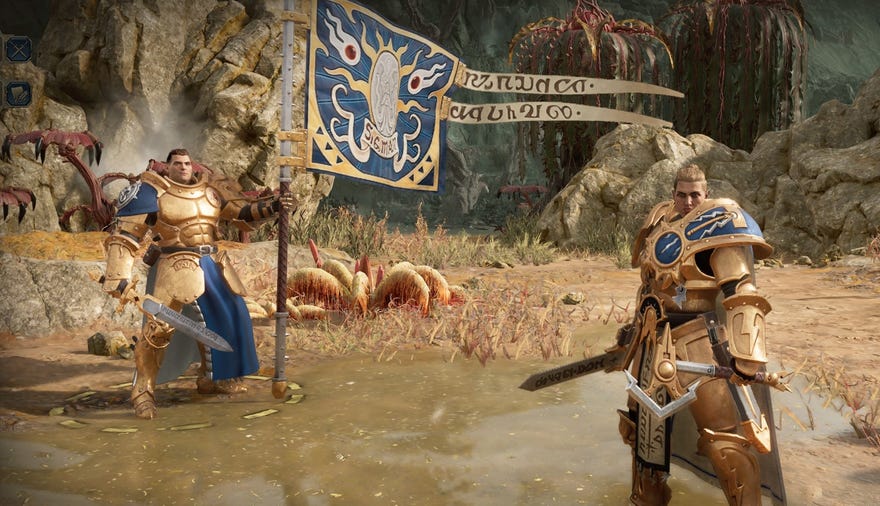
Using the setting from Warhammer Fantasy sequel Age Of Sigmar, Realms Of Ruin lets you play as four factions: Stormcast Eternals, Orruk Kruleboyz, Nighthaunt and the Disciples Of Tzeentch. Of the bunch, the human Stormcast Eternals are your likely starting point, as they’re medieval knights with mostly human units that are easily recognisable.
Recognisability is important because Realms Of Ruin splits all its units into four categories and shapes combat via a rock-paper-scissors system. Melee beats armour, armour beats ranged, and ranged beats melee. There are icons above each retinue’s head to tell you which is which, but it doesn’t hurt when you can also see your ranged Stormcast soldier carrying a bow. Named characters like Sigrun and Demechrios are heroes, fitting into that fourth unit type on the battlefield. They aren’t part of the combat triangle of the others - that would make it a combat square, geometry fans - but they have particular strengths, including special abilities, that can turn the tide of a fight.
The Stormcast Eternals are also your intro to Realms Of Ruin’s campaign. In between-mission cutscenes and in-mission dialogue, you’ll get to know shiny gold soldiers Sigrun and Iden and magic boy Demechrios. Or, you’ll get to hear them talk a lot, at least. There’s little resembling a personality between them, and their pompous speechifying about artefacts and prophecy makes them a tough hang.
Not the time or the place, Iden. |Image credit:RPS/Frontier Developments
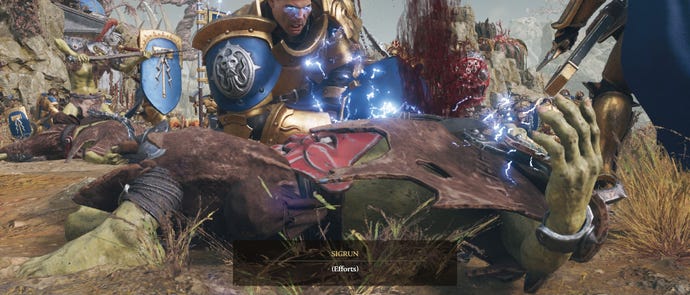
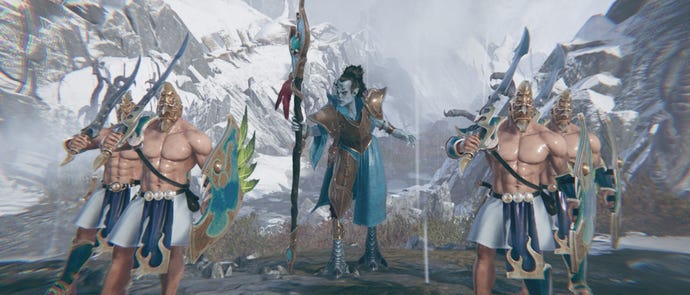
Alas, it’s tough hangs all the way down in the campaign, as the several missions in which you control the Orruk Kruleboyz and Disciples Of Tzeentch are similarly one-note, replacing “pompous” and “speechifying” with “angry” and “shouting”. This probably seems like an odd complaint - this is Warhammer, they’re Orruks, etc. - but the bits of Fantasy or 40K I like tend to have at least some humour to them and that’s entirely absent here. Plus, character motivations and clear stakes are fundamental tenets of good writing, and that holds true whether or not your characters look like they’re cosplaying Ferrero Rochers.
Nice to see Scottish football fans represented. |Image credit:RPS/Frontier Developments
This is where micro makes the difference. Until you upgrade your HQ, you might only have six squads of soldiers - hero units are a squad unto themselves - and so victory is dependent on utilising the combat triangle and manual activation of unit abilities. Sending an armoured unit against a melee unit is a sure way to see them destroyed, with an expensive and slow process to then deploy replacements back at your base and traipse them back to the frontline.
Some of the campaign’s best missions are those that break free of the capture-and-hold system. In one, you take control of the Na’vi’s twisted cousins, the Tzeentch, mutated magic cultists who make for a fun army, and must rapidly construct a tower defense route. In another, you lead Sigrun on a rampage behind enemy lines, with no soldiers except those you rescue en route towards a fight against a single, taunting Orruk.
The battlefields do look great when littered with corpses. |Image credit:RPS/Frontier Developments
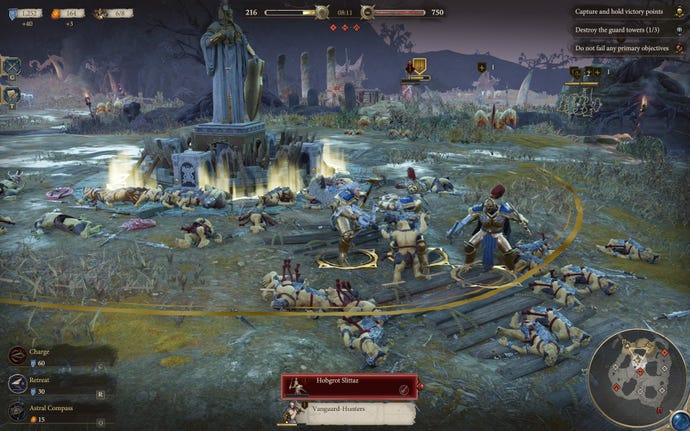
Where the capture-and-hold system succeeds is in creating tense stalemates in which you control half of a map and your enemy the other, and there’s a clearly contested chokepoint to focus the fight around. In these moments, the fight is less about clicking the fastest and more about making the right choices in how you focus your fighters on the correct enemy, or about managing your economy and upgrades efficiently enough that you eventually turn up with the superior force. I particularly relished the latter. Once you’ve lost man after man against mixed squads of Orruks defending a capture point, showing up with the Stormdrake Guard, a fire-breathing dragon, and burning them to a crisp feels earned.
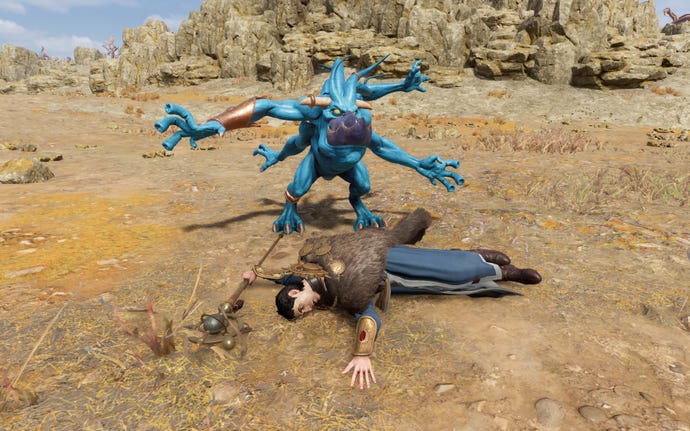
I staged this death of Demechrios in the level editor photo mode, because I don’t like posh magic boys. |Image credit:RPS/Frontier Developments
That doesn’t mean it’s not for you, however. Strip those personal complaints away and Realms Of Ruin is a solid RTS with some fun units and missions. Even if I do still think you’ll find the Stormcast Eternals boring.
