HomeHardwareFeatures
The Witcher 3 next-gen update tested: worse performance, even without ray tracingUpdate: Hotfix deployed, no longer a downgrade
Update: Hotfix deployed, no longer a downgrade
Update:CDPR have released a PC hotfix thatreturns non-ray traced performance to its previous levels, with RT performance getting a boost as well. Hooray! Though it’s still quite stuttery and it appears AMD FSR is causing crashes. Less hooray! The original article, based on test results taken before the hotfix, continues below:
Earlier today we brought news thatThe Witcher 3: Wild Hunt’s next-gen update – a seemingly juicy serving of new ray tracing,DLSS/FSRupscaling, and assorted quality of life features – had in fact arrived ina bit of a mess. To assess the damage, I’ve spent some time with it myself, and can confirm: it ain’t great! Besides the devastating frames-per-second toll that the RT effects take, it seems far more crash-prone than I ever remember The Witcher 3 being in the past, and performance in general is just worse than it was pre-update.
This isn’t my usual performance analysis/best settings guide routine, because in this case I kinda think it’s better to wait and see if CD Projekt Red can tame the performance problems with hotfixes and future updates, which they’ve nowacknowledgedthey’re looking into. More on these woes below, and I also chatted to Liam about our shared inability to wrangle a good framerate out of the new settings:
The Witcher 3’s next-gen PC update is disappointingLiam’s had similar issues with The Witcher 3’s next-gen update performance.Watch on YouTube
The Witcher 3’s next-gen PC update is disappointing
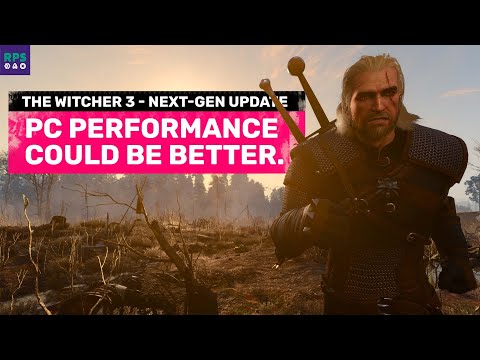
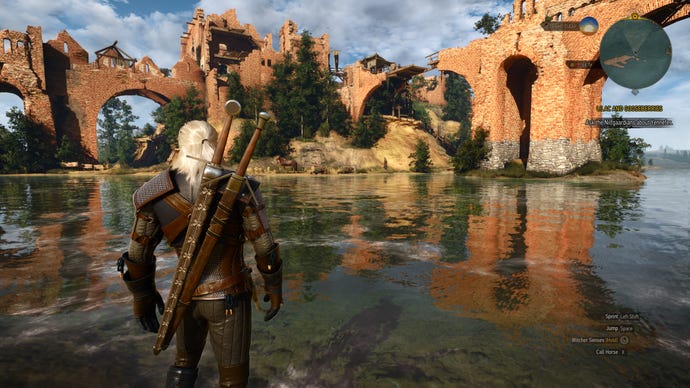
First off, some balance. With all four of the new ray traced options enabled – that’s global illumination, reflections, shadows, and ambient occlusion – The Witcher 3 does look noticeably better. The iffy screen space reflections on bodies of water are replaced, no longer jerking across the surface depending on where you’re looking, and the improved ambient occlusion give added depth to detailed interiors.
It’s great to see FSR and DLSS involved, too. In an ideal world, these performance boosters would be in every PC game, and while DLSS looks crisper in its Balanced and Quality modes than FSR does, their joint inclusion means every GPU make is covered. ForRTX 4080andRTX 4090owners, there’s also the option of enablingDLSS 3with frame generation. It’s a commendably substantial update, graphics-wise.
1of2CaptionAttribution
1of2
1of2
1of2
CaptionAttribution


CaptionAttribution
Caption
Attribution
Sadly, even upscaling can’t save most GPUs from buckling under the weight of Wild Hunt’s ray tracing additions. I’ve mainly been testing with a high-endRTX 3070, installed alongside an Intel Core i5-11600K and 16GB of DDR4 RAM, and at 1440p, the all-in RT Ultra preset averages a mere 27fps. With DLSS on Balanced mode (and this is DLSS 2, not DLSS 3 with its interpolated bonus fames), that only rose to 34fps.
After bothering Katharine for her old benchmark spreadsheets, I found she’d previously averaged 102fps from the RTX 3070 when running the game’s Ultra preset back in 2020. 27fps therefore represents a 74% ray tracing tax, or 67% when using Balanced DLSS to make it just about playable. But it’s even worse than that, because I re-ran the Ultra preset with this next-gen update and averaged only 90fps. So the internet grumbles are true: The Witcher 3 really does run slower after this patch, even if you completely ignore its most hardware-intensive features.
Even dropping to 1080p – surely a resolution at which the RTX 3070 would usually be overkill – produced some deeply underwhelming results. The RT Ultra preset? Still only 38fps. RT Ultra with Balanced DLSS? That was 54fps, a better boost than I got at 1440p, but at the cost of more noticeably blurred visuals due to the upscaler’s render resolution dropping even lower than 1080p. And once again, the game ran worse on the standard Ultra preset than it did in 2020, an average of 115fps lagging behind the 133fps that Katharine recorded.
There’s another preset simply named RT, which keeps the RT Ultra preset’s ray traced global illumination but switches it off for reflections, shadows, and ambient occlusion. Back at 1440p, a combination of the RT preset and Balanced DLSS afforded the RTX 3070 a more reasonable 51fps. However, that still means you’re roughly halving overall performance to get the least individually noticable ray tracing effect of the bunch.
RT Ultra does look great. Just… not always in motion.
Obviously, such regular wonkiness needs urgent fixing on CDPR’s end. Though for me, the most egregious failure of the next-gen update is the fall in non-ray traced performance. It’s one thing to sit in an RTX 30 series tower and bemoan dropping to 90fps, but there will be Witcher 3 players out there with graphics cards like the GTX 1050 Ti or Radeon RX 570, and thus need every frame they can get. Ray traced effects were never going to be viable for lower-end systems but for them to face an FPS cut anyway is immensely disappointing.
Luckily, you canroll back The Witcher 3 to an earlier versionif the next-gen update isn’t working out for you. Not as lucky as we’d be if it didn’t botch anything in the first place, but hey.
