HomeFeaturesLegion War
The Rally Point: Legion War is the perfect summer wargameSmells like cricetine spirit
Smells like cricetine spirit
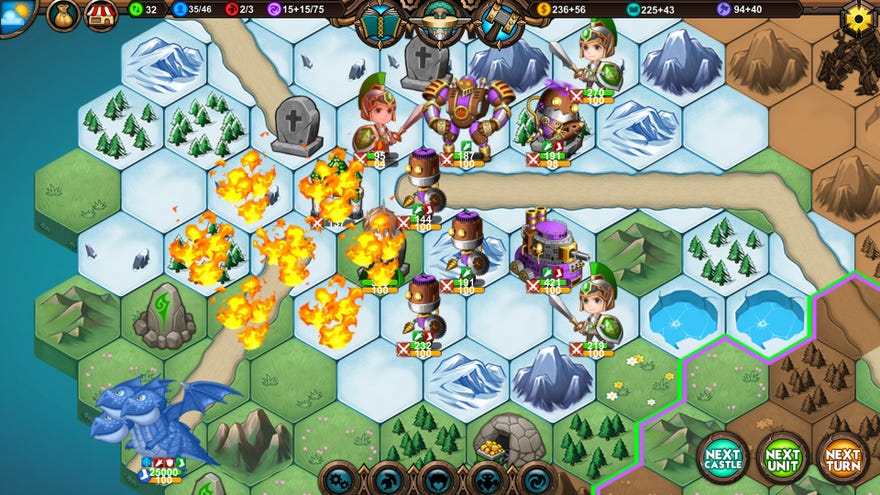
There’s an obstacle to playing strategy games. All games have their upfront learning period (even using a mouse or controller is a skill we all had to learn), but it’s strategy in particular that often has me start up a game, stare at its menu or map or world generation screen for a while, then close it down. It’s a kind of focal cover fee.
In this sweltering heat (hello to other countries, congrats on not being here, for many reasons) these fees have near bankrupted me, and only partly because I’m still weaning myself offWorkers & Resources. I’ve retreated to something more inviting. A little place that doesn’t charge me upfront, but eases me into a seat and sprays a cooling mist in my face.
Legion Waris all my brain can handle right now, is what I’m getting at.
The 2021 Independent Games Festival and Game Developers Choice AwardsWatch on YouTube
The 2021 Independent Games Festival and Game Developers Choice Awards

I covered Legion war forUnknown Pleasuresa few years ago, and now that it’s got a full release I’m glad to see even that recommendation was if anything underselling it.
Gold is used mostly for upgrading buildings, but also recruiting troops and buying magic items from the market. Items themselves offer still more differentiation, allowing your heroes to stand out a bit more. But even once your handful of hero units are kitted out, the leftover crap is worth collecting as you can add it to the template for one of your mundane units, modifying their abilities instead in exchange for a higher production cost.
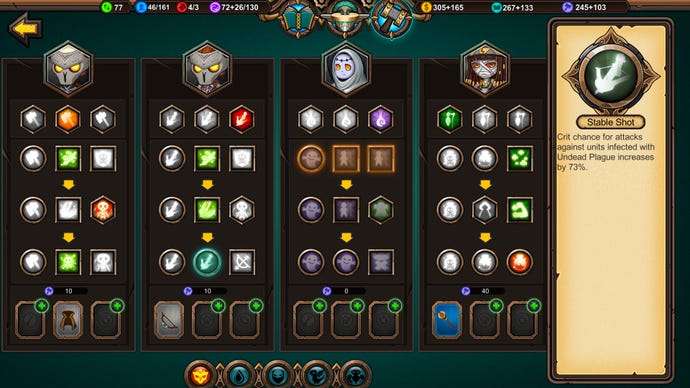
Even without those items, you’ll be upgrading your units en masse on a per-type basis using industry points. Instead of picking bonuses for individual units as they level up (they do gain XP, but levels simply increase their numbers automatically, making experienced units desirable without requiring micromanagement), those industry points unlock your choice of specialisations for a whole troop type. Most of these choices are exclusive, so once you’ve committed to making your archers better damage dealers, you’ve sealed off the chance to make them more durable, but later choices might let you mitigate that, or double down on their specialty, or add a secondary effect to their special attack. And that’s if you touch archers at all. You might instead invest your industrial hammers in upgrading your expensive support class or magician, or give a few upgrades to all your unit types for a more broad military strategy.
I’m fully tooling up my skeletons, but the ghostie scout gets no love. Maybe next time?
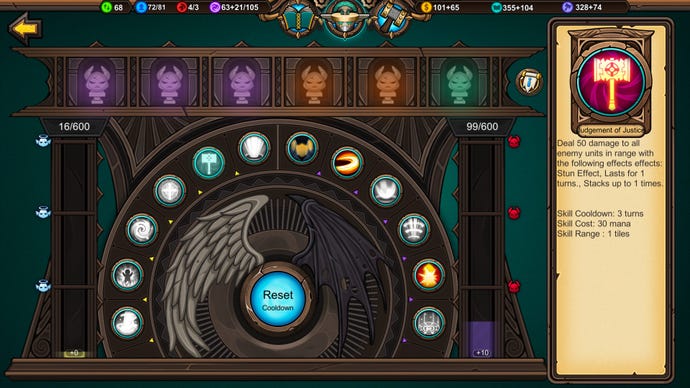
Where they capitalise on overwhelming and building momentum, the animal faction are more tactical, with troops that perform better when given a turn to cycle on the front line, and spells based around placing temporary totems on the map. The wood-and-brass robots are very expensive but hardy and able to self-repair, and more about positioning and map control, with spells that launch bombs and fire around to trammel enemies into position, and unit attacks that knock them around and into each other for extra damage. I mentioned spells a few times there, because that’s another layer still: each faction constantly generates mana too, to power its own unique set of spells, which can be upgraded with research points… or you can direct that research into military or economic upgrades instead.
There are yet more layers, as hero units are faction-specific too, and have their own, more traditional (though partly randomised) levelling up system, as well as access to cross-faction mercenary heroes, and depending on the map you might capture shrines or undersea cities, each with another set of units again to layer into all of this.
Those enemies will fight each other too, thankfully. Letting them keep each other in check is key, and the closest it ever gets to diplomacy. Legion War is all war all the time. More is always better, and plateau phases are few and brief. But you should take care not to put yourself between multiple rivals. Probably my most successful campaign was as the undead, against three random AIs who happened to all be human, all fighting across the sea for a central island. As I marched another army south across the ice, I encountered remnants of two sides who’d been at each other’s throats while I crushed my first neighbour, and realised I was essentially playing the white walkers against three stupid human jerks all killing each other for me. It’s a nice change from everyone singling you out no matter what. It’s always a nice moment when the rogue who leapt from the shadows to stab your death knight runs into a common enemy and gets cut in half.
Less nice is its habit of under-explaining some things. While the translation is generally fine, and broad strokes are easy to learn, the detailed information is often buried away in disparate encyclopedia screens with little cross-linking. A few turn summary screens wouldn’t go amiss, particularly when it comes to recognising what spells were cast and which units died (cameras zooming in on the wrong thing when units fight or die has been a weirdly common issue with games these last few years. Just me?) . Oh, and a couple of random events are crap.
Legion War occupies a strange position. It’s something I can recommend to a broad audience, while also fulfilling a niche. Sometimes you want a big ol' war that isn’t mindless, but also doesn’t demand much, or feel tiring to play. A rabbit with a rifle. A cooling mist. I think it will get a harder time than it deserves thanks to surface-level impressions, and as my head think stuff visibly sublimates from my hearing thingies I can confidently say the big words to make reader play the game good.
