HomeFeaturesDominions 5: Warriors of the Faith
The Rally Point: Conquest Of Elysium 5 smuggles roleplaying into strategy turfHesiod one out
Hesiod one out
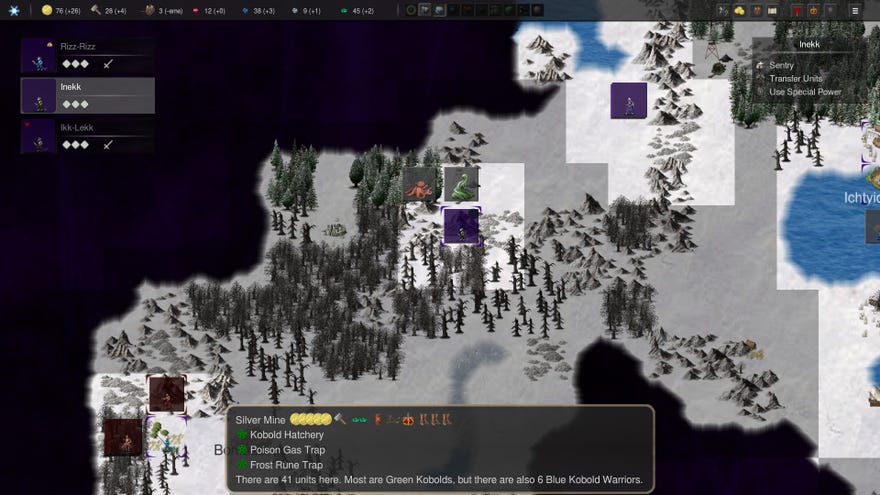
In fact, I’ve always somewhat overlooked the series, not really understanding what it was. That was definitely a mistake.
Top 12 Best Strategy Games to Play on PCWatch on YouTube
Top 12 Best Strategy Games to Play on PC
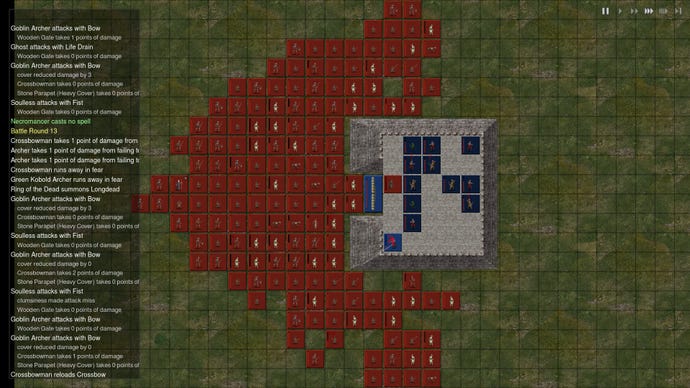
This sounds like micromanagement hell, but another reason Elysium stands out is that you have no influence whatsoever over battles. Whenever opposing forces meet, a turn-based battle goes on until one side is annihilated. The only control you have is who’s there, and what spells your mages prepare beforehand. It takes some getting used to, but what’s frustrating at first becomes where its unique strategising works best. You can’t possess every soldier, unfairly turning a group of dullwits into a perfectly co-ordinated force. You have to work with what you’ve got, learn how they’re going to act, and organise your forces to make the most of that. A lot of the battle is in analysing the enemy and deciding which forces to leave behind, not telling every crossbowman in turn which goblin’s bollock to shoot off.
Creatures have vastly different power levels and degrees of utility, contributing massively to each faction’s unique playstyle. Most players will probably hire a few human spearmen or archers at some point, but the bulk of your forces will be unique to your faction, as will the magic your spellcasters have access to. Trolls will use goblins and various giant brutes, enchanters will hide behind automatons, and cultists will lead with insane fishmen.
It’s not just about army composition. Sure, some sides will swarm with cheap disposable fodder and others will try to weather those swarms with a small core of hoplites, or maybe a few giant regenerating beasts, or a wall of armoured scorpions. Yes, the absurd amount of spells available can dramatically alter many fights. But on top of that, each faction values different things on the map itself.
Before a game starts, you choose an era. This world was wild and teeming with dangerous wildlife, and then it was gradually settled. An empire rose, fell, splintered into kingdoms, then began to reform. Which era you pick defines how many neutral settlements there are, and how powerful both they and more wild forces will be. That matters a lot, because money comes primarily from occupying those settlements, and everyone uses at least some money.
But the other resources change things more. If you’re a Bakemono side, you’ll do well to capture lots of small hamlets, gathering sacrifices your mages can ‘spend’ on rituals to unlock more battlefield spells, and empower themselves to summon powerful demons, giving you the edge your slightly underpowered armies need to compete with the hardier sides. But those demons? They might be offended that you summoned them. You can adjust the number of sacrifices spent to do so, but even the RRP might not cut it, so instead of reinforcements you just teleported a pack of hostile immortals into your town. Oops. In some eras the empire might be too strong, so your game will mean marching down from the mountains to pick away at easy villages and farms instead of those fortified cities.
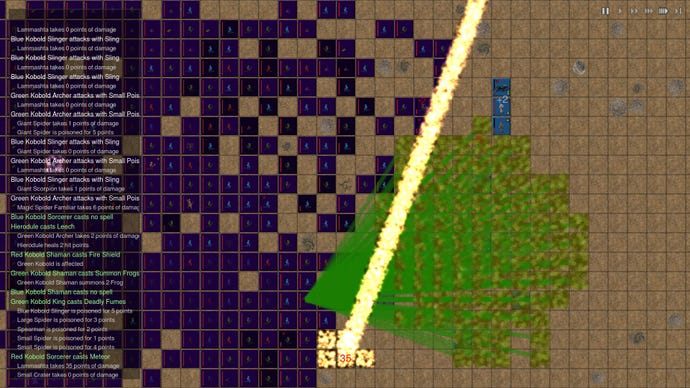
One of my sorcerors nails a weapon-immune lammashta with a meteor after it drove off over 100 kobolds. But a humble slinger killed its leader. Everything has its use.
Barbarians, meanwhile, can’t access sacrifices at all. Their soldiers are cheap and strong berserkers, capable of fighting through otherwise mortal blows. They gather herbs from any jungle, forest, or swamp square to power their rituals, and will have you sweeping through whole regions, terrorising all in your path, but also needing to control large amounts of wild territory to keep up. Wilder eras are doubled edged for barbarians: there’s more land for herbs, but more dangerous animals and magic beasts taking it back from you too.
Holding land is extremely important in Elysium, since wandering forces are near impossible to expunge completely. Initially this is seems like a flaw, but it works to break you of the habit of putting everything into one massive army, instead forming multiple smaller ones to cover and protect more land. Over time you’ll realise these are more effective anyway. Having 400 goblins just means the archers and spellcasters you need are too far back to do anything about the single swordproof enemy bastard feeling not one of your theoretical thousand cuts. All this adds up to a strong sense of roleplaying, as your units determine what you can do, and your unique resources what you value.
I didn’t think I liked it, at first. It felt too faffy, too much like other games about manually marching armies back and forth, when the relatively simplicity of movement was one of the things I appreciated most about Dominions (even more so inImperialism 2). But whenever I finished a game, I was immediately starting another one to try out another faction. Perhaps I’ll be an enchanter, with the option to turn a mine on the map into a giant golem, gambling that whole source of resources against the chance that the irreparable behemoth will gain me far more before it inevitably falls. It reminds me ofWarlords Battlecry 3, disdaining clinical, boring balance where flavour can do so much more.
Archers are surprisingly effective against lots of ghostly monsters, but this one has an aura that induces fear. They are doomed.
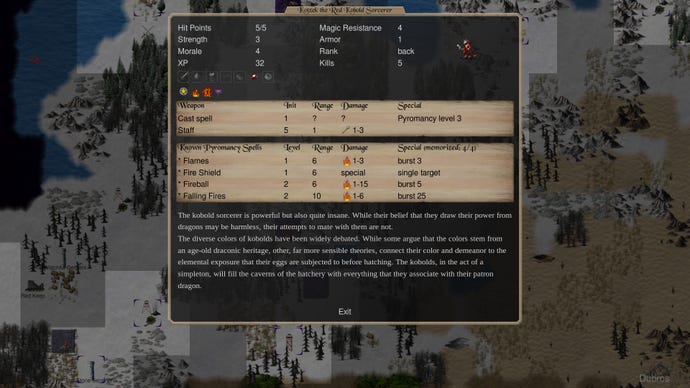
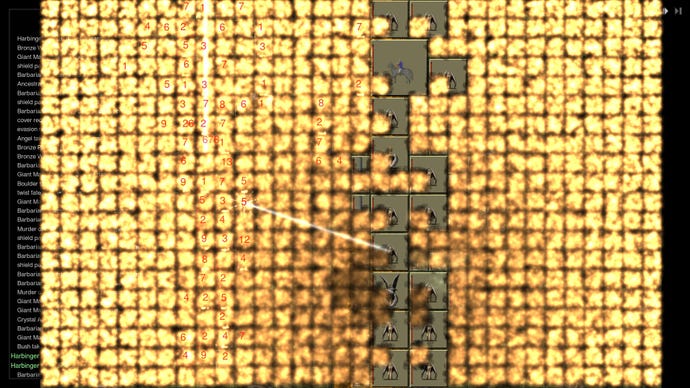
Primitive as its production values are, some of the bigger spells are genuinely startling. Yet a humble red kobold would survive this. In conclusion: kobolds.
It could use some tweaking, still. The menus should be made opaque - inadvertently clicking through one cost me an entire game, and some of the summoning sound effects are annoying and deafening. The UI still requires a lot of manually mousing over tiles and units to get information that overlay options would make much smoother. In particular, finding magic items, identifying leaders in battle, and transferring units get needlessly difficult in larger armies.
I should be annoyed that these things are still a problem, but I’ve come to love Conquest of Elysium 5. It’s somewhat less complicated than Dominions, and perhaps a little more orthodox in structure, but in exchange it often pulls me in even more. It feels less necessary to know things in advance, to have a structured plan or path through research and magic. There’s more adventure and drama to it than to any of its closest kin, and I still feel like I’ve barely touched on everything it can do. It doesn’t quite earn the place Dominions does in ourbest strategy gameslist, but it’s a damn fine accompaniment.
