HomeFeaturesWar On The Sea
The Rally Point: compromise, or War On The Sea?Not entirely shore
Not entirely shore

It is time to declareWar On The Sea. And thus it is that I gave the order to dive to crush depth with oh wait, no this is a destroyer what have I done.
War on the Sea: Available NowWatch on YouTube
War on the Sea: Available Now

Killerfish Games may not be a household name, but they established a solid pedigree in marine warfare games withCold Watersand Atlantic Fleet. War On The Sea is their latest, and it’s something of a sideways step in terms of design. You control either the US or Imperial Japanese navies during their war over the south pacific, establishing naval and airbases at key points in the region and using them to pump out and service real ships as you see fit. You have full control of a strategic layer, in which command points are used to summon forces that you then send around the map to fight enemy ships and ferry vital troops and supplies to land at hostile ports.
Points are gained for sinking ships, and lost forever if your own hit the seabed, making each victory feel significant, and every loss a real injury, especially early on. Each week your major ports are resupplied with troops, oil, engineering tools and generic ‘supply’ needed to maintain armies, and all this must be shipped to smaller ports and airfields, or those you’re fighting over or have just conquered and need to rebuild. Naturally this means spending precious command points on cargo vessels and whatever escorts you prefer (you can risk going without of course, but it only takes one scout plane to spot them and tell a submarine about it), so each port costs a big upfront and ongoing investment.
Sub attacks in the shallows are extremely reckless, since there’s no sonar-disrupting tidal layer. But if you land three or four torpedos…
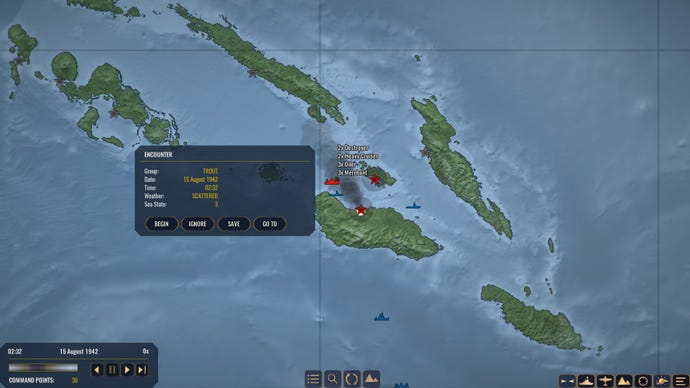
It’s this open, two-layer structure that originally tempted me. Submarine games in particular tend to have somewhat dynamic campaigns, but something about the sea suggests that total strategic freedom is a natural fit. It’s all water, right? There’s an obvious limit to where you can send your land armies, and thus where the fights can happen, but the sea is a free for all once you’re no longer reliant on the wind.
The second part of that structure is the battles themselves. Like X-COM or JA2 orAchtung Panzer, when fighting forces meet, they duke it out in a local battlefield under your total control. This takes the game away from the abstraction of numbers and specifications that often puts me off an oceanic war. Sure, I might have arranged my fleet poorly for this fight, but if I can sail the ship myself and time my own depth charges, I’ll get some satisfaction out of avenging my oil tanker when I watch its killer’s engines grind to a halt, and hear the terrible groaning of its cracked hull as the precious air abandons its crew. Christ, what a horrible way to go.
War On The Sea also boasts a fairly equal representation of ships and boats (aircraft are secondary but still vital, and a solid bombing/aerial torpedo run on a carrier is a sweet, sweet hit of fiery command points), and the control it gives you of your own forces means you can experiment with ship roles and fleet compositions.
This latter point is another reason I historically bounce off naval wars. The terminology. Modern warfare is complicated, and sailing is already a jargonous affair before you bring combat into it. If you’re going for even a semi-realistic naval wargame, you’ll have to face that barrier somehow. Typically, wargames and sims assume that the player already knows the basics about ship classes, gun calibres, navigation and so on. While I like to half-joke that nobody really knows what a cruiser or frigate is, that’s not an unreasonable approach for a niche interest. But it does sort of paint your game into a corner, especially if you expect a player to build a fleet from scratch. I’ve always found these games an uphill battle.
“Sin are you using the sonar or just saying ‘bing’ into the radio.”
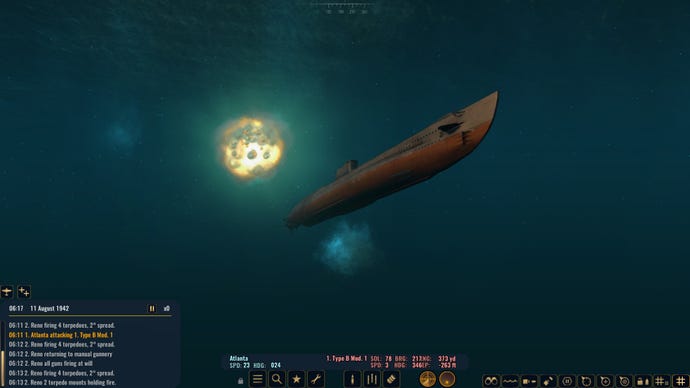
Let’s be clear: this is a me thing. I’m no stranger to detail - I spend more time organising and admiring myJagged Alliance 21.13 armory than I do using it, and each of my X-Piratez has a dozen weapon types on her kill sheet. But when it comes to seafights, the differences just don’t sink in.
I bang on about all this because accessibility is a big strength of War On The Sea. The tutorials are succinct and the open structure gives room for errors, inefficiency, and the occasional foolish risk to learn from without losing everything. If you’re sailing into a losing battle you’ll usually know it before it’s hopeless, and so can pull out and come back another day with a better ship (repairs take time, but once fixed, you can send back an unwanted vessel for a full command point refund at any major port).
Shooting back at aircraft is disappointingly hands-off, but hey ho.
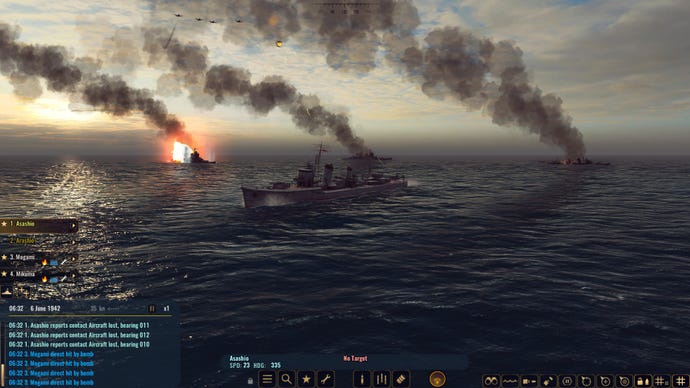
It’s a compromise. A little bit like Strategic Mind, War On The Sea feels like a mid-level degree of simulation. No one element of it dramatically stands out, nor is depicted in particular detail. But it would feel unfair to give it a hard time for this. Compromises were clearly necessary somewhere in the design to get all its parts to cohere without one or the other taking over. Model torpedo calibration fully and it’d become a game in its own right, diminishing the surface wars and strategic planning. Go in hard on more detailed supply systems and you’d spend the whole time supervising cargo runs. Controlling each plane is possible but generally best left to the AI, and if it were any other way you’d surely feel forced to micromanage every flight to get results, making carrier battles impossible.
In truth, I don’t think I’m exactly in love with War On The Sea. For all my dull-witted moaning about how complicated and demanding its genre mates can be, part of me wants it to be more like Silent Hunter, or Killerfish’s own Cold Waters, with their more advanced targeting, stealth, and gunnery systems. But then another part keeps eyeing up the arcadey Crash Dive 2, so perhaps I’ve lost the war, and become a person who just likes naval warfare now. Killerfish have been patching the game steadily since its release, too, and there’s already a modest modding community at work ona variety of substantial tweaks. War On The Sea is doing something interesting, and though its flaws are a little too grating to entirely forgive, it feels like a good place for a landlubber to start.
