HomeReviewsThe Great War: Western Front
The Great War: Western Front review: alternately compelling and exhausting, which is probably deliberate“Tasteless war poem pun”
“Tasteless war poem pun”
I keep alternating between wanting to play more and feeling weary at the prospect. While that might sound bad, it arguably means that it’s balanced an appealing strategic challenge with the grinding theme of trench warfare.
The Great War Colon Western Frontis about taking the Triple Alliance or Entente through the hell years of 1914-18, or beyond. It’s a purely military game about overcoming massed defences through attrition, both in localised real-time battles, and a turn-based strategic map. It’s perhaps unfair to criticise it for repetition and some intermittent sense of futility, since a First World War game without them would defeat the point. But I still feel a little mixed.
The Great War: Western Front | Extended Gameplay First LookWatch on YouTube
The Great War: Western Front | Extended Gameplay First Look

TGW is neither jingoistic or moralistic, nor is it coldly dispassionate. Winning the war is a case of enduring rather than basking in glory, and its battles emphasise destruction and mass death without feeling voyeuristic or sanitised. There’s no blood or gore, but nobody’s having a good time, and the sheer cost of even victories in wasted lives is impossible to ignore.
Your influence is contained to the front. Scripted events tell of Irish revolutions and broken promises in Palestine, but you have no influence beyond your army. You can’t prevent America from joining, nor Russia from bowing out, giving each side a much-needed boost at their respective historical times. That’s not a complaint. It simply is what it is: manage the front line, break their lines and/or their resolve, and endure. You can’t train extra soldiers, but you can choose where they go, and where to spend money on support structures and hardware.
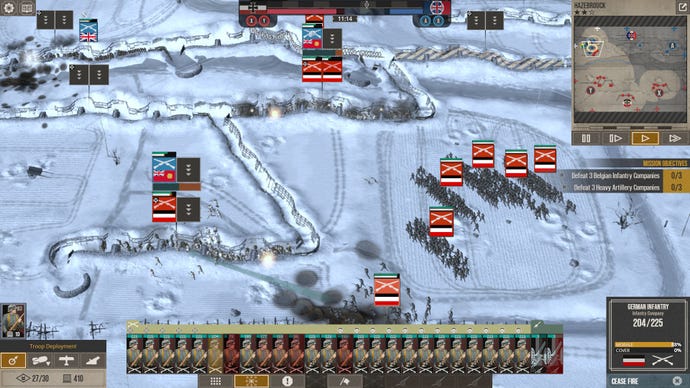
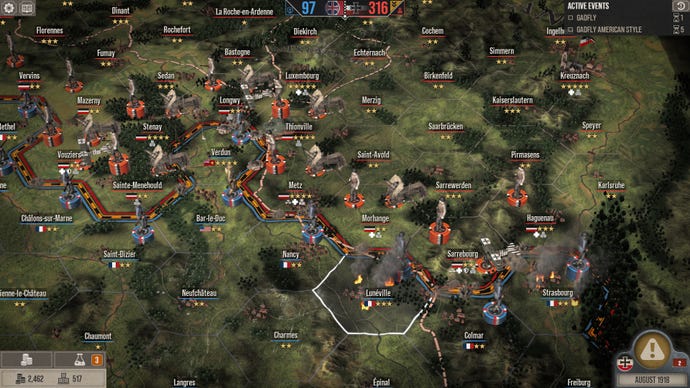
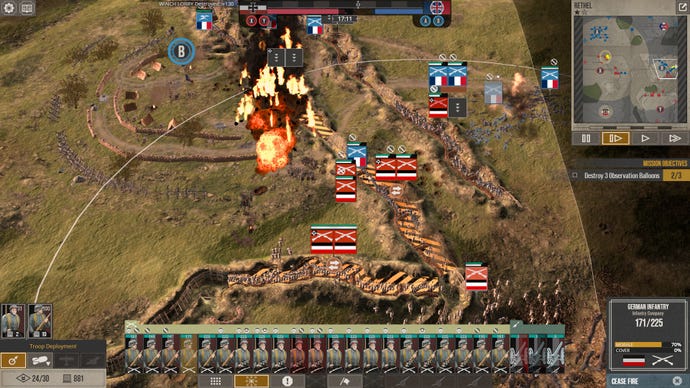
No one battle can change everything. You can have a Somme or Amiens, but each province must be won multiple times to be occupied. Battle outcomes range from stalemate to the best possible “great victory”, which depletes a star from the hostile province. Deplete every star and it’s yours. Consequently I found the prospect of taking somewhere like Luxembourg exhausting, since its five stars require multiple overwhelming victories. Auto-resolve is always an option, but tends towards inconclusive outcomes, and I found myself considering less extreme outcomes a waste of time. Sure, they cost the enemy national will, but so would auto-resolving three or four minor victories or stalemates that cost them more than me, and took a fraction of the time.
But a sluggish UI compounds a need for frustrating micromanagement. Petroglyph specify that they’re working on known issues around trench movement, but you wouldn’t believe how often I screamed aloud at my men tostay in the fucking trench. They love leaping out of them, or, finding one occupied, standing around in the open instead of running to the next one. It leads to lots of tedious fiddling, especially as soldiers seem content to share a trench with the enemy until both sides stop moving, then suddenly fight to the death. Enemies occasionally waltz along a line and hang out unbothered in the middle of your army. One used this temporary invincibility to wipe out four surrounding companies with a flamethrower. Even if these are pre-release glitches, performance was really quite sluggish. The lowest video settings were something of a chug, and moving up to medium sometimes froze my system entirely. This week I learned that you can, in fact, get a blue screen on Windows 10.
Although the map layouts persist, held territory does not. Each map is functionally a fight over control points, but even if you take the whole battlefield, the starting positions are reset afterwards. This presumably represents the reality that even taking ground wouldn’t really last unless the local opposition was totally exhausted. A trench warfare game shouldn’t involve many lasting victories, and on a practical level, allowing the player to start out holding most of the map would make for a foregone conclusion. And taking a whole map does offer satisfaction, even if it doesn’t last. This system feels like a necessary compromise between realism and enjoyability, basically.
Is that wrong? I don’t know. I like Western Front, for sure. Its frustrations detract from a good experience rather than overwriting it, and it’s more entertaining than the theme suggests, without feeling glib or shallow. It’s a solid go at a difficult niche, blending tactics and strategy well, but is best enjoyed on its own terms, and with perhaps a little more patience than I have.
