HomeFeatures
The Flare Path: Priceless VictoriesPanzer Corps 2 substitutes for the stony broke
Panzer Corps 2 substitutes for the stony broke
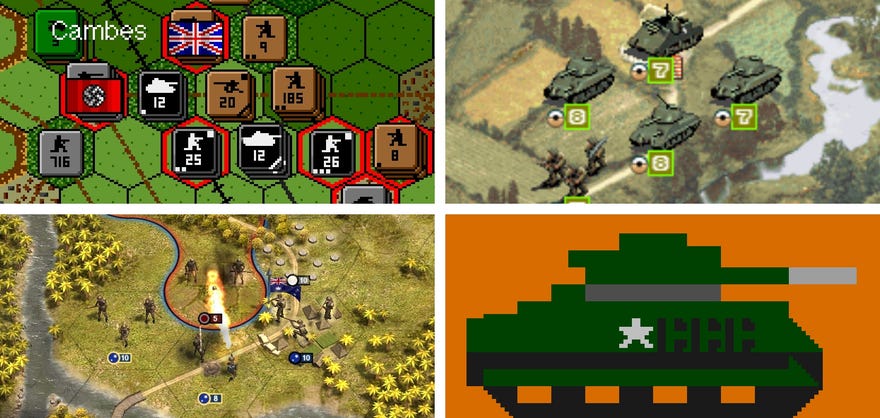
Panzer Marshal

Nicu Pavel’s gratis,browser-friendly* Panzer General homage flourishes thatAlan Partridge shrug gifwhenever it hears Panzer Corps 2 bragging about a “massive branching campaign including around 60 scenarios”.
- Availablein downloadable formtoo, if you prefer.
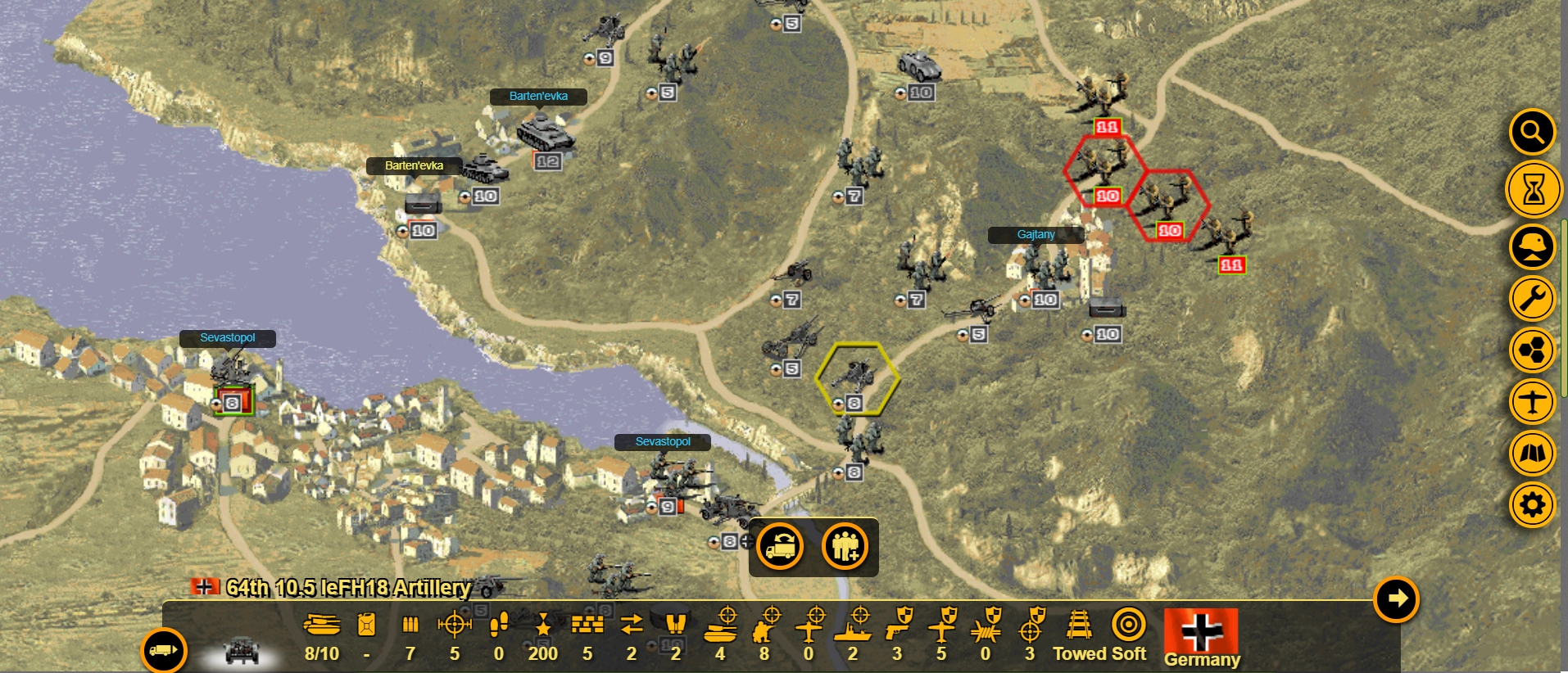
Incorporating many of the mission trees created forOpen General*, it offers a far larger selection of outings, theatres, and units than the spriteless wonder released yesterday.
- Equally free, but slightly less convenient.

In addition to all the usual suspects, there’s a generous sprinkling of rarely ludologised WW2 clashes. Fancyleading Free French forces in the Western Desert,liberating Bessarabia as the Romanians, or evicting the Japanese fromWakde Island? Convinced you look good in apith helmet,slouch hat, orsnow suit?Panzer Marshal, and its newPacific offshoot, will suit you to a T-28.

The myriad scenarios are playable as single scraps or as linked campaign episodes. Thanks to a sensibly modernised interface, however you choose to wage war, confusion is likely to be rare and turn turnover rapid. Even if you’ve never Panzer Generaled before, you’ll be up and running in no time, as long as you keep in mind basics like…
(Most other questions can be answered with help fromthe PG2 manual)

^ This is me testing ice thickness on a frozen Finnish lake.

^ Here I am teasing a Jagdpanzer IV with a Mustang prior to launching Operation Cobra.

^ Early doors in a Market Garden scenario that makes UoC2’s version look painfully cramped.

^ And this is me trading gallons of gyrene blood for a toehold onTinian.
Order of Battle + Erik’s campaigns

Because Panzer Marshal, likePanzer Corps, is basicallyold plonkin a new bottle, it’s, sadly, not a game in which daring envelopments lead to slow strangulations. For satisfying supply line severing you need something like Unity of Command 2 orOrder of Battle: World War II.
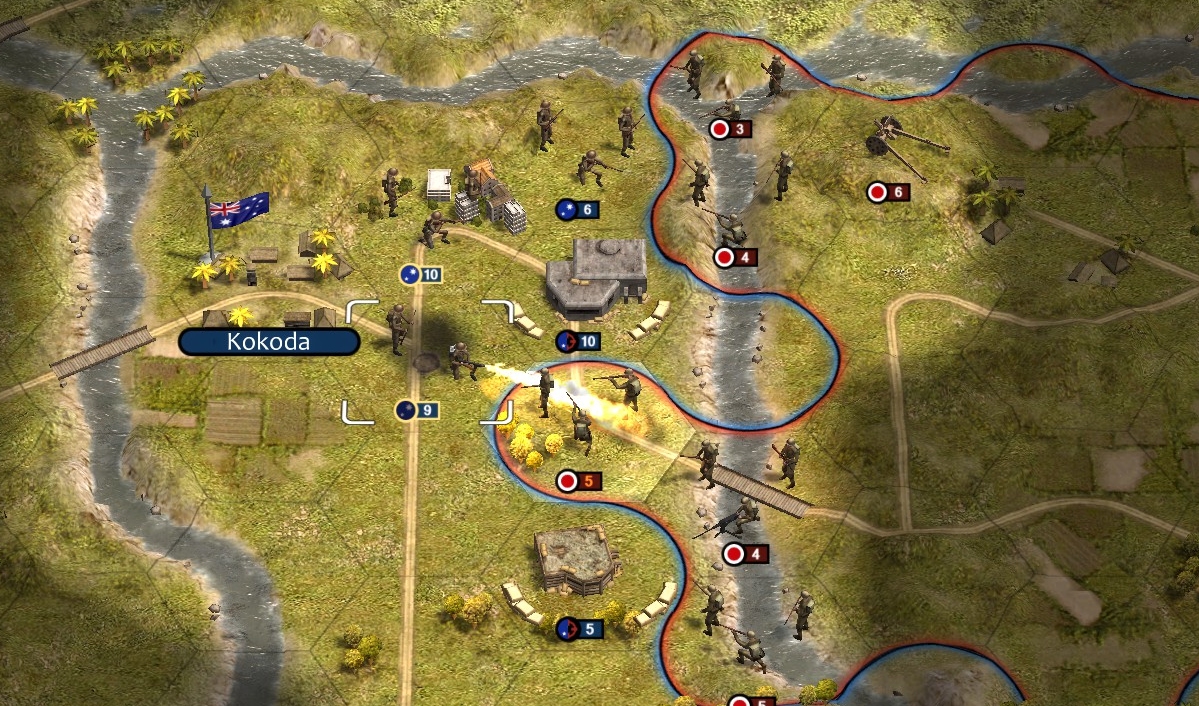
OoB:WW2 encourages pocketing with an easily understood supply mechanic, and is, for my money, a more interesting Panzer General-like than Panzer Corps in consequence.

The free base game is poorly provisioned scenario-wise. However, augment it with at least one paid DLC (necessary to unlock modability) andfive years' worth of Erik Nygaard’s free handcrafted campaignsand you finish up with a high-quality diversion that dwarfs Panzer Corps 2 the way a Jagdtiger dwarfs a Panzer II.

Erik’s efforts range far and wide. I’m naturally drawn to his Far Eastern and Melanesian sequences because so few wargames remember theForgotten Army, or bother to model gruelling tank-light episodes like theKokoda Trail campaign.

OoB’s natty ‘efficiency’ concept (morale, fatigue, and cohesion rolled into one) combined with that game-changing supply mechanic, mean it simulates the difficulties Australian and Japanese forces faced in Papua New Guinea’s rugged, verdurous interior, surprisingly well.

Armoured Commander II
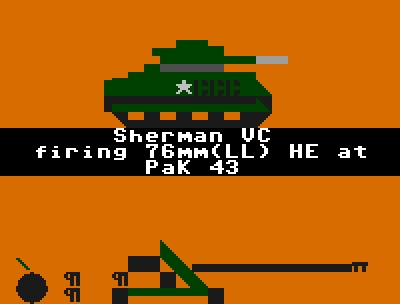
A nostalgic tank sim-cum-TBS for people weary of scripted campaigns and gatefold key lists,Armoured Commander IIhas come on leaps and bounds since it was last Flare Pathed.

The free as air 1.0.4 build boasts five campaigns (Poland, Winter War, Fall of France, Liberation of Europe) all of which are playable from multiple perspectives. There’s around twenty different angry houses on offer ranging from bijou flats like theTKS tanketteandVickers Mark Eto three-bedroom semis such as the Matilda II and Sherman Firefly.

Randomly generated venues, opposition, and mission types ensure every day at the front is distinct. Battlefields are dual layer, encounters on the higher level hexagon strips triggering manoeuvre and combat on more intimate hexagon rosettes.

The graphics may be stone-tool primitive, but when you’re bogged on the edge of a Silesian wood with a wounded commander, an out-of-commission main gun, and a new armoured threat on your flank, that crudeness is the last thing on your mind. You’re thinking about how best to employ your crew (during a turn’s command phase you give instructions like “spot”, “drive”, “first aid”, and “operate gun” to each man in your AFV) and hoping and praying one of your AI-controlled wingmen saves your bacon.
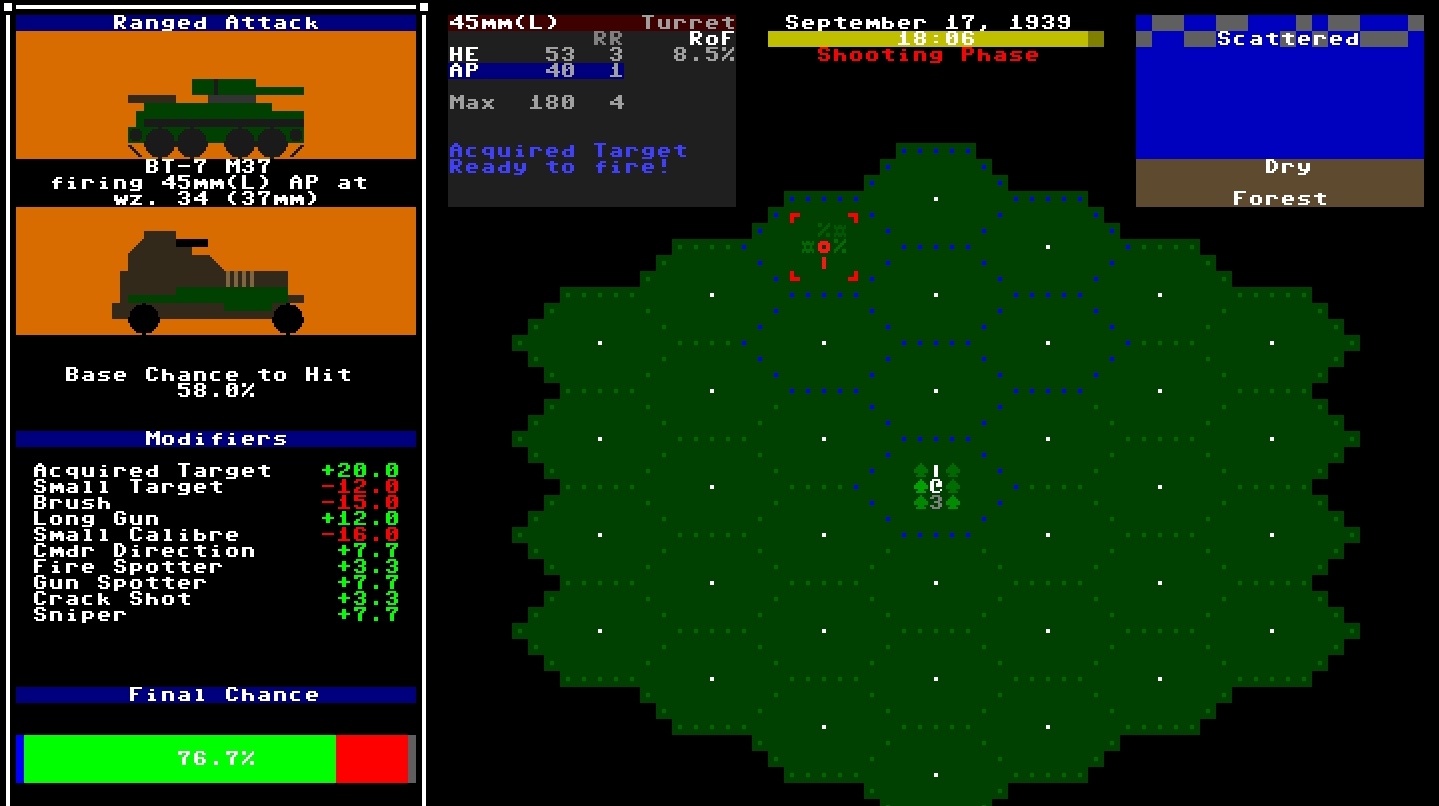
Similar in feel to classic solitaire board wargames such as Patton’s Best and B-17: Queen of the Skies, AC2 makes no attempt to camouflage its mathematics. When you’re in a position to sling a shell or loose a fusillade of MG fire, the chances of projectiles hitting or missing are clearly displayed. Naturally, a hit guarantees nothing. It’s merely the preamble to an equally tense penetration/damage dice roll.

Weather, terrain, movement and crew tasking play major roles in spotting and firing algorithms. With the possible exception of CM, I can’t think of another wargame that illustrates better why so many tank commanders of the period ended up KIA or WIA. The “buttoned or unbuttoned?” dilemma is one of the game’s thorniest.

Crew cultivation takes place between the day-long actions. XP increases sometimes lead to levelling up and new Advance Points awards. APs can be spent boosting core attributes or acquiring new skills. There’s no point inflating Morale stats at present (morale mechanics have yet to be implemented) but increasing Perception, Knowledge, and Grit is worthwhile (Knowledge enhances skills and Grit makes personnel more resistant to injuries).

A manual would be nice, but isn’t essential. Once you’ve realised that additional management menus are accessed with the number keys (1, 2, 3, 4), there are few reasons to head scratch. What I would like to see in a future build is the possibility of multiple saves, and a little more control over difficulty levels. The original AC could be a real ballbreaker. The sequel leans in the opposite direction.
V for Victory

Abandonware hex strategy doesn’t come much better thanthe V for Victory series. Before Keith Zabalaoui and chums fell in love withpocket-handkerchief battlefields and real-time firefightsthey produced four hex wargames that balanced plausibility and playability just about perfectly.

The reason the V4Vs (Market Garden, Velikiye Luki, Gold-Juno-Sword and Utah Beach) still feel so fresh today is primarily their reliance on simultaneous turn execution. A WeGo approach means more surprises, more chaos, more resonance. The interface has also stood the test of time well. A mouse-movable map would be a priority in any remake, but quick, efficient interaction isn’t impossible without it.


During the hands-free Execution Phase the forces of both sides fidget and fight. Missed an engagement? Worry not. Although there are no replays, hexagons of interest are highlighted and, once selected, furnish summaries of what went on.
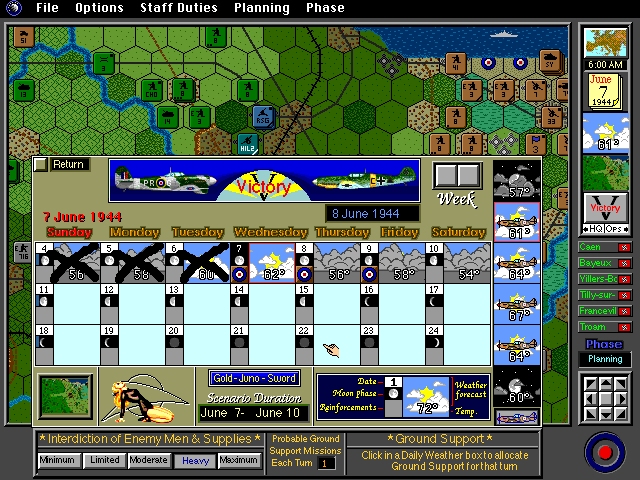
Influential terrain, fatigue, and supply mechanics, logical combat (add armour and arty to an attack, and assault from two or more directions to improve your chances) and helpful delegation, divisional movement, and undo facilities, add to the appeal of a series that’s long overdue a revival. If I end up enjoying Panzer Corps 2 as much as I enjoyed my lastDOSBox-enabled encounter with V4V: Gold-Juno-Sword, next week’s FP will be a celebratory affair.
