HomeFeaturesThe DioField Chronicle
The DioField Chronicle is shaping up to be real-time Fire Emblem meets Final FantasyNow that’s my kind of combo
Now that’s my kind of combo
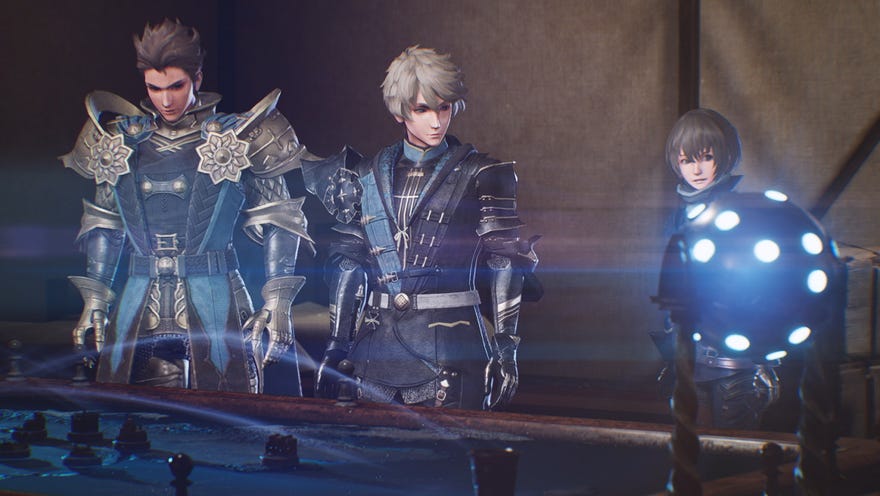
Square Enix have made a vast array of RPGs over the years, but rarely have they ventured into the realm tactics andstrategy games. A couple of big names come to mind, the obvious one beingFinal Fantasy Tactics, TacticsOgreif you count their PSP remake of Quest’s SNES original, and most recently, Triangle Strategy on the Switch. Outside of that, though, it’s all a bit barren, which is why the real-time tactical sword-swinging of their upcoming strategy RPGThe DioField Chronicleis such an interesting landgrab for them. To say they’re pushing into new territory would be an understatement.
The DioField Chronicle | Release Date TrailerWatch on YouTube
The DioField Chronicle | Release Date Trailer

The real-time nature of its top-down diorama battles naturally gives The DioField Chronicle a slightly different rhythm to the long, drawn-out turns of recent Fire Emblem games, but when you’re constantly pausing the action to direct your units where to move, attack and which special moves you’d like to deploy, its similarities go further than you might think. The closest comparison is probablyFinal Fantasy VII Remake, which blended real-time and turn-based scraps with surprising style, giving players plenty of time to think and make decisions while keeping the pace of battle riding high.
So it is here in The DioField Chronicle. In classic RTS style, you can drag and drop your mouse to select all four units at once, or you can click them individually to relay specific orders. The action is paused while you’re doing this, the screen entering a dull monotone to help differentiate its ‘tactical pause’ from the main action. In this mode, you can also see enemy sight circles, the range of explosive barrels, and other handy environmental cues you might want to consider taking advantage of as you push up through its largely linear play spaces.
The top-down dioramas are quite grid-like in their design, but their attention to detail makes them lovely to look at from above.
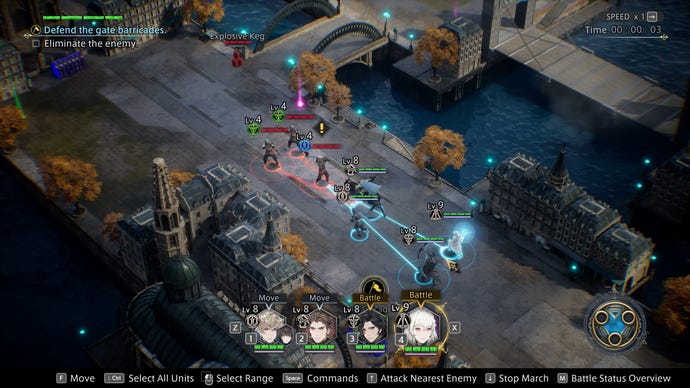
Not all enemies are displayed at once, though, with many more beaming in mid-mission as you reach checkpoints or capture outposts. For the most part, I found this helped to keep battles feeling fresh, as it meant you couldn’t easily predict how they’d shakeout as you progressed. That said, there were still a few rug-pull moments here and there which, if I’d known were coming, I might not have wasted my big Bahamut summon on, for example, or I might have made more of an effort to collet some the leftover HP and ability point crystals scattered around the battlefield. Still, these moments were few and far between in the three hours I spent playing this opening chapter, and I felt better able to react on the fly as opposed to dreading the onslaught yet to happen.
Before every mission, you get a lovely overview of the battlefield, and every time it makes me think I’m playing in anOctopath Travelertown.
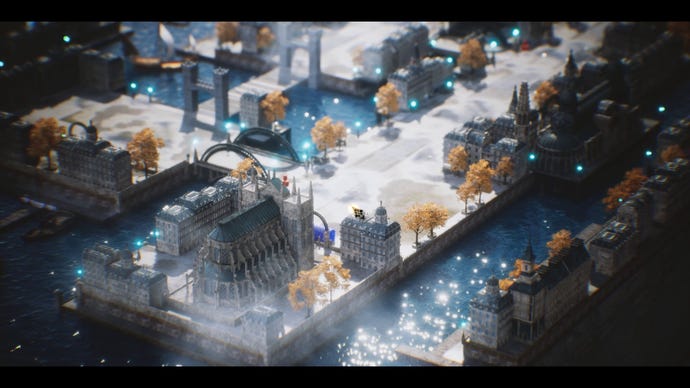
Most missions have mini-objectives along this kind of line, but that doesn’t mean you’re constantly replaying the same kind of five-minute battles again and again. Sure, The DioField Chronicle’s opening chapter does some pretty heavy tutorialising in its first clutch of missions, giving them a natural sense of variety as it introduces all of its various concepts, but within those first few hours, I’d done your classic ‘eliminate every enemy on the map’ type mission, defended a manor house from the undead, captured turret towers to unlock drawbridges and open up new areas of a map, escorted a carriage through a dangerous mountain path, and fought three boss characters.
Whenever you want to issue an order, the game enters a kind of tactical pause menu that freezes the action and gives you plenty of time to think.
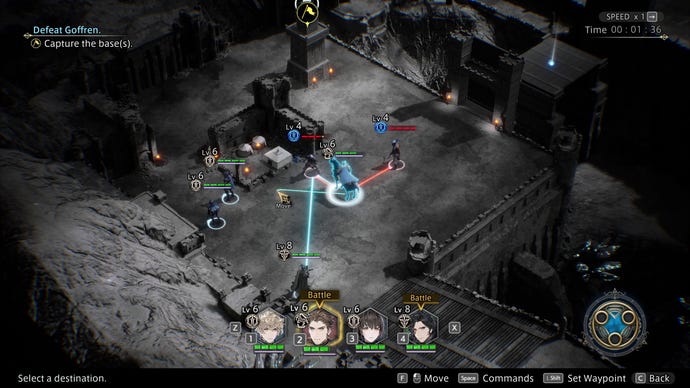
Admittedly, the bosses might be the weakest part of The DioField Chronicle, as they’re essentially just massive HP sponges, simply requiring you to hack away at multiple health bars until they’re dead. In their defence, they do have slightly more flamboyant attacks than your run of the mill infantry goons, but when their areas of effect are clearly telegraphed with big red danger zones that become increasingly angry-looking the closer it is to being enacted, simply moving your warriors out of the way or stunning them with a shield bash attack (as you would with every other enemy type with an AOE attack) is about as ‘tactical’ as these encounters get.
That’s not to say positioning is completely unimportant, though. Generating aggro so some of your warriors can attack from behind in deadly ‘ambush’ attacks is vital to dealing damage quickly, as is managing your characters' special abilities over the course of a mission. These can range from similarly devastating AOE attacks to individual sword dances, but others with status effects can make for some particularly powerful combos to help you manipulate the flow of battle. Frederet, my big knight on a horse, for example, has a big frontal assault charge, which not only hits multiple enemies in a big straight line, but it also knocks them back into a nice, bunched up group, leaving them open for my archer Iscarion to lay down some concentrated covering fire in the area they’ll be using to race back toward the rest of my squad. I know they’ll be running this way, too, as my swordsman Andrias has just put up his taunting shield barrier. The final touch is often a big fiery meteor spell from my healer mage Waltaquin, setting the ground alight as they continue running blindly forwards.
Enemy AOE attacks are clearly marked on the map. To dodge them, you can either move out of the way, or stun them with a special attack.
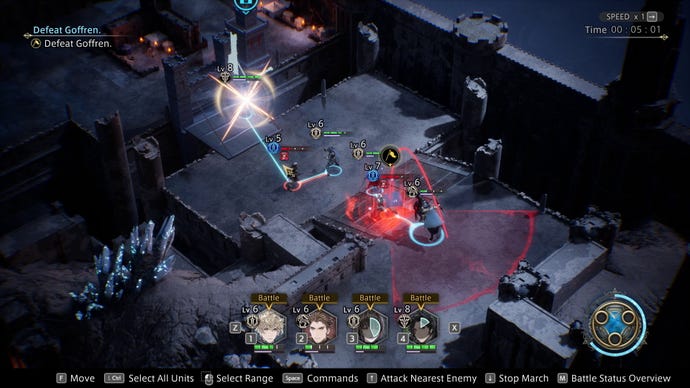
However, each character only has so many EP points to dole out these kinds of attacks, so another part of The DioField Chronicle’s strategic layer is knowing when to bring out the big guns, so to speak. Items can used to top up characters' EP bars mid-battle, but money to buy new ones is reasonably scarce on this war-torn island (even with completing the gold-boosting mini objectives), especially when you also need to balance those funds with upgrading your warriors' weapons, armour and stat-boosting accessories and upgrading your various merchant stalls back at your mercenary HQ.
Skill Points are shared across your entire party, so you’ll need to be very selective about which abilities you choose to upgrade.
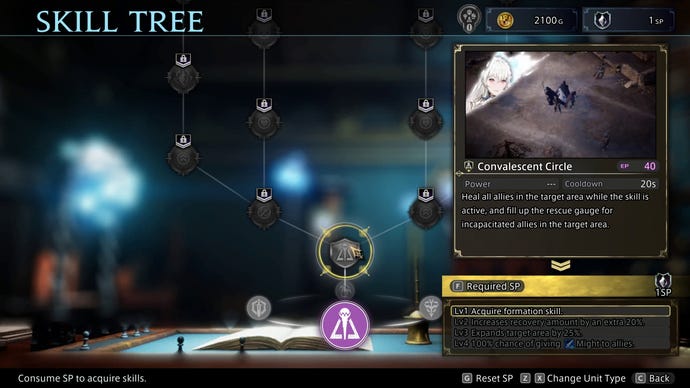
As such, you’ll want to make sure a character’s EP bar lasts the entire length of a mission, so you’ll need to balance them out with their regular auto-attacks. It’s actually very Xenoblade-like in some respects, as each skill also has its own cooldown timer before it can be used again. It’s probably a big reason why I like it so much, although even I’m willing to admit that this hero-led style of RTS battling will likely prove divisive among traditional strategy fans.
Between missions you can wander around your mercenary HQ and chat with your fellow squad mates.
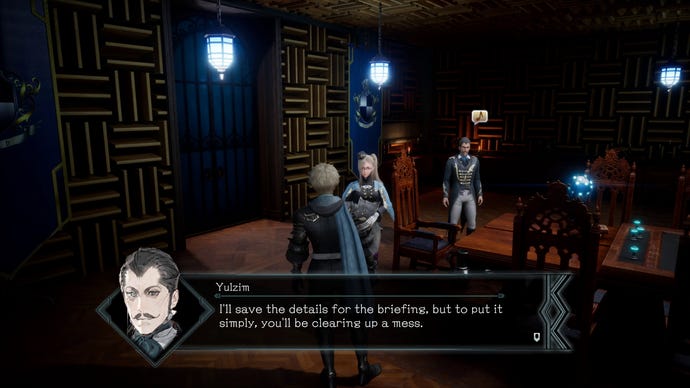
As a place, it’s certainly more artificial feeling than the Three Houses academy (seriously, who puts up iron gate railingsinsidetheir house to stop people going up the stairs?), and yes, there were parts of its story about warring clans fighting over ancient, precious resources that felt like reheated leftovers of a discardedFinal Fantasyplot. But its central protagonists made for a winning quartet as RPG parties go, and its mix of aristocratic subterfuge, ancient sorcery and Final Fantasy-style summons has me itching to stick around its halls just a little longer to find out more. I would love to have more Square Enix strategy epics on PC, so here’s hoping the full game doesn’t disappoint when itcomes out on September 22nd.
