HomeReviewsSongs Of Conquest
Songs Of Conquest early access review: an already-stylish tactical RPGFree wieldin’
Free wieldin’
Just a few days ago, the expected release ofSongs Of Conquestturned into the expected release of Songs Of Conquest into early access. There are times when such a pivot might dramatically change the angle you’d need to review a game from.
This isn’t really one of those times, because I think I’d be recommending Songs Of Conquest overall as it is anyway. Giving it an estimated year for Lavapotion to “figure out, together with the community, what features we should prioritize” could well push me into a wholehearted endorsement, though.
Songs Of Conquest - Gameplay TrailerWatch on YouTube
Songs Of Conquest - Gameplay Trailer

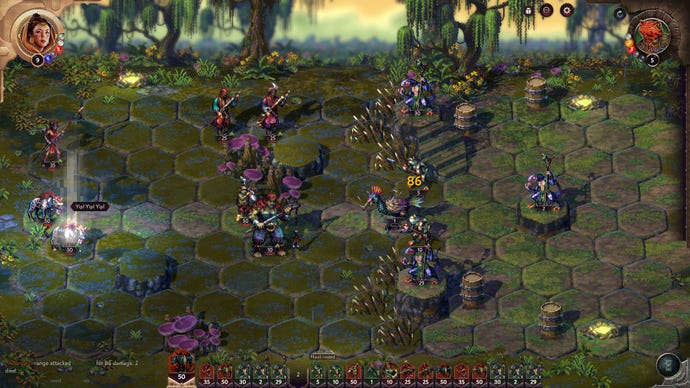
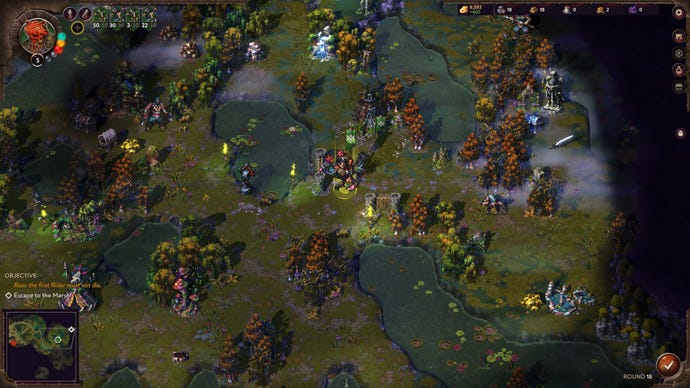
Naturally, you’ll be wanting to have a go at them, which kicks off a skirmish. These are remarkably intuitive to begin with. Each unit moves according to its initiative (as opposed to each player moving all their units at once), and can generally move then attack if something’s in range, with a helpful tooltip giving an estimate of what damage you’ll do, plus how many figures within a hostile unit you’ll kill. Units have a zone of control, meaning any time you try to move while adjacent to an enemy, they’ll take a free shot, and surviving units will counter attack, making melee a serious commitment. Ranged units, meanwhile, do extra damage within their “deadly range”, so getting close is generally advisable, but maps are small enough that it’s also risky. They also feature hexes of different heights, giving offensive and defensive bonuses and enough variety that I never felt any sense of routine. There was always enough to think about to keep me interested. I’d say I never felt completely lost either, but I’ll tell you about the exception to that later.
The sound and animation deserve highlighting in particular. While the maps are lavishly drawn and teeming with detail, it’s the fights that really highlight the talent on show. Every attack sounds solid, every unit moves and hits hard. Taking out an enemy always feels satisfying, and they all die with a dramatic flourish, especially when it’s the last one on the field, for which the game zooms in for a little slow motion.
The battles are short and fast, so you’re never away from the map too long, and each army tends to feel a little improvised thanks to the way they’re tied to your economy. To reinforce your armies you must visit one of your settlements, which generate soldiers every turn based on what you’ve built. Vicious faey spirits and burly beastmen generate from groves, while empire players can build peasant huts to gather crossbow-toting militia, or taverns to attract defence-boosting minstrels. Some settlements can be upgraded for gold, wood, and stone, which opens more and bigger building sites. Large settlements thus form a natural hub for recruiting advanced troops and unlocking research that bumps up unit stats, but the limited building slots make expansion crucial, so your wielders will be out on the road most of the time looking for more sites as well as more goodies. This in turn means that your armies will be stuck several turns away from the settlement, and thus reinforcements, so you’ll find yourself recruiting whatever’s available from neutral mercenary recruitment buildings, or outlying village with limited options. Either that or you’ll schlep home often.
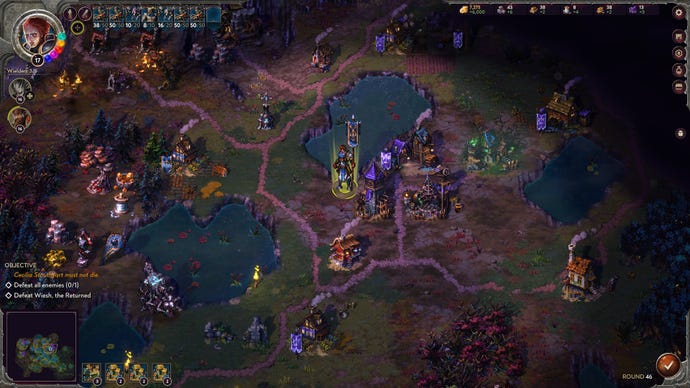
It does, however, leave you to your own devices, with minimal information on what the enemy are doing. This isn’t outright bad, but it leaves you vulnerable to that strategy game thing where you’re mathematically doomed but won’t know it for another two hours. Your enemies, see, are doing all the same things you are, right down to hoovering up the piles of loose gold and stone that you’re too slow to reach, and beating neutral armies into XP that will level up their wielders. Leveling is a matter of choosing one of three skills rather than mucking about with too many numbers, but those decisions are still huge, and choosing ones that don’t counter your enemy’s strengths can cost you.
There’s a lot going on, despite how straightforward any individual turn is. You need to be fighting and exploring to level up your wielders, and deny your enemy free resources. You also need to be defending your settlements, and enemy ones. I had one game where a wielder wound up several levels behind everyone, but may have been the MVP of the game because her map movement bonus let her partially raze enemy buildings then leave, forcing their wielders to run back home instead of capturing my villages.
This is where Songs Of Conquest can be wearying. You’ll reach a point in long gamers where it’s clear you’re going to win, but the enemy will still run around capturing a weak village for every two you are (which oddly reminded me ofWarlords Battlecry 3). The lack of a notification alerting you to enemy presence is a problem, but exactly the kind of detail that you’d expect to get addressed in early access. Less easily solved is the way that chasing a weak opponent round the map becomes an annoyance for everyone involved. While a defeated army can be restored, this is expensive, and stretches your reinforcements further. Cards on the table, though: I hate losing dudes. Especially when a game’s balancing dictates that losing a big battle means grinding away for another few hours just to get back to where I was before the battle. Feeling the sting of loss very intensely may, then, be a me problem, and it’s probably one that more experience would teach me to work around anyway. Though the campaigns are good, the skirmish mode (single or multiplayer) and map editor leaves this feeling like a game people are going to really dig into competitively.
This gets complicated when you consider that any time I’ve talked about a “unit” here, that unit actually represents anywhere between one and a hundred individual creatures, a little bit like inMaster Of Magic. But each unit of a type generates the same points regardless of how many creatures are in it. It’s obviously better to fill an army slot with 50 out of 50 militiamen, right? They’ll hit harder and live longer. But if you split them across two slots, they’ll generate more magic for you. Suddenly that wielder with fewer troops spread across 9 army slots has a fertile magic garden.