HomeReviewsSlipways
Slipways review: schedule-shatteringly moreishIn space, no one can hear you optimise the potential for future synergies
In space, no one can hear you optimise the potential for future synergies
Slipways - Announcement TrailerWatch on YouTube
Slipways - Announcement Trailer

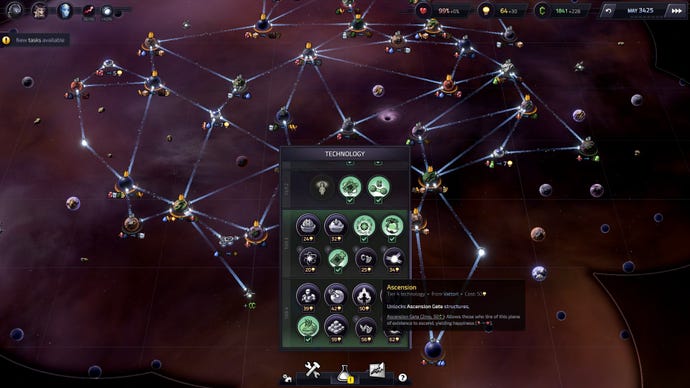
The secret sauce to all of this is a two-fold blend of efficiency and risk-management. The moment you opt-in to colonising a planet, that planet will begin both producing and requiring resources. If you’re fine with temporarily eating the happiness penalty, you can still make use of whatever resource that planet produces. You’ve got a late-game tech planned that’ll nullify the missing resource anyway, right? It’s fine. It’s absolutely fine. Until you get overconfident, leave too many planets screaming into the void for the green goop they so richly crave, and your Scandinavian train network of clean efficiency now resembles a Scalextric track in a washing machine.
Therealsecret sauce, though, is time. Each standard run lasts 25 years, which is somewhere between 45 minutes to a couple hours in real time. Everything you do, from launching probes to connecting planets with the titular Slipways, costs time. There’s no ticking clock, and you can undo actions provided you haven’t revealed any new information, but everything that yields tangible results saps just a little of the limited time you have for your run. This limitation provides crunchy consequences to each decision, yet frees up Slipways to be this easy-going, bite-sized, almost tabletop-like thing that still manages to scratch many of the same itches as yerStellarisorCrusader Kings.
Variety comes from both the council perks you choose and the random planet seed given to you before each run.This seed can result in a few early restarts, especially as you don’t start with a single colonised planet, and I’ve no doubt that the very best of runs on the higher difficulties will require some good RNG. Otherwise, there’s always something you can do, even if that something involves haphazardly expanding into the endless, twinkling black with no guarantee of future stability.
The final piece of the puzzle is getting your planets from stable (receiving one required resource) to successful and beyond. Bonus resources and several import and export routes will get you so far, then you’ll need to make connected clusters of overachievers, since worlds with successful neighbours themselves thrive. It’s a rule set up for long plays that rewards planning, where knocking over the final domino creates a ripple effect, and you’ll score big for pulling it off.
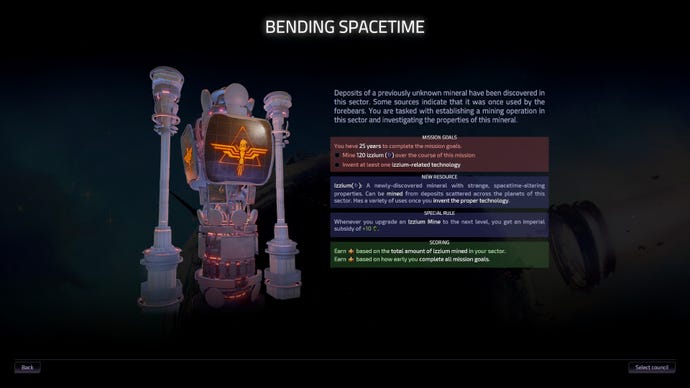
There is a steep learning curve to all this, despite the game billing itself as something of an instant Zen experience. It’s not a huge undertaking, but it took meone Youtube videoand onevery helpful Steam guideto start getting the most out of the game. There is a readable tutorial with some moving images included, but I reckon a playable, fixed seed with a friendly robot telling you things like wot Stellaris has would be ideal.
The music of the spheresI have described synth music as ‘bubbly’ more times than I’ve had hot bubble baths, but make no mistake: these boys are some bubbly customers, and very pleasant to listen to. The UI is clean, readable, and replete with all the wondrous, satisfying, space-ass plinks and whooshes you could ever want. There’s a few nice tactile elements, too, like physically dragging each Slipway, or timing the probe-blips for maximum reach, although these can be set to auto-max if you don’t fancy it.

I guess it’s more accurate to call Slipways a grand strategy-themed puzzle game than a 4X-lite, though, in the same way thatInto The Breachis a turn-based-tactics-themed puzzle game. Probably. Still, it emulates so much of the other good stuff from 4X. The efficiency puzzle of empire building in a fixed space. The exciting leaps of faith that see you mess with the design perfection you arrived at just moments ago, in the hope of soon establishing something grander. It even manages - miraculously in such a short time frame - to impart the sense of an early, mid, and end game, complete with the lovingly broken snowball at the final hurdle where your tech turns you into a reality-bending deity, providing you invest in tech early.
I suppose, too, that you’ll need to care about scores - about constant improvement - to care about Slipways. Without other species to fight, claim dominion over, or break trade agreements with, your biggest adversaries here are your own impatience, greed, or lack of foresight. Personally, I find these bastards to be worthy opponents, but you may not. There are a few different modes, including a campaign which bends the rules to offer discrete, fixed puzzles, and an endless sandbox mode, but for me, it’s Standard, the best fast food sandwich, that provides the most entertainment.
So, whether you’ve long liked the look of Civilisation but balk at the commitment, or have a seemingly self-replicating collection of untouched Stellaris expansions that you can’t quite find the time for, or honestly just like a good puzzler, I reckon you’ll find something to love here. Personally, Slipways has come at just the right time to occupy a gaming space I wanted filling, but even if it hadn’t, I think it’s a phenomenally smart piece of design. Maybe something will soon come along to replace it, but for now, the view from up here is just perfect. At least, it will be, once I’ve linked that here. Oh, and that there, and… Ah, it’s one of those planets, is it? Well, that changeseverything.
