HomeReviewsSix Ages 2: Lights Going Out
Six Ages 2: Lights Going Out review: a fascinating story-generator with a wealth of possibilitiesRaid against the dying of the light
Raid against the dying of the light
Image credit:Rock Paper Shotgun/Kitfox Games
Image credit:Rock Paper Shotgun/Kitfox Games
It’s hard to know where to start withSix Ages 2 Colon Lights Going Out. The initial uncertainty and esoteric nature of its world has always been the series' biggest problem, as it appears to demand a lot of foreknowledge to play. But rather than memorising facts and (ugh) “lore”, it’s a series that encourages a different mindset to pretty much any other game. These games are about culture and myth, and how both interact and change over time.
It’s harder, though, to write about this entry without justrepeatingmyself. It is a Part Two of a planned three, thus much the same as before, yet different in some interesting, but esoteric ways. Do I try to convince the unfamiliar, detail those differences for fans, or try to cover both and succeed in neither?
To see this content please enable targeting cookies.Manage cookie settings
To see this content please enable targeting cookies.Manage cookie settings
Let’s start with the simplest argument: it’s still really damn good.Six Agesitself would present my dilemma and offer further options like “ask a god for advice” and “ignore this until it goes away”, while your noble advisors suggested a course of action based on their knowledge, favoured gods, and personality. One of them might blame a rival clan somehow, or ramble about some vaguely relevant myth instead of admitting they don’t know. Considering their advice, your circumstances, and the potential interpretations of your people before deciding what to do about some event or other is the core of the game. It’s about leadership as a test of wisdom, not a calculation of numbers or raw power fantasy.
Image credit:Rock Paper Shotgun/Kitfox Games
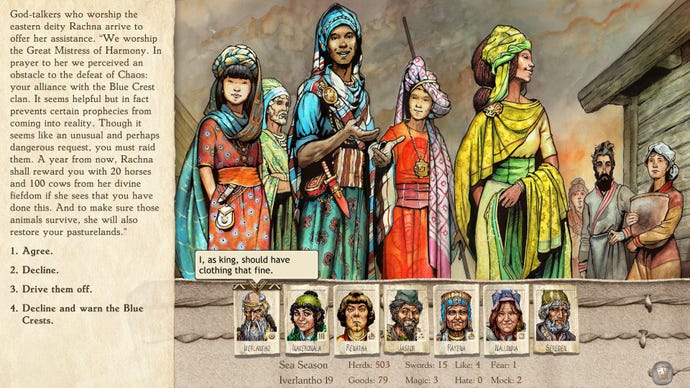
Thus the threat this time is not some conflicting human culture to be reconciled with, but Chaos, the force that’s killing the gods and gradually undoing reality itself. Where once the world was getting colder, now even the ice itself might ask for your help against chaos. The soil is barren and the air visibly coloured with poison. The world is so entirely hosed that we’re referring to the previous time of apocalyptic problems as the “Good Darkness”, as opposed to today’s Bad Darkness. It will sound very familiar to those of you who are currently experiencing reality.
This marks Lights Going Out as different even to the previous entry,Ride Like The Wind, as the gods are a much smaller consideration. Sacrificing to them is still important, but less reliable, and you’ll likely spend more time consorting with wild spirits like Ladybug, Whistling Wind, and, uh, Cheese. You may even find yourself helping foreign cultures support their stupid foreign gods, palling up with ancestral rivals, and stopping mid-raid to fight off the common enemy that suddenly appeared. Your people, ancestors, and even gods are more tolerant, and this gives you as a leader and player more leeway to break the rules and define your story more.
The story itself takes a while to make it clear what, exactly, is the right path, which will alienate some but accentuates the strength of its whole concept. This is, more than ever, a series of stories of your probably failed clans and how they fared through all their ups and downs. Even a successful clan will struggle through a run of bad luck or the terrible sum of several minor bad decisions. You’re meant to roll with the punches, accept that people are messy and fickle, and sometimes even doing the right thing turns out wrong. It’s frustrating, and it’s sad. But hey, after my first clan disbanded for lack of horses (and food, and cattle, and people who were not all plaguey), the mini-epilogue detailed that my war chief personally murdered the entire leadership of our rivals. Maybe we were just the backdrop to her story.
Image credit:Rock Paper Shotgun/Kitfox GamesImage credit:Rock Paper Shotgun/Kitfo Games
Image credit:Rock Paper Shotgun/Kitfox Games
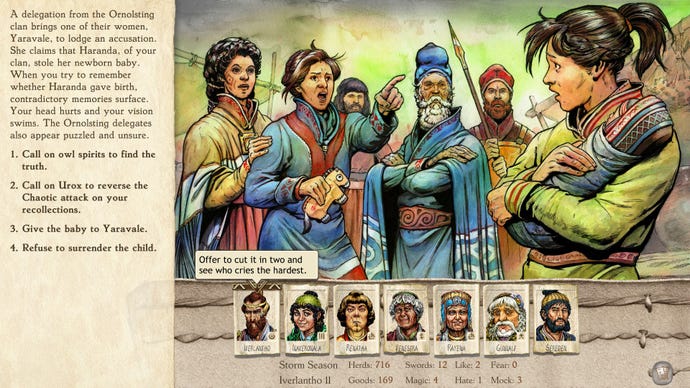
Image credit:Rock Paper Shotgun/Kitfo Games
You’ll have your favourites. I had one whose judgement I trusted absolutely, and another whose opinions were mixed, but would occasionally say “Send me. Alone.”, and then do something absolutely unhinged. They bicker and bitch about each other more now, and politics becomes a little more personal, and your clan reflects more internally what was always the point of the series: that cultures shift and adapt to the world, and would still even if the gods were tangible and monsters could spill from the earth and melt your son. Contrast a series like the Elder Scrolls, which spans hundreds of years and almost no discernible shift in culture.
Image credit:Rock Paper Shotgun/Kitfox Games
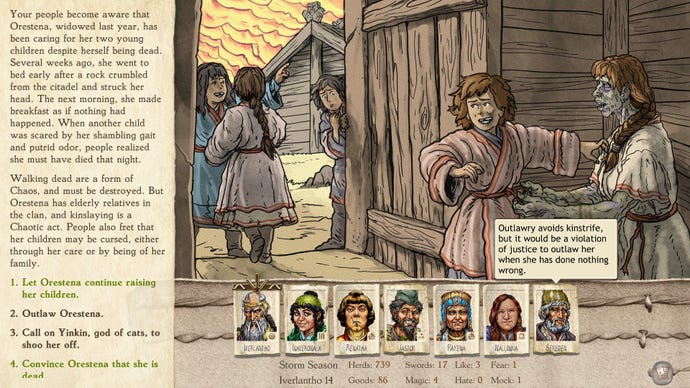
Lights Going Out repeats some annoying flaws like ring members only ageing at the end of the year, thus dying at the exact moment it will deprive you of precious magic for the year. It’s a little better at presenting and contextualising information, but could still improve some screens, and it is, as ever, an overwhelming and frustrating game to start out with, demanding more decisions upfront in a more severe scenario. All actions taking one ‘turn’ feels cruel when you’ve two dozen spirits and gods to entreat, and the constant need for repetitive food maintenance tasks leaves more interesting ventures in the dust (2.5 clans in, I’ve yet to hold a single feast).
But it also feels like an exploration of themes, a pressure cooker for societies to organically adapt into the form seen in the far future of King Of Dragon Pass, where other games would just say “the empire united against evil the end”. Although everything is familiar, it feels like it’s developing as a series through a wealth of thoughtful, amusing stories and possibilities. There is, in a word,still nothing quite like it.
