HomeHardwareFeatures
Seagate Barracuda Fast SSD reviewA great value external SSD
A great value external SSD

With more and more laptops and PC motherboards supporting the latest USB 3.2 Gen 2 standard these days, external SSDs such as theSamsung T7andCrucial X8are finally starting to come into their own. Touting maximum sequential speeds of well over 1000MB/s, they’re arguably some of thebest external SSDsyou can buy today, but that doesn’t mean that regular USB 3.0 drives like the Seagate Barracuda Fast SSD on test today should be overlooked. Indeed, while its rated read speeds of up 540MB/s may look positively pedestrian next to Samsung and Crucial’s external SSDs, Seagate’s Barracuda drive is true to its name, delivering fast transfer speeds and very comparable random read and write performance for everyday use, all at a very reasonable price.
The Seagate Barracuda Fast SSD comes in three sizes right now: 500GB, 1TB and 2TB. I was sent the middle 1TB drive to test, which currently goes for£121/$138. That’s still quite a lot compared to an internal 1TB SSD, but unfortunately that’s the price you pay for being able to take your files and games on the road with you.
Indeed, the entry-level 500GB Barracuda Fast SSD is a much more wallet-friendly£73in the UK, putting it pretty much on par with Samsung’s excellent and slightly olderT5 SSD. The latter has been increasingly difficult to get hold of in recent months due to it going end of life, and its newer T7 successor is still quite a bit more expensive -£85at time of writing - making the Seagate Barracuda Fast SSD a ripe replacement for those after a more cost-effective external SSD that doesn’t break the bank. The 500GB Crucial X8, meanwhile, is even more expensive at£90.
Over in the US, it’s a bit more complicated. The Samsung T7 is actually a very tempting$79for its entry-level 500GB model right now, making it quite a bit cheaper than its$109Barracuda and Crucial X8 rivals. In this instance, it simply doesn’t make much sense to opt for Seagate’s Fast SSD here, especially when you get full USB 3.2 Gen 2 support on the Samsung T7 and Crucial X8, rather than just USB 3.0 on the Barracuda.
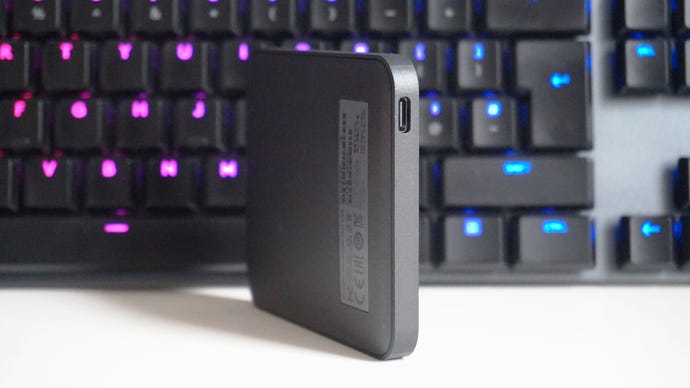
For those in the UK, however, the Barracuda Fast SSD is much more compelling. While its svelte, almost floppy disk-like form factor isn’t quite as lovely as the all-metal business card-sized Samsung T5 and T7, it still feels like a sturdy bit of kit that you’d feel safe chucking in a bag, and you still get dedicated USB-C to Type A and USB-C to C cables in the box.
The Barracuda Fast SSD’s transfer speeds were pretty good, too. To test this, I used AS SSD’s copy benchmark, which transfers three different file types from my OS drive to the SSD - an ISO folder consisting of two large files, a Program folder with lots of little files, and a Game folder that’s made up of files both big and small. The Barracuda Fast SSD finished the ISO test with a speed of 400MB/s, the Program test with 149MB/s and the Game test with 300MB/s.
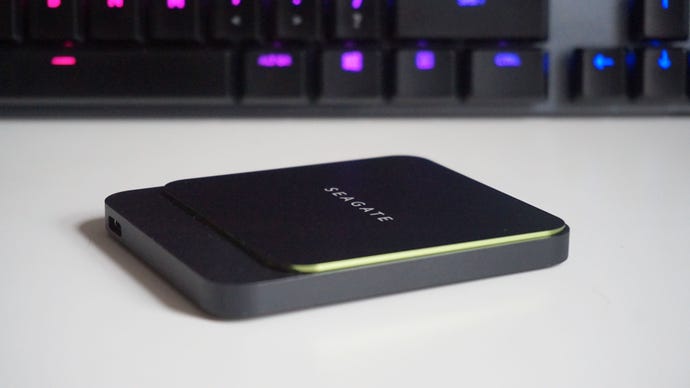
Its ISO speed is a fraction slower than the Crucial X8’s result of 439MB/s, but the Barracuda Fast SSD is clearly the better drive for those who regularly deal with lots of small files on a daily basis, as the X8’s Program and Game results were miles behind, finishing with just 116MB/s in the Program test and 278MB/s in the Game test.
That’s quite the coup for the Barracuda Fast SSD, especially when it’s so much cheaper than its Crucial X8 rival. Indeed, you may even see faster game transfer speeds than its 300MB/s AS SSD result in daily use, too, as when I moved my 98GBAssassin’s Creed Odysseyfolder from my PC’s WD Black 3D NVMe SSD to the Barracuda, I saw an average speed of around 350MB/s. The whole process took bang on five minutes to complete, too, which is pretty much identical to the 4 minutes and 48 seconds it took to copy it over to the Crucial X8.
