HomeFeaturesThe House in Fata Morgana
Project Code Name M, the mysterious new game from the Fata Morgana devs, shows a different side of TokyoGame director Keika Hanada shares some of the new challenges NOVECT faced
Game director Keika Hanada shares some of the new challenges NOVECT faced

Stories always came first for the team at NOVECT. The critical and commercial success ofThe House In Fata Morganasurprised many upon the title’s international release, including the developers themselves. Headlines were made when the game shot temporarily to the spot of most critically-acclaimed game of all time on Metacritic, despite being still relatively under the radar beforehand. Fata Morgana first released to the public in Japan in 2012, and gained a cult following before its eventual successful international release. The reason for it’s acclaim? Storytelling. Every single review praised Fata Morgana’s surprising and enthralling twists and turns as what made this visual novel a must-play title, even for non-fans of the genre.
NOVECT New Game, Project Code Name “M” Teaser TrailerWatch on YouTube
NOVECT New Game, Project Code Name “M” Teaser Trailer

It’s a firm departure from historical European fantasy and the VN genre for an adventure game about serial murders from the seedy underbelly of Japan, set in the heart of Tokyo. It’s also a proving point and new direction for a studio with more eyes on them than ever before. The challenge to retain their trademark attention to story in a more open-minded interactive format is a new one for NOVECT, yet it’s one that CEO, Fata Morgana writer and Project M’s director Keika Hanada is excited to face.
A still from The House In Fata Morgana

“It’s the same in Japan, but when a visual novel comes to console people who don’t usually play these games will give them a try, so I thought the games may perform well if they came to console,” explained Hanada, as we touched on Fata Morgana’s surprising international success. Having released to acclaim among PC VN audiences in Japan, similarly high praise met the game on its initial English-language release via Mangagamer in 2016. Yet it was the console release that saw the title reach beyond these core audiences to wide-ranging success, boosting sales and the image of the studio on both console and PC alike.
“I’m grateful we had the help from Limited Run Games in the porting process, as it would have been a lot of work for us to handle ourselves, and with their help we had less to worry about on whether we would recoup the costs from porting, if it would be a success, so it was really great,” said Hanada. As the team have admitted in the past, the company’s humble origins left the company in a position where the financing and technical skills needed to handle a port would have been difficult. They were adept at making stories first and foremost, adapting to the process of making games as they went along.
“We were a bunch of university friends who played and made tabletop RPGs and were in university groups at first,” he explained. “But for me personally, I’d wanted to make doujin and indie games for a while and make a name for myself that way. But not everyone can or wants to, since they have their own lives or jobs, so I was thinking from then how to make indie games and build an indie developer.”
Many of the people NOVECT met at that time - who helped with Fata Morgana and the various adaptations for drama CDs and manga - have continued with the company for their latest game, Project M. “The people working on this game I’ve mostly been working with together since 2014. The illustrator on Fata Morgana, Moyataro, is someone I’ve been friends with for a long time. He has another job, though, so our work together ended after the release of the Another Episodes in 2015,” said Hanada. “Because of that I was trying to find another person to assist us, and at that time we were in the process of releasing a manga adaptation of Fata Morgana. I had a lot of synergy with the mangaka [Kanemune] and they really understood my work, since we had the same sensibilities and approach, and I felt we could really work well together on this project.”

Yet compared to The House In Fata Morgana or Seventh Lair, Project M is a vast departure from the VNs NOVECT have worked on previously. The team have woven their storytelling prowess into a more interactive template, taking inspiration from adventure games they both enjoy as fans or have been involved in throughout their careers.
Project M takes place in Tokyo following a series of murders. The story is told from the dual perspectives of both detective and killer as you get to the root of these mysterious serial crimes, with players taking an active role in each. In the role of the killer, players will construct the perfect murder scene, creating the so-called ideal locked-room murder, or faking a suicide note to deflect suspicion. In the detective sequences we explore Tokyo - or, more specifically, the Asakusa and Yoshiwara areas of the city - in order to uncover the truth. It’s a journey that sees us meet a number of unique characters, including the workers of the corpse disposal business and a mysterious girl named Marianne, while our search for answers takes us into the seediest areas of the Japanese underworld and the arms of the yakuza.

Project M is ambitious, and hasn’t been without its own share of hurdles to overcome. “We’ve faced a lot of challenges!” Hanada admitted. “I’ve worked for companies making adventure games in the past, so I was involved in games like Layton vs Ace Attorney and others I’m not really able to name. But because of that I feel I know what is needed to make such a game. I think because of it I know a lot about what makes an adventure game fun, but the challenge is turning that into a game of my own while creating something that’s more grounded in the expressions of our characters.”
This experience with the genre and a love of games like Ace Attorney andAI: The Somnium Fileshas certainly influenced the direction of Project M, but it’s still rooted in the storytelling ideas that made many fall in love with The House In Fata Morgana. With Project M still early in development, however, much of the game remains shrouded in mystery. Details on the characters and the story - beyond the brief Bitsummit showcase of an early-game investigation into a triple homicide in a garage and a stroll through the streets of Asakusa with Marianne - at times raise more questions than answers.
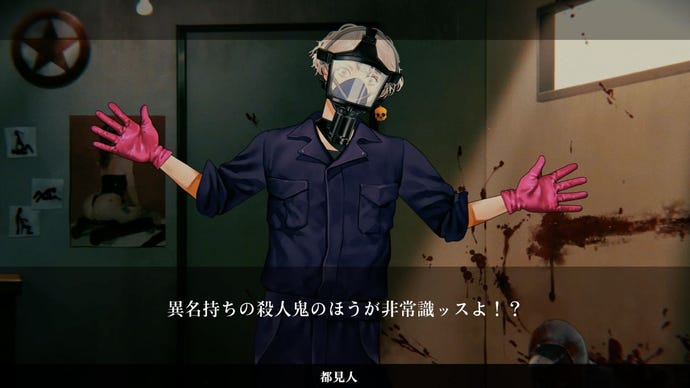
The environment in which Project M will come out will be far different to the one that met Fata Morgana, upon either its initial Japanese or international release. For Project M, audiences both at home and abroad will already be intrigued at what sort of adventure awaits them. Whatever it is, Project M promises the same enchanting writing, entrancing art and unique stories that caused audiences to fall in love with the work of Hanada and his team in the first place. Even if the wait is set to be a long one, there’s a lot of promise behind this game’s bloody surface.
