HomeFeaturesInkbound
Playing Monster Train dev’s new co-op roguelike with pals is going to be harder than I thoughtRPS Treehouse friends have opened my eyes
RPS Treehouse friends have opened my eyes
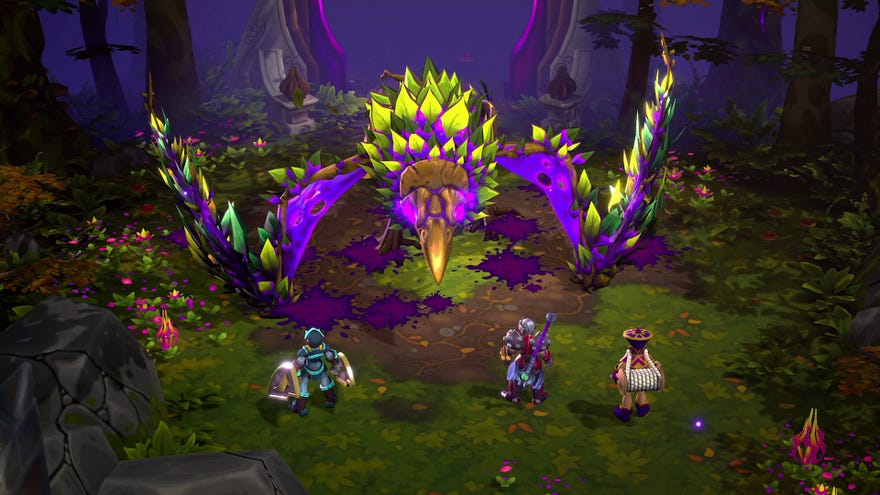
I’ve played Shiny Shoe’s upcoming roguelikeInkboundonce before, and not only is it markedly different to their previous gameMonster Train, but it also featured the snappiest turn-based combat I’d seen. With that in mind, I dove into the game’s recent technical test with fellow RPS Treehouse-dwellers Ollie and James to sample the game at a more leisurely pace, and to draw upon their greater strategic expertise. Did the combat hold up? Were they pleased to be dragged into a co-op session with me? Yes… and no. We had fun, but it didn’t come quite as naturally without the guiding hand of the developers showing us the ropes.
Inkbound - Combat OverviewWatch on YouTube
Inkbound - Combat Overview

When I last played Inkbound, I sampled a run with Shiny Shoe’s CEO Mark Cooke and creative director Andrew Krausnick, and I wasleft smitten with the game’s turn-based combat(do give it a read if you want a quick rundown of how the game’s runs and upgrades actually work). At the time, I had no doubts in my mind that the game successfully sped up turn-based bashing without hurting the strategic side of things. You and your pals are all able to take your turns simultaneously, you see, moving and unleashing your hotbar full of abilities all within a single turn. Once you’ve all clicked the “Yes, that’s me done” button, the enemy gets their go. It’s quite likeMarvel Snap, in that sense. It’s fast and fluid and ensures that most runs don’t drag on for too long.
Last week, however, I returned to it during its recent public technical test, which was pretty much the same build as I’d played before. Only this time I had Ollie and James in tow and no developers to guide us through it - and the result was quite a different experience. Whereas before Cooke and Krausnick had gently steered me through proceedings, we now had to figure things out for ourselves, and in our attempts to co-ordinate attacks or survive the toughest encounters, it turns out it was quite a bit harder to problem solve as a team.
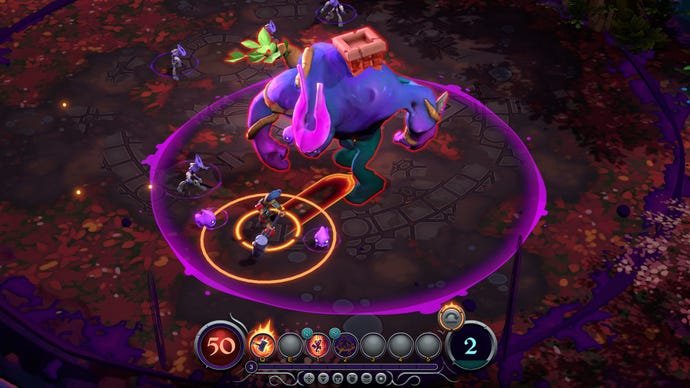
With most turn-basedstrategy games, combat can take a while because you’re forced to sit through each unit’s moves. Everything is flagged for all to see: the meteor shower spell, the mana cost of the spell, the damage it dealt, the radius of the spell in question – you get the idea. Sure, it takes longer, but at least everyone’s clued in on what each other’s doing even if the chat room’s gone quiet. There’s room to potentially comment on whether the meteor shower spell is better spent on the large orc instead of the little goblin, or quickly point out that your icicle blast is able to take them out, so there’s no point in your pal wasting their mana.
Enemy designs are wonderful and each stage looks the part, but when purple cones start littering the floor it’s very difficult to tell what’s going on.
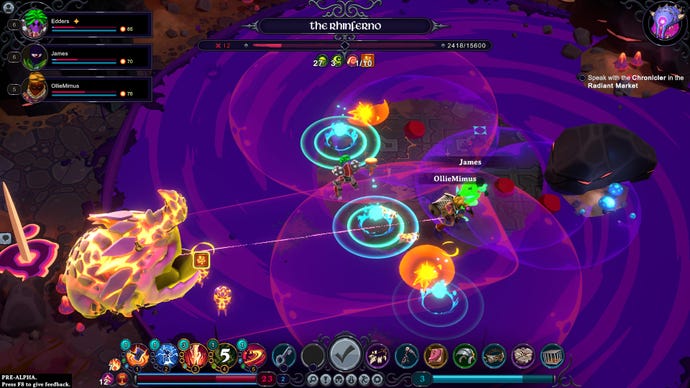


The main bit of co-ordinating we did lay in drawing aggro from enemies who’d direct their attacks to whoever smacked them last. That is, if we managed to get our heads around the game’s overlapping area-of-effect markers. Fights take place in a circular arena, with a poisonous fog that closes in as they progress. This means that tougher fights are often in cramped spaces, against enemies who are capable of spawning enemies, or exploding, or charging you. All of these circles and lines and markers begin to merge into an indiscernible mesh when this happens, making it very difficult to understand what’s about to happen between turns. Talking things through helped a bit here, but there were times where we also had to just give up and hope for the best, too.
Despite all that, though, we did manage to make it work and complete a run together. And I think that speaks to Inkbound’s strengths, which is that, even without rigorous planning or much knowledge of everyone’s strengths, we were still able to hop into a game, focus on our own thing and have a good time. We genuinely had a lot of fun! But the difference between my previous experience with the game was palpable, and I worry that snappy combat may end up becoming quite long and protracted if those tougher runs require players to explain their moves to one another over many, many potential turns. I think we’d all like to see some sprinkles of clarity over the battlefield, too, and perhaps a way to quickly see what moves your allies have used at a glance if you’re not able to chat (or type out long, complex battle plans) in real-time. Still, with its release date remaining a general 2023 for now, there’s hopefully plenty of time to grow.
