HomeGuidesPath of Exile
Path Of Exile vendor recipes explained, plus helpful recipes for league startTake advantage of this early crafting system to level fast in Path Of Exile
Take advantage of this early crafting system to level fast in Path Of Exile

Path of Exile: Siege of the Atlas Official TrailerWatch on YouTube
Path of Exile: Siege of the Atlas Official Trailer

How to use vendor recipes in Path Of Exile
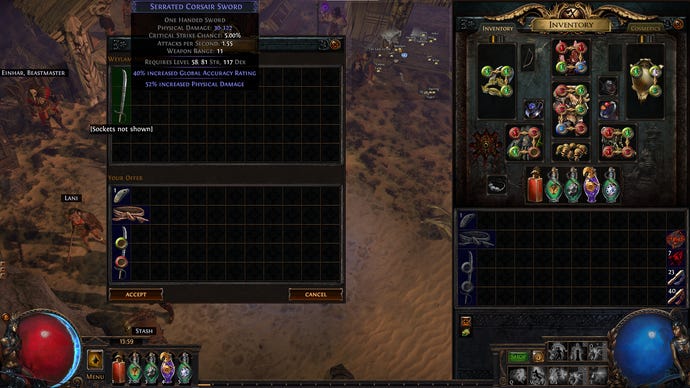
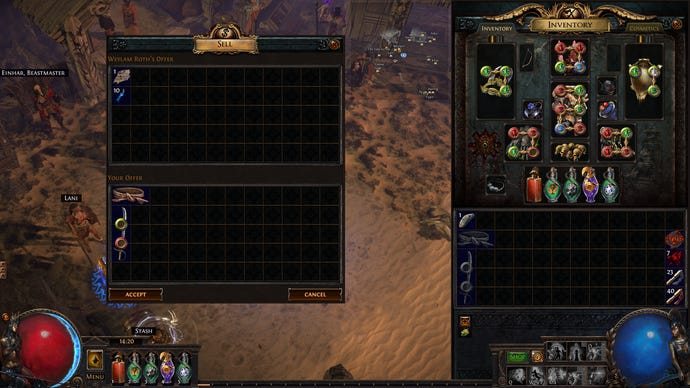
The process of crafting with vendor recipes is very straightforward. However, it is not explained in-game, so here’s a quick breakdown for brand new players. To use a vendor recipe, all you have to do is place the required items in any vendor’s sell window. If you have the right combination, the vendor’s offer section will show the item that is being upgraded or created. You can see an example in the image above, where the vendor is returning a sword with an added modifier. If you have missing or incorrect components, the vendor will return various currency shards like in any other sale. See the image below for an example. The missing Blacksmith’s Whetstone makes the recipe incomplete, so the only return is shards.
Best vendor recipes for Path Of Exile league start
On your first character in each league, it can be very difficult to find a weapon with decent damage in the early acts of the campaign. Thankfully, there are a few helpful vendor recipes that can set you up with a powerful early game weapon. Use these recipes to smooth your progression through the first half of the campaign and beyond. Keep in mind that the weapon recipes listed here return a Magic weapon, regardless of the rarity of the weapon you trade in. You won’t be able to tack extra damage onto a Rare weapon using these recipes.
Increased physical damage
Ingredients:
This recipe is extremely useful for any build that uses physical damage attacks, like Steel skills, Slams, or Shield Crush. Even some elemental attack builds start off leveling with Steel skills, and will use this recipe to solve their damage before switching to an elemental skill later.
Flat added elemental damage to spells weapon
Ingredients:

Caster weapon with “+1 to level of all physical/fire/cold/lightning/chaos spell skill gems”
Ingredients:
This recipe sounds more complex than it really is. If you hover your cursor over a gem, you will see its tags under the skill’s name, and above its level, like in the example above. So, to bolster a chaos spell like Bane, you can gather up gems with any amount of quality plus the chaos tag until their total quality exceeds 40%. Increasing gem level is one of the best ways to scale most spells in the game. However, you are unlikely to find enough quality gems to use this recipe during the campaign. Still, a +1 wand can carry most spell builds through early maps in the revamped Siege of the Atlas endgame. This is a recipe to keep an eye on, especially in solo-self-found leagues.
Gemcutter’s Prism
Ingredients:
20% quality, level 1 gem
Ingredients:
Trading in a level 20 gem and a single Gemcutter’s Prism returns the same gem at level 1 with 20% quality. Most gems scale primarily off of level and gain smaller boosts from quality. Gemcutter’s Prisms are rare though, so it is difficult to hit 20% quality on your skill gems in the first few days of a league. Of course, you don’t want to drop a gem you’re actively using to level 1 either. That leads us to the most common strategy; level a second set of your most important gems in your secondary weapon set (x is the default keybind to swap sets), convert them to 20% quality gems using this recipe, then level them back up to 20. This strategy is practically a must in solo-self-found leagues and can save trade league players some early currency.
