HomeHardwareReviews
Meta Quest 3 review: Meta’s best VR headset yet, but the jury’s out on mixed realityMixed opinions
Mixed opinions
Image credit:Rock Paper Shotgun
Image credit:Rock Paper Shotgun
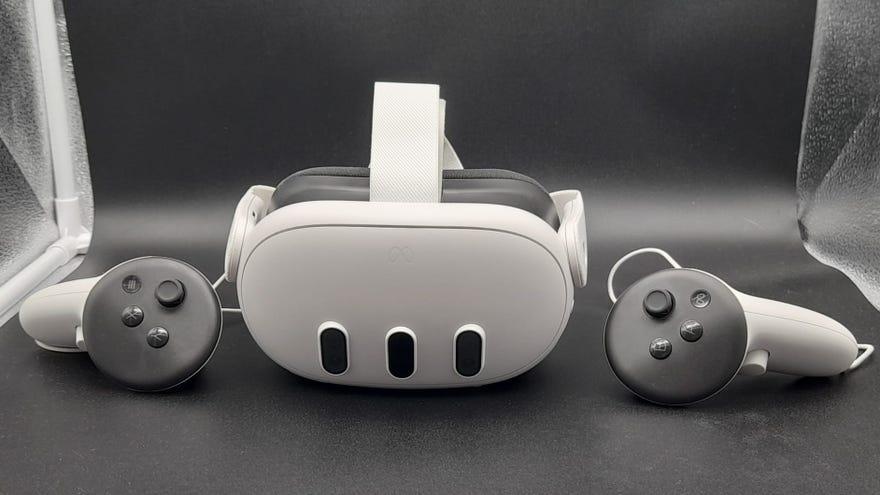
Meta may have spent the last couple of years tumbling down a metaverse rabbit hole, but the company is still responsible for creating thebest VR hardwarearound. TheMeta Quest 2was the ideal gaming VR package: powerful and accessible enough to provide easy, convincing immersion, while also staying highly affordable. Nonetheless, Meta’s sudden fixation on creating a legless version ofSecond Lifedid have me worried about the future trajectory of its VR hardware. What daft gimmickry would their next headset come festooned with, and what would it mean for the future of the Quest as a gaming device?
With the Meta Quest 3, we have the answer. And the truth is, Meta’s latest headset does have a whiff ofMetaverseabout it. Dubbed a “mixed reality” device, its raison d’être is to break down the barrier between reality and the virtual world. While mixed reality is an angle I’m not wholly sold on from a gaming perspective, crucially, the features that make it a mixed reality device are useful even if you don’t want to hold a meeting in your office with a bunch of bisected Sims. Moreover, they’re built into a headset that is more powerful, more comfortable, and generally better than the Meta Quest 2.
To see this content please enable targeting cookies.Manage cookie settings
To see this content please enable targeting cookies.Manage cookie settings
The most visually obvious change to the Quest 3’s design is the twin, front-facing RGB cameras situated on the headset’s faceplate. These facilitate my favourite new feature of the Quest 3 – coloured passthrough. Previous iterations of the Quest enabled you to see your surroundings through the headset via cameras, but the image was low res, black & white, and overall not especially useful.
While hugely improved, the passthrough image is still far from crystal clear. I was able to read my WiFi password on the underside of my router, for example, but doing so took a fair amount of squinting. You’d also struggle to read something on another screen unless it’s in a very large font. Nonetheless, the new passthrough makes the entire VR experience both less fussy and less disorienting.
Image credit:Rock Paper Shotgun
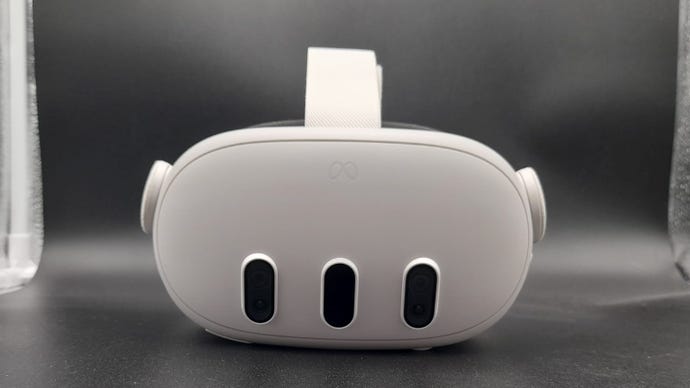
The last major new feature is also the most likely to be contentious – room scanning. The cameras and depth sensors on the Quest 3’s faceplate make it capable of scanning and digitally memorising your room layout. This has a couple of functions. First, it makes setting up your safety boundaries much easier. Instead of having to physically draw a layout, you can simply look around, and the headset will record the contours of your room and create a boundary that fits within it. It’s fairly accurate too. At the risk of telling the entire Internet how I live, one side of my office is currently piled up with stuff I am putting off taking to the charity shop, and the scan created a boundary that neatly avoided the jumble.
But room-scanning isn’t just a quality of life feature, it’s integral to the Quest 3’s mixed reality aspirations. This is demonstrated in an introductory MR game called First Encounters, which sees you fighting off waves of tribble-like aliens with a pulpy laser pistol inside your room. The key gimmick here is that the aliens smash through the walls and ceiling of your room, revealing a sweeping alien landscape behind.
It’s undeniably cool tech, but there are a couple of big caveats. First, its success will depend heavily on the applications made for it. There are a couple on the horizon, like the multiplayer turn-based strategyDemeoBattles, andLego Bricktales, which lets you play with animated VR Lego sets on your tabletop, but it’s still too early tell how much momentum mixed reality will have. The other big caveat is what data this means handing over to Meta. During setup, the Quest 3 states that it doesn’t capture room data, and asks permission to scan your room when the time comes. But the real issue here is one of trust, and even in the most positive reading, Meta’s record when it comes to data privacy ain’t exactly spotless.
Ultimately, these are all handy new features with substantial, if as-yet untapped potential. But importantly, they come on top of an all-around upgrade of the Quest’s hardware and design. While only a few grams lighter than the Quest 2, the actual box that sits in front of your face is more compact, meaning the sense of it pulling down on your nose is noticeably reduced. It also has an adjusted strap system that combines a soft overhead Velcro strap with sliding side straps for fitting around the circumference of your head. These are quite stiff to adjust initially, and they also snagged my (short!) hair, which is less than ideal. Once fitted, however, the headset is fairly comfortable.
Image credit:Rock Paper Shotgun
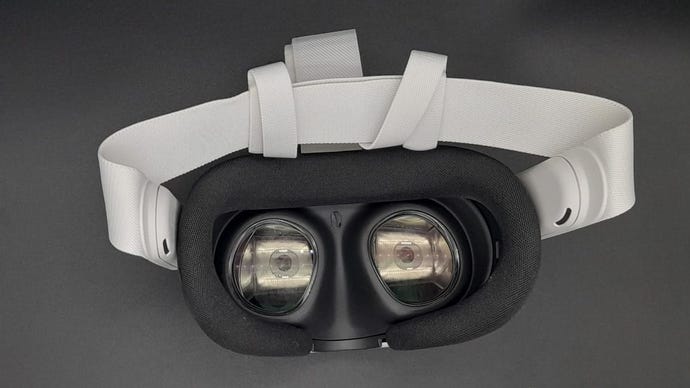
The headset also comes with improved IPD range (IPD being interpupillary distance, or the distance between the centres of your eyes), with a dial on the underside of the headset letting you adjust it between 58-70mm. It supports eye relief adjustment as well, so you can change the distance of the lenses inside the headset from your face. This is a little fiddlier to adjust than the IPD, as the buttons for doing so are on the inside of the headset, but it ultimately makes the Quest 3 more suitable for glasses wearers.
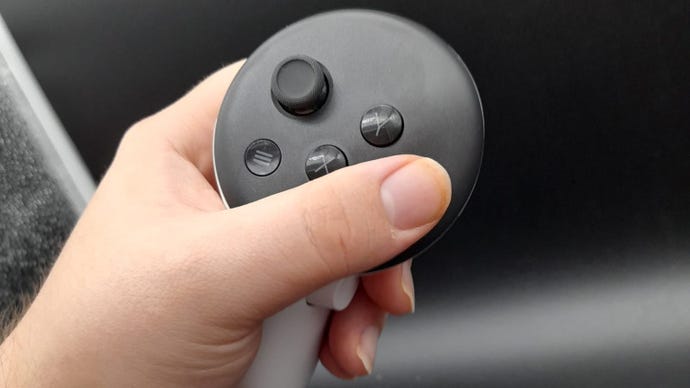
The most dramatic change to the Quest 3’s design, however, is not to the headset but the new Touch Plus controllers, on which the distinctive circular tracking ring has been removed. This signals a change in how the Quest tracks your hands, with infrared sensors in the top and bottom of the controller rather than in the ring. On that note, the tracking cameras in the headset have also changed positions, with two on either side of the headset, as well as the more visible cameras on the front.
Although the Touch Plus look very different, the lack of a tracking ring doesn’t make a vast different to their feel in the hand. Meta’s controllers have always been pretty comfortable, and the Touch Plus are only a few grams lighter and have a similarly ergonomic grip. The main difference is that the absence of the ring leaves room for a proper thumb rest. This is also touch-sensitive, letting the Quest 3 simulate a more nuanced squeezing action.
Image credit:Rock Paper Shotgun
Speaking of PCVR, it’s worth noting that the Quest 3 can still be used as a PCVR device, via Quest Link and Air Link. I wasn’t able to test the cable link due to a faulty cable, but The Quest 3’s Air Link is dependable enough that I didn’t feel much need to jack in directly anyway.
The Quest 3 comes with two storage options, the familiar 128GB option, and a much meatier 512GB. The latter is the one I tested, and it certainly makes downloading most VR games (which tend to only be a few gigs in size) trivial. Finally, like the Quest 2, the Quest 3 comes with a headphone jack and built-in stereo speakers. Besides an impressive volume range, these speakers enjoy a rich depth of sound; they’re not at all tinny or distant, and playing a game like Unplugged, which has actual rock tracks from bands like Weezer and The Offspring, sounded great.
Image credit:Rock Paper Shotgun
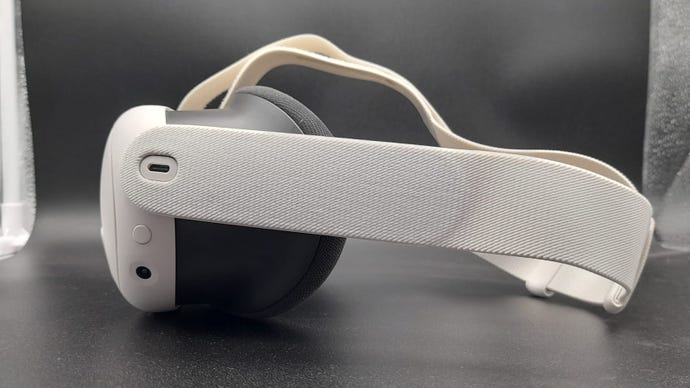
The only real gripe I have with the Quest 3 is the same one I’ve had with every Quest: the battery life. Like the Quest 2, the Quest 3 is supposed to have a battery life of 2-3 hours, but in practice it’s firmly at the lower end of that range. The charging cable is also impractically short, and I don’t just mean that’s it’s too short to play while charging (which it is). If you plugged it into a wall socket directly behind your desk, you’d struggle to charge the Quest on a desktop unless you ran the cable up the back of the desk.
All told, the Quest 3 does represent a significant step forward over the Quest 2. Then again, it really, really should. With an RRP of £480 for the 128GB version, the Quest 3 enters the market at almost £200 more than the Quest 2. Which brings us to the big question: is it worth the price?
I’d break it down like this. If you’re buying a VR headset for the first time, or you’re upgrading from an older headset having skipped the Quest 2, get the Quest 3. It’s still the best Quest headset, and it’s worth coming in at the cutting edge at a price that, if not as affordable as the Quest 2, is at least comparable with modern home consoles. If you already own a Quest 2, though, wait a little and see. The extra power and fidelity are certainly welcome, but they’re only worth investing in if you use VR all the time. The mixed reality features are likewise cool, but right now there isn’t a sufficient library of games that support them to make it worth taking the leap.
