HomeFeatures
“Like a PC game that Nintendo would have made”: the making of Slime Rancher (and Slime Rancher 2)Monomi Park co-founder Nick Popovich talks the farming-sim smash and its wildly successful sequel
Monomi Park co-founder Nick Popovich talks the farming-sim smash and its wildly successful sequel
When Nick Popovich was a kid, his parents ran the Sprague Road Tavern in North Royalton, Ohio. “Everything was a dive bar,” Popovich, now co-founder and CEO of Monomi Park, says of the drinking scene in the Cleveland suburb. “It was all working-class, like dive-bar kinda thing. Which is basically what this place was.” His mum and dad wanted to do up the joint, make it into something resembling what today would be called a sports bar. As part of this plan, Popovich’s father added a game room to the building, filled with pool tables, shuffleboard (“As a result I’m hugely into shuffleboard”, Popovich notes) and most importantly of all, a rotating stock of arcade machines.
Back in the day, explains Popovich, the cabinet was the expensive thing. So his dad would find a cheap cabinet, they’d put in a cheap second-hand board and monitor, and paint the outside to make it look like the official version of the game. To the regulars drinking and shooting pool, it didn’t matter that the arcade cabinet looked like a bootleg – that Donkey Kong was just a picture of a monkey that Popovich Senior had stencilled onto the side of the cabinet. What mattered was that the cabinet did what it needed to do, and that the game inside was legit. This line of thinking, of making something only as good as it needs to be, was an essential component in the development ofSlime Rancher, Monomi Park’s massively successful sci-fi farming simulator. “The original Slime Rancher cheated. A very small group of people made it, and it looks like many more people than that made it,” Popovich says.
Slime Rancher 2 Early Access Launch TrailerSlime Rancher 2 is out now in early accessWatch on YouTube
Slime Rancher 2 Early Access Launch Trailer

Popovich was lead designer on 2011’s Spiral Knights, a massively multiplayer action game that would later prove influential in Slime Rancher’s design. After it launched Popovich decided that, after a decade at Three Rings, it was time to go his own way. Popovich had a bunch of ideas about games he wanted to make, creating a spreadsheet that assessed the potential risks of each one. There was one idea he couldn’t shake. “At the end of the day, I just wanted to make Slime Rancher, because it was funny,” he says. “And it was also first-person, I’d never done that before. It was using physics, I’d never done that before. So it was interesting.”
Popovich built a prototype and took it to a former colleague at Three Rings, Mike Thomas, who Popovich persuaded to sign onto the project. Together they spent the next eighteen months developing Slime Rancher, and Popovich says they did that with no crunch, working a year-and-a-half of 9-5 (or 10-6) days. In sticking to this rule, Popovich and Thomas adopted a highly practical approach to design, that “do only what it needs to work” philosophy that Popovich’s father had when building his arcade machines.
Approaching a mysterious structure in the first Slime Rancher
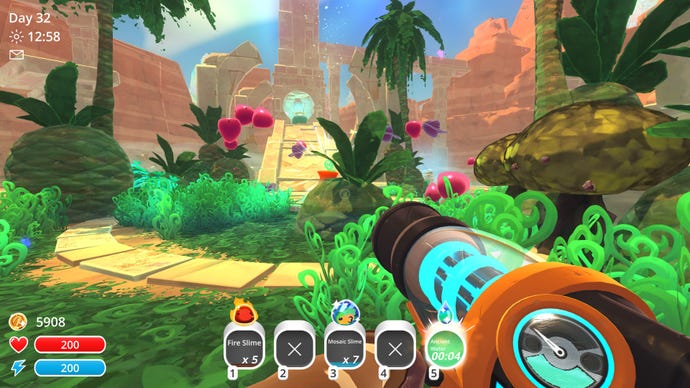
For example, Popovich settled on slimes as the subject of the game partly because they require no animation. “Even when the slimes are wrong, they look right,” he says. “Had Slime Rancher been cats, cats need to walk, cats need to adhere to the ground, cats need to not be upside-down in a tree and vibrating,” he says. “Whereas if the slime is upside down and stuck in a tree and shaking and smiling… it’s funny, right?” Similarly, the simulation governing player interactions with the slimes and the ranch is “as deep as it needs to be”, according to Popovich. “Slime Rancher was not a great farming game. It’s so shallow compared to other farming games in terms of the number of decisions you’re making,” Popovich says. “And we have just enough shallow systems that talk to each other in interesting enough ways.”
This isn’t the only clarification Popovich wants to make about Slime Rancher either. Because of its appearance and (mostly) nonviolent play, Slime Rancher has earned a reputation as a kids' game. But Popovich is keen to stress that the game was never targeted towards children. Instead, the intent was to make a game that welcomed everyone. “With our games, we are pro-inclusivity. We want to make it as open as possible, we want to have as many different kinds of people able to play it,” he says. “It’s also a smart business decision. Like, why wouldn’t I want the other fifty percent of players out there, let’s say, to feel like they’re welcome to buy this game?”
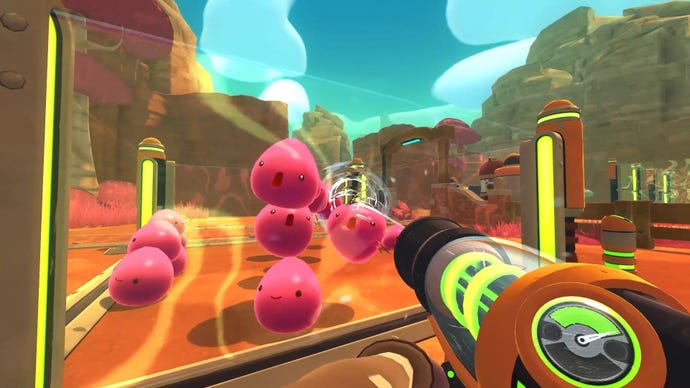
Pink is a great colour on slimes
This inclusive approach isn’t just about making the game look cute and colourful; Popovich wanted players to learn how to play through their own curiosity, rather than mandated instruction. “That’s why the tutorial is like a minute and a half long,” he says. “You really can vacuum out the magic of a world but putting in a bunch of structure. That’s one of the reasons why so many Nintendo games are so popular. You get to play with it first. We have always tried to do that. Maybe [I’m] being a bit presumptuous here, but I would love it if someone who plays Slime Rancher is like ‘this feels like a PC game that Nintendo would have made.'”
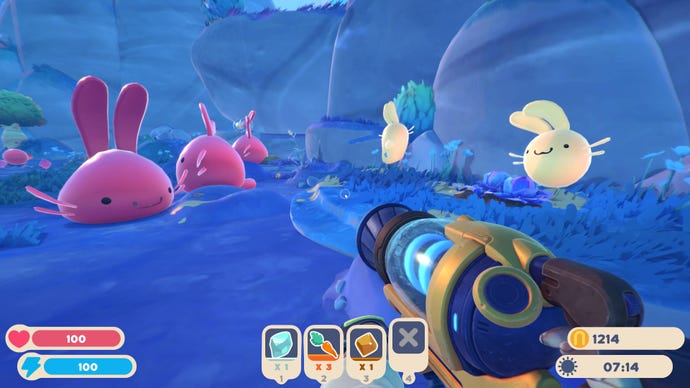
In Slime Rancher 2 your Largo slimes can have bunny ears
Slime Rancher was a major success, and the next few years saw Monomi Park building on that, delivering Slime Rancher out of Early Access, and supporting it post v1.0. In an ideal world, they would have continued supporting it for much longer. “We try to run our games forever, because we came from MMOs”, Popovich says. But two things prevented that. First, they reached a hard limit on new environments and content they could add to the game without completely restructuring it. Second, Monomi had grown into a much larger studio than it had been during Slime Rancher’s early days. “You can’t take a new team and say ‘these decisions that two people made in 2014 are what you’re chained to.'”
Hence, Monomi Park opted to build a new version of the game, one that could serve as a platform for all the stuff Popovich wanted to add to Slime Rancher, but couldn’t. It also gave them the opportunity to let their new team breathe their own talent into the game. “That’s whySlime Rancher 2is this huge graphical leap over one, because the engineers and artists had new ideas,” he says.
Presentation has been a bit of a bugbear for Popovich, not because he thought the first game looked bad, but because a lot of people expected Slime Rancher to run on a potato due to its cute graphics. But the game’s colourful presentation belies the heavy physics cost of rendering all those slimes. “There are hundreds of real physics actors in the environment, which even the heaviest of AAA releases will not emulate, because you’d be crazy to do that,” Popovich says. “Slime Rancher 1 is easily equal to Kerbal [Space Program] in terms of the physics simulation.”
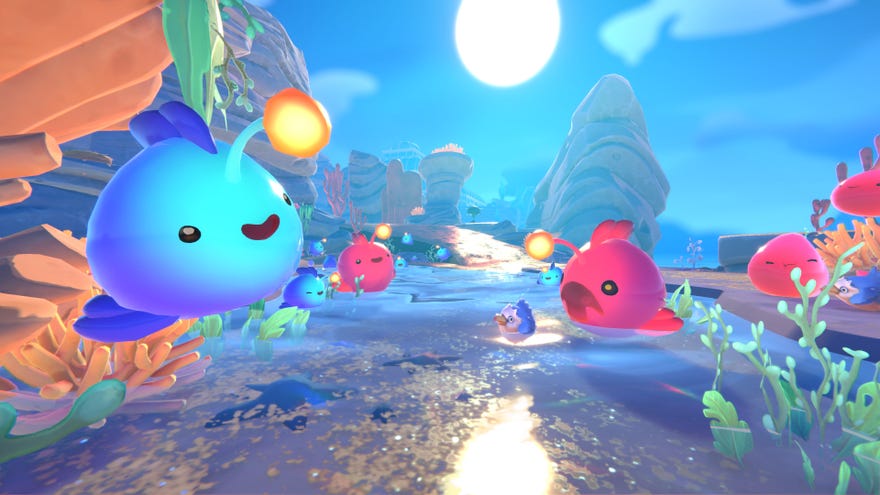
Slime Rancher 2 is like Slime Rancher butmore
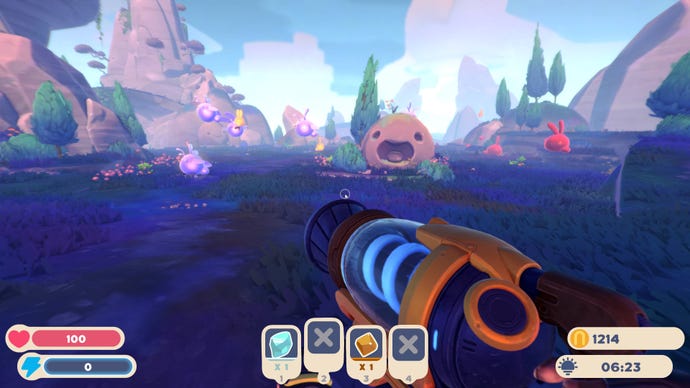
With Slime Rancher 2, Monomi wanted to make the game look as impressive as the technology that supports it, which is why Rainbow Island is such a dazzling bit of visual design. “It’s a pastel first-person shooter,” Popovich says. “Any one rock, even if its grey, you get up close to it and there’s like 12 different colours in it. It was all a conscious decision that there are rainbows in everything.” Unfortunately, this hasn’t stopped people from complaining about performance. “Some of the feedback we get, it’s like, ‘why can’t this run on my Chromebook or whatever,” he says. “It’s simulating real-time light, refractions and liquid. It’s doing all the things that your AAA games are doing.”
That slime rock is kindy of freaky though
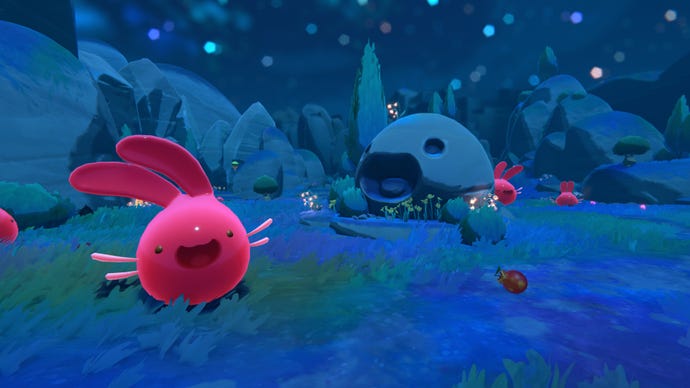
Crucially, Monomi has the resources to support Slime Rancher 2 for years. The sequel has dwarfed the success of the original, selling on its first day what Slime Rancher 1 took nine months to sell. “I’m still shocked over it,” says Popovich, sounding somewhere between dazed and giddy, “but it bodes very well. We already courted quite an audience. And for all the updates and stuff that we have planned, we’ll be able to give them a pretty good experience in this journey through Early Access.”
