HomeReviewsLemnis Gate
Lemnis Gate review: a time-twisting shooter full of more frustration than creativityThis time ‘aint big enough for the both of us
This time ‘aint big enough for the both of us
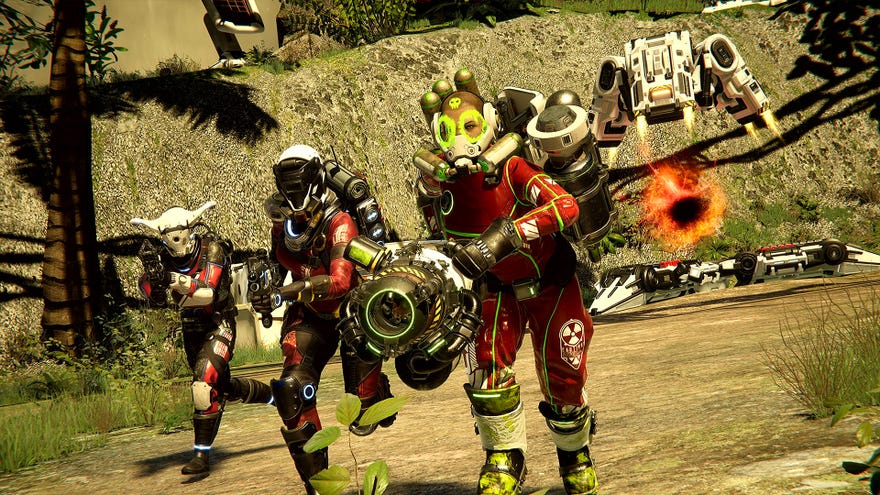
It’s not, but then again, it sort of is?Lemnis Gateclearly wants me to compare it to 4D Chess, but in (this) reality it feels much closer to timey-wimey Tic-Tac-Toe.
Lemnis Gate | Gameplay Overview TrailerWatch on YouTube
Lemnis Gate | Gameplay Overview Trailer

You’ve probably got two questions. One: why are we fighting across time? I do not know, and Lemnis Gate has not made any particular effort to tell me. Someone does mention the words ‘Lemnis Gate’ in the admirably brief tutorial using a tone that denotes terrible importance, but it really doesn’t matter. This isn’t about lore, it’s about high-octane yet cerebral temporal squabbling between seven mechanically distinct yet aesthetically beige characters, with the one questionable exception of the robot who looks and sounds almost exactly like Pathfinder fromApex Legends. Let’s not think about that, and move on to your second question:howare we fighting across time?
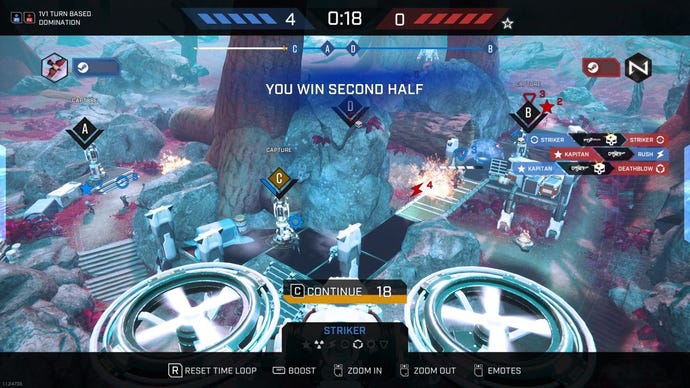
We’re nearly done, promise, but I’ve got to mention the game modes because they all play so differently. There’s a 1v1 mode where you and your opponent take it in turns to add an operative into the loop, a 1v1 mode where you simultaneously add operators to the loop, then the 2v2 equivalents of both of those with further variations on exactly who gets to play and when.
Now, you might be thinking all of that adds up to some mighty fearsome boffin-offs. You might be picturing two wizened old time-wizards, twiddling their comically-proportioned beards as they muster all their powers of prediction and strategy, leaving white-hot reflexes to the kids. You might even be salivating at the prospect of rich mental back and forths, novel ideas and ingenious surprises, with layers of bluff and counterbluff stacked higher than a Delorean. I was salivating too, but that is not the version of Lemnis Gate I have played. Maybe those wizards exist and are like, properly going at it in the upper echelons of the skill curve, but nearly all of the matches in my bracket pan out in the same surprisingly simple fashion.
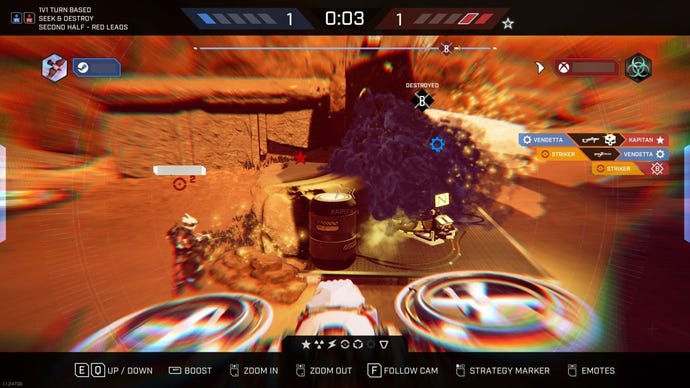
If that happens, then simultaneous games go the way of a bog-standard shootout, while turn-based usually seems to favour whoever goes last. That stings, even though every match is actually played across two separate loops and you swap at half-time. If you win the same number of objectives then the overall winner is whoever eked ahead on kills, which rarely fails to feel anticlimactic.
It does have its moments. There are neat interactions between operatives, like the way the rocket man’s rockets can backfire if they hit a shield on a close up enemy, or how the teleporting poison-spewer can toxify places where you know enemies are going to stand later on in a loop. Despite those, though, I can’t point to a single time when either me or my opponents have done something that’s made me go ‘ooh, that was clever’. When a plan falls apart, it’s usually down to a failure of execution rather than imagination: that shield is a particular culprit, with its habit of attaching to the ground rather than forming a bubble around an operative. The reply to every play is usually straight-forward, with both players going back and forth, undoing and redoing progress until the final round renders most of that irrelevant. That example I gave at the start was illustrative, but only of the games I played before I realised the importance of saving Karl for the end. Now I feel rail-roaded into repeating that effective strategy, rather than adapting a new one to each circumstance.
Because of that, Lemnis Gate lacks any background excitement, that required hum of tension or stress. The turn-based modes necessarily involve a lot of downtime, and even when it’s your turn to pop into the loop, shooting at people from the past can feel more like a chore than a challenge. Messing up in that context is a frustration, a failure to consistently clear a low bar rather than a satisfying defeat at the hands of someone who’s clearly outsmarted you. The simultaneous modes, meanwhile, play too much like straight-up shooters - shooters that inevitably pale in comparison to the likes ofOverwatch.
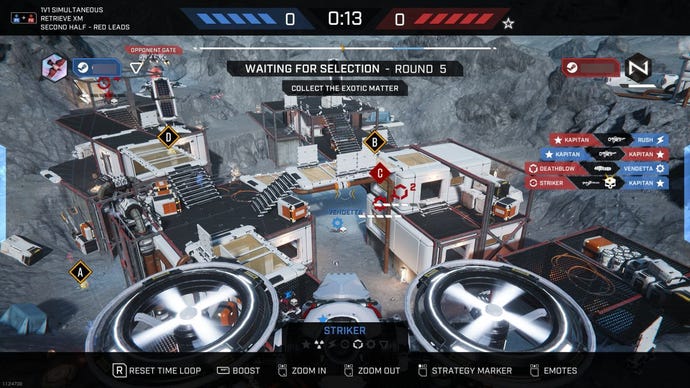
It’s worth mentioning I haven’t had quite as long as I’d have liked to get to grips with higher-level play, because another unpleasantly recurring (wahey) thing about Lemnis Gate is its crashing habit. I’ve had my fair share of disconnects, too, as well as a great deal of difficulty trying to play with a friend - first having to re-download so we had the same Steam/Windows version, then trying to wrestle it into letting us form a party. I’ve consequently wound up in more 1v1s than 2v2s, and so I can’t rule out there being more depth tucked away there. At the very least, I’m sure it’ll take some getting at.
