HomeFeaturesShadow Empire
In the war of strategy games, Shadow Empire has already wonStart with a good Foundation
Start with a good Foundation
When Graham asked me to write a strategy games column, my first challenge was of course to think of how to annoy as many people as possible. “I won’t stretch the definition of ‘strategy’”, I thought, “I’ll warp spacetime itself until all points within it are ‘strategy’”. You have to set goals with these things. But what game would irk the most readers? “The hardcore strategy ofAmong Us”, maybe. Is there a Mario game on PC? I could get dark gags out of lives as strategic resources. Call Of Duty would surely make it too obvious?
I left those questions to my brain while I had a go at something I’d had my eye on already anyway. It’s calledShadow Empire. It is a grand strategy 4X wargame. I have been playing it almost every day since. It is as strategy as strategy gets, and it is so excellent it has ruined everything.
Shadow Empire || in 2 minutesWatch on YouTube
Shadow Empire || in 2 minutes

It’s the premise, first. Shadow Empire is set in the space future, after a great galactic dark age following the collapse of a big ol' interplanetary republic. But you’re not playing as one of a dozen isolated species who all inexplicably became spacefaring at once. You’re descended from the hapless people left behind on an alien planet when civilisation fell in on itself, and your goal is to lead them to somewhere more hapful.
It’s basically a game about what happened in the first Foundation book, but instead of uniting the galaxy, you’re confined to one planet. My interest was first piqued at the prospect of a modern Emperor Of The Fading Suns (an intriguing, ambitious, crap mega 4X I plan to write about later, about fighting vast ground and space battles for approximately infinite hours). But any disappointment faded when I created my first planet.
You start out in typical 4X fashion, with a little village and some militia dudes. You’ll scout the area, maybe meet some neighbours, and think about where to expand to and what to research. Eventually, sure, you’ll conquer enemies, build new settlements, train better armies, manage trade and diplomacy. But all this is elaborately woven into a wargame. A proper, full on, recon-and-supply-lines-and-impenetrable-TLA wargame.
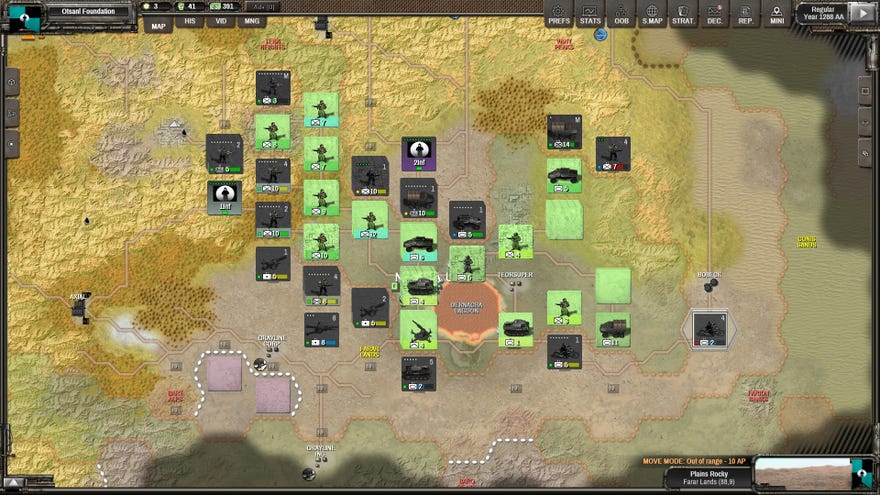
A hard armour push in the East, infantry clearing the mountains, and a column of APCs about to cut off reinforcements in the West. Without supplies, their laser tanks starve like anyone else.
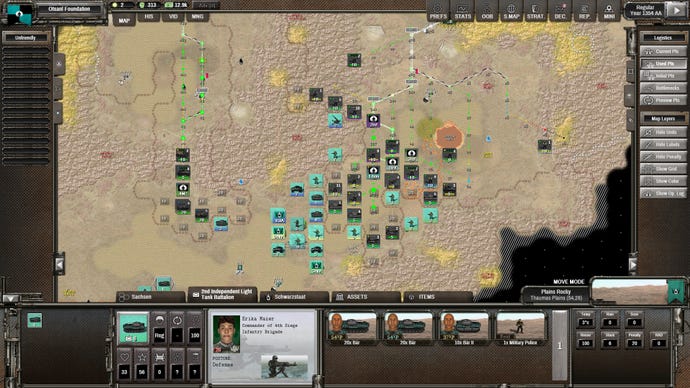
The other reason I’ve become utterly consumed with it is that it’s a fantastic science fiction game. The best part of any game with a black map is gradually uncovering it, and the planets this one has you fight over are wonderfully evocative. Oh, they don’t look much, you can see that. Although I’m rather partial to its simple, very budget retro look (the amusingly clunky two-frame animation when you capture a hostile city would barely have taxed an Amiga), this is not a pretty game. Not even for a strategy game. And yet I quickly became fond of its look.
Its humble tiles combine to make a world that feels special each time. Shadow Empire has possibly my favourite map generation of any 4X game. You don’t choose the shape of the landmass, the proportion of ocean, how many rivals there are, or whether it’s a desert or swamp. Instead, a planet is generated in stages, starting with its orbital path, axial tilt and spin. Those factors start you out, and dictate the parameters of the climate, which in turn affect the biosphere (if it even has one).
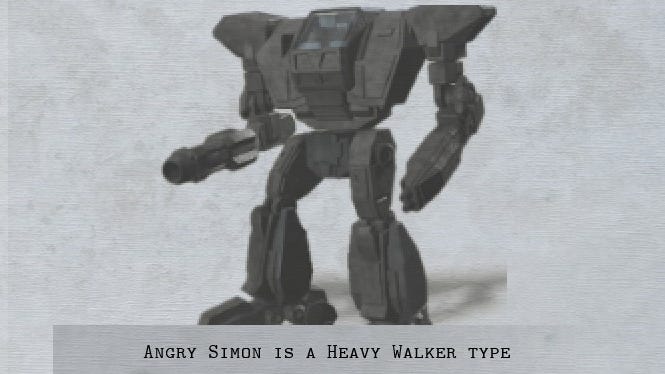
Argh Jesus Christ Help II - An impenetrable heavy tank with a very unnecessary ability to obliterate acres of infantry.
lmao gottem - The only aerial bombardment unit in a world that came to somewhat regret its constant rejection of my peace envoys.
BEES - buzz bzzz
The type of sun, and your distance from it matters. The seasons change in length and variety based on its orbit. If it’s too small it will have no atmosphere, because its gravity will be too low. If it doesn’t spin right there won’t be enough wind for rainfall. If it’s old enough there might be fossil fuels… unless there’s no native life to form them. Will the atmosphere be too thin for aircraft? Is the local flora edible, and if so, what conditions does it need? Will you have to farm indoors? Can your people go outside without dying? Is there radiation from the war? Can it support aerial units?
Each stage of the process determines the parameters for the next, from basic physics through climate, then onto abiogenesis, the nature and extent of human settlement, and then finally, the precise history of the apocalypse that struck it in the wake of the imperial collapse.
All this means that you could be playing in all manner of places. And since the nature of those places also dictates what resources are there, it makes a real difference. I’ve fought on an icy desert world, clinging to a single forest for defensive bonuses and fighting to take over the narrow equatorial band where crops could grow. I’ve sent armies across a planet teeming with strange pink plant life, none of which was edible, to defend a glacier. My troops have fought over land bridges in a grassy paradise, around rivers of magma for metal mines, across gruelling mountain ranges for coal, between ammonia lakes for revenge, and in a dusty, dry land where I inevitably named a settlement “Gas Town” and ran fleets of motorcycles around the one narrow pass between us and a hostile neighbour.
One planet was home to edible plants that grew well at 40 below zero, in thin bands at the poles. Without free rain or surface water, those crops will need you to secure a glacier, or find ice deposits deep underground. One captivating world’s friendly conditions made it home to billions before the war, who left behind vast ruined cities. I’d previously only seen ruins across a tile or two, but here there were some that filled an entire screen, many dozens of hexes wide, and each hex a source of precious metals.
Picture two factions settling into an uneasy truce, each scavenging the ruins on their side of an abandoned city, each satisfied with the compromise until the salvage starts to dry up, and the recycling facilities move closer and closer to the border. You can see it, can’t you?
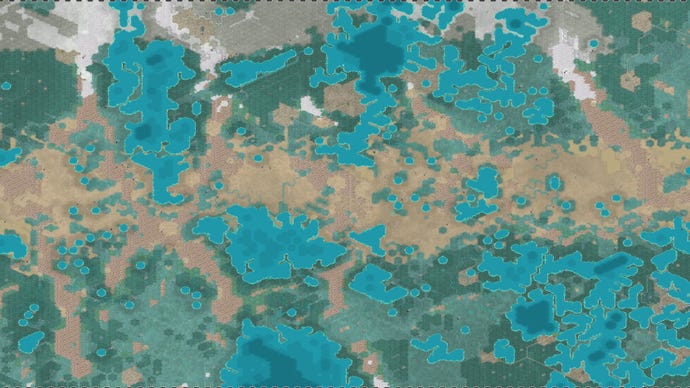
This 70% or so of a small planet gives some idea of scale. If you started blind in the Northeastern forest, you might not even know the enormous desert existed for a dozen hours.
There’s enough variety to make anything viable. Your responses to events can consolidate your current profiles, or gradually switch you over to another set. It takes commitment and occasional sacrifices to maintain the exact outlook you want, especially as you need to balance the three pillars of your population (workers, soldiers, and civilians, who operate state buildings, shoot dudes, and run the vital-but-complicated private economy, respectively) too. You’ll also need to keep in mind the opinion and loyalties of your staff.
With a little experience, battle feedback makes sense.
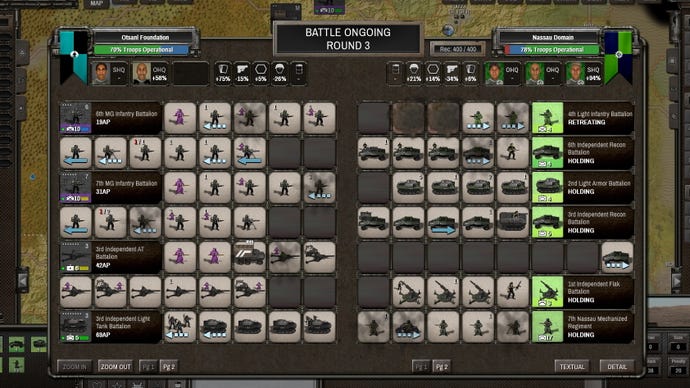
For something so complicated and large in scale, the individual turns are remarkably low hassle. I suppose partly because I find balancing everything and building my manufacturing/bureaucratic base more interesting than the usual 4X build order roteness. You know how wars go in a 4X. Either they attack you out of nowhere because you’re the player, then you both have all your dudes stand on each other’s shoulders and bash into each other, or you research boats and sail an army directly up their chuff. The battles here are more than just chucking Biggus Dickus at the nearest enemy army until they’re all gone, and the way they scale up gradually from nothing makes them feel manageable.
Overwhelming as it all sounds, the clever connection of all these systems makes them much more approachable than you’d think, and the 4X structure gradually reveals them to you over your first game or two. In truth, Shadow Empire’s RPG side will take a back seat, and it cribs key patterns (not the whole cloth) from the civ-like. You will absolutely be waging a tonne of war, possibly right from the beginning if you get unlucky with planet generation. And that war will take proper planning and thought and practical support networks. It remains a wargame first and foremost, so if you absolutely outright hate them, you probably won’t get over that.
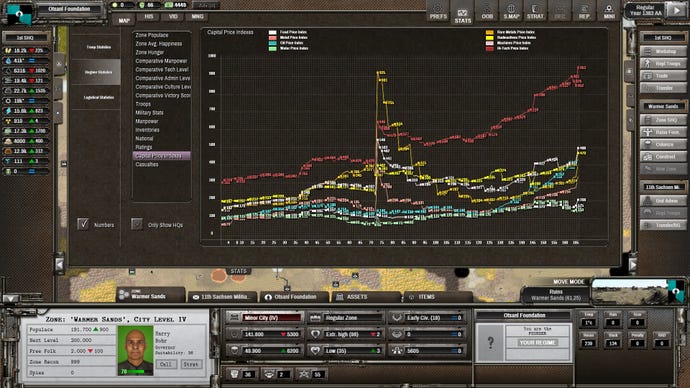
Supply and demand are in effect with independent traders. It’s not as gnarly as the charts make it look. In fact the vast majority of its countless reports can be ignored most of the time. Bureaucracy amirite?
It’s not without flaws, of course. Much as I love the planet generation, it sorely needs some refinement, and more options to customise or lock down wanted aspects. The unpredictability of each start can be a lodestone when you start out in a hopeless situation, or get an unwanted set of rival empires. Wargame or not, it could use a more involved diplomacy model, or at least some friendlier empire archetypes, and though the option of a planet with dozens of rivals appeals, the extremely long AI turn times make them near impossible to play. This is absolutely a game to alt+tab in and out of, even if that’s not your usual habit. Oh, and there’s currently no naval power or enterprise at all, which doesn’t bother me personally but might you. And finally, although I’ve learned a tonne about it, and continue to learn more detail near every day, I won’t pretend it doesn’t take some dedication, or at least willingness to be confused and badly beaten for a day or two. 2021 moods, amirite.
But I love Shadow Empire. It came at me from the right direction. Instead of feeling like a test I had to memorise an encyclopedia for, it enticed me. It uses the nation-building and management as a bridge to hefty war simulation, and the exploration and technology progression to liven up some fairly standard combined arms strategies. The ingredients it transplants from elsewhere sprinkle enough chocolatey cinnamony goodness into that often dense, stodgy porridge to make it the best and most compulsively playable serious wargame I’ve ever played for a solid month. It’s the perfect place to start and I am utterly furious.
