HomeFeaturesHumankind
Humankind’s million potential civs make for some great strategy moments -and some seriously busted synergiesSelf. Replicating. Caveman. Swarm.
Self. Replicating. Caveman. Swarm.
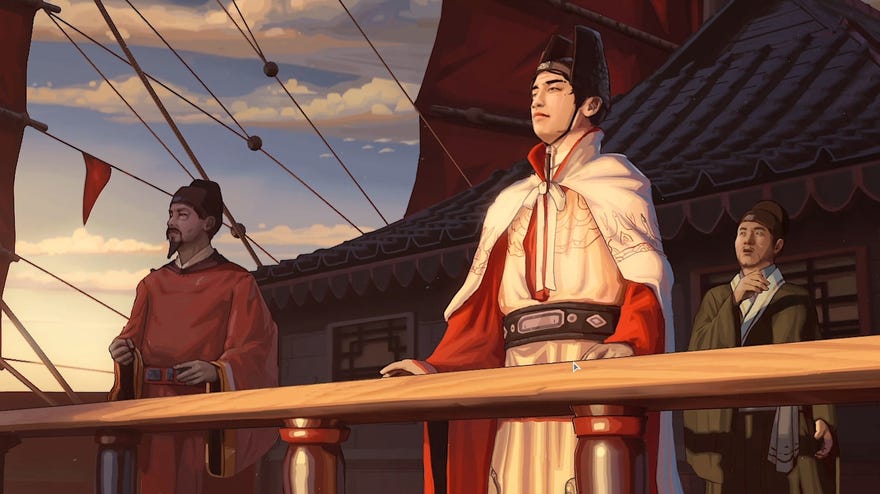
The mayor steps to the podium, resplendent in silk pantaloons and a turquoise-embellished cuirass, and clears his throat. In the strip of face visible between his fancy Mesopotamian beard and his tricorner hat, the ancient dignitary’s eyes flicker over to a commotion in the East. the Huns are assaulting the city wall. Again. The Huns arealwaysassaulting the city wall, so the mayor ignores the screams, and returns his attention to the mass ofhumankindgathered in the square before him.
HUMANKIND™ Victor OpenDev - Official Trailer [PEGI]Watch on YouTube
HUMANKIND™ Victor OpenDev - Official Trailer [PEGI]

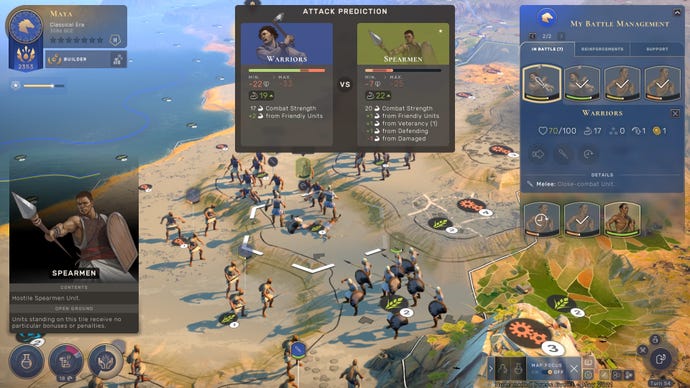
Last week I got to have a 48-hour go with the latest build ofHumankind, the much-heralded 4X game on the way fromAmplitude. When I last played it,one year ago, I only saw the very beginning of the game. This time, I got to play right through five of Humankind’s six technological ages, getting all the way to guns and steam engines.
Overall, I was left feeling that the game had grown into pretty much what I had hoped it would: a solid, big ticket strategy game with the power to casually whittle away at the rest of my life, eight hours at a time. It’s beautiful, apart from anything else. The artwork is lavish and atmospheric, while the UI does elegant work in getting your eyes to the numbers they need to see, without ever feeling like business software. As flimsy a thing as it sounds to say, it’s a game that’s full of heart. It just feels… good. Cared about, perhaps? The fact I can’t dissect my reaction any more precisely than that, I hope, speaks to how well Humankind has been put together. But I wouldn’t call it an unqualified triumph.
Humankind’s most exciting aspect is also its most marketable. At the start of each of its six eras you get to pick a culture, which is grafted over the top of your current culture like a new coat of paint. Each culture has a special perk, as well as a unique unit and a unique building, and the perk sticks around when you trade up. Six choices of ten means there are one million potential civilisation builds in Humankind. Like I say, very exciting. But also very problem. Because a million builds means a million combinations of stacked culture perks, which all have fairly dramatic effects.
This absolute beast of a building is the unique district of the Mayans, an era two (classical) culture. It has an utterly transformative impact on industry.
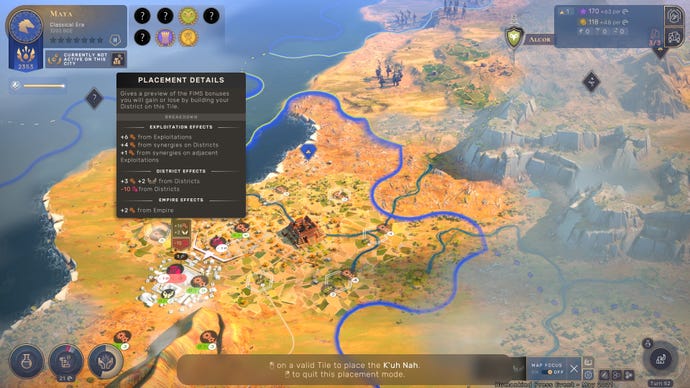
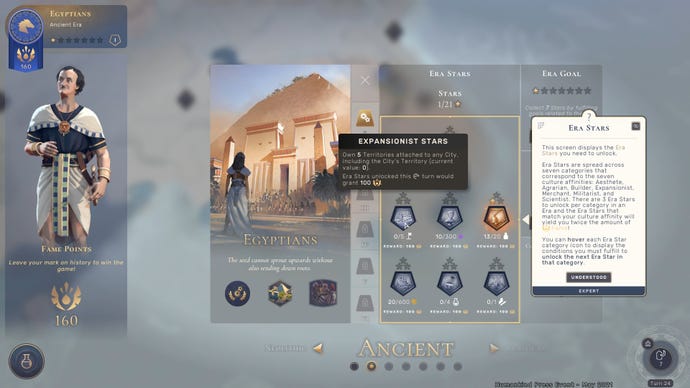
Moreover, it’s about finding the synergies between these modifiers. And with one million potential combos, there are plenty to be found. Add to that all theadditionalmodifiers a civ can pick up - from the religion and civic unlock trees, to clever city placement, to efficient arrangement of districts - and you’ve got an incalculable number of ways to turbo-charge your ant farm. You’ve also got an awful lot of mathematical space for completely busted combos to hide in, even with the amount of time Amplitude still have to tweak balance.
I had quite a few moments, while perusing potential buffs for my civilisation, or when choosing sites for districts, where I found myself muttering “surely not?” at the size of the benefit I was about to accrue. The big-impact nature of these changes was great in a way, since it ensured I had to go through lots of changes in strategic direction, and kept things from getting stale. I really think it could make for excellent multiplayer, too.
It’s not like there wasnochallenge, though. It just became more of a solitaire experience, is all. Rather than a struggle to compete against other civilisations, the game was reframed as a question of how brutally I could trounce them. Thanks to the “fame score” system I had a clear way of measuring my progress. I was invested in ramping up my civilisation for its own sake, and the crucial “one more turn” compulsion, which sits at the heart of any good 4X, was definitely in play.
In the fourth of the six eras, you can start to merge your cities together, making massive, continent-spanning megalopolises like off of Judge Dredd.
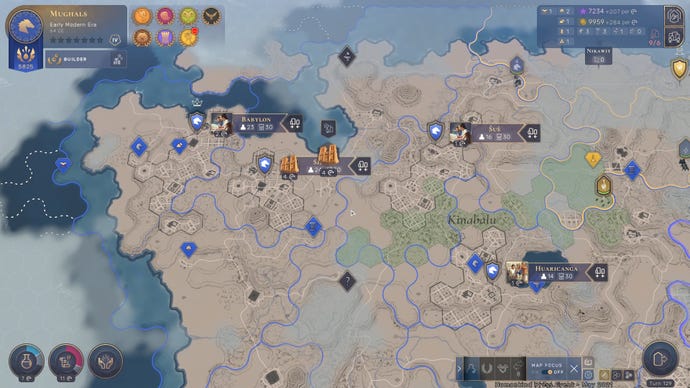
But I can’t help but wonder if I’d keep feeling this way after a few more weeks with Humankind, and the chance to discover some truly broken synergies. Already, I’ve found one tactic that I can honestly never bring myself to shy away from, since it’s never done anything less than turned me into a god: the self-replicating caveman swarm.
Not even the noble mammoth can stand before the Swarm.
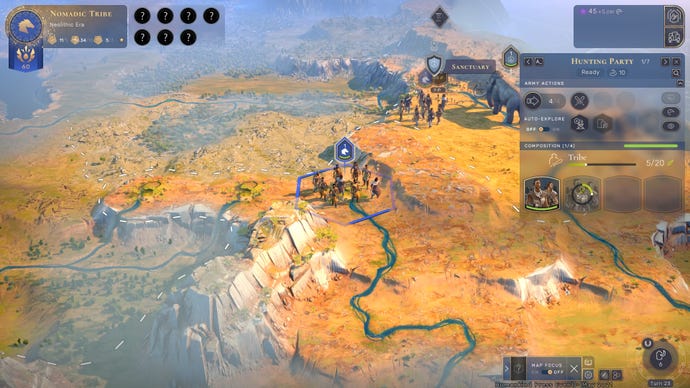
At the start of the game, before you found a city and pick a culture, you exist in the neolithic, with only one kind of unit - a bunch of humans, which wanders about eating things and looking at bones. Eat enough things, and your manswarm buds off a copy of itself, which can do exactly the same. I think you’re supposed to get two or three of these, and then settle down and become a civilisation. But I don’t.
Every single time I play, I stay in the neolithic for twenty to twenty-five turns, spamming brute mitosis until the entire world is awash in a horde of gnawing, fumbling hunter-gatherers. Then I do found a city, advance to the ancient age, and watch this legion of beastmen turn magically into scouts. They’re not brilliant military units. But since nobody else has managed to build anything to defend themselves with yet, they can usually take a couple of cities before the madness can be contained, and guzzle further treasures on the map, earning me an enormous head start.
The caveman swarm could easily be made less viable, I’m sure, with a couple of balance tweaks. But it speaks to a problem with Humankind - and possibly to the whole genre of 4X games, to be fair - which can’t be addressed so easily.
Part of being human is doing counterintuitive things for the sake of belief, passion, or pure impulse. Weird decision-making is arguably the most powerful force in history. It’s certainly the most interesting. But with 4X games as they stand, it’s just not something which can be simulated. Ironically given its name, I felt like Humankind was leading me to play like a computer.
Maybe it seems unfair that I’m holding Humankind responsible for an issue endemic to a whole genre. I suppose, for me, it’s down to the fact this game has already done so much to challenge the traditional 4X formula with its design. After all that, I sort of wish it would go the whole way and add a fifth ‘X’, which somehow stands for ‘Roleplaying’. Still, you can bet I’ll be raring to take the self-replicating caveman swarm out for another spin, when the time comes.
