HomeFeaturesWitch Strandings
How Witch Strandings is moving Hideo Kojima’s Strand game ideals into new, slightly cursed territoryWe chat to Xalavier Nelson Jr about how the “toned, naked ass” of Norman Reedus has busted open a whole new genre for indie devs
We chat to Xalavier Nelson Jr about how the “toned, naked ass” of Norman Reedus has busted open a whole new genre for indie devs
That’s right. Taking cues from Hideo Kojima’s hiking postal simDeath Stranding, Witch Strandings is a game that not only asks what Sam Bridges’ cross-country cargo routes might look like if they were made with a fraction of Kojima’s development budget, but also how games can create experiences that are “larger than my screen,” says Nelson Jr. And the answer, it turns out, lies in your PC’s humble mouse.
Top 10 Best Games Coming To PC In June 2022Watch on YouTube
Top 10 Best Games Coming To PC In June 2022

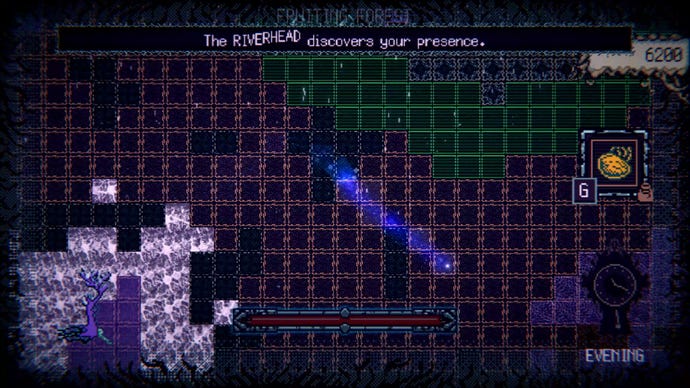
Only you aren’t navigating this world with a keyboard or a controller. Instead, the only way to move your spectral ball of light through its forest of gridded squares is to swipe, push and nudge your mouse where you want to go. Large sweeps will see you leap across the screen, for example, while gentle brushes will only move you a square or two. However, when your vision is limited to just a handful of squares in front of you, it’s easy to find yourself trapped in one of its poisonous bogs or tangle of thornbushes if you rush in too quickly. As such, it pays to go slow and steady when you’re pushing out into new, unknown areas, and you can finetune your mouse’s sensitivity settings to give smaller bumps and prods on your mouse mat a real sense of careful, cautious resistance.
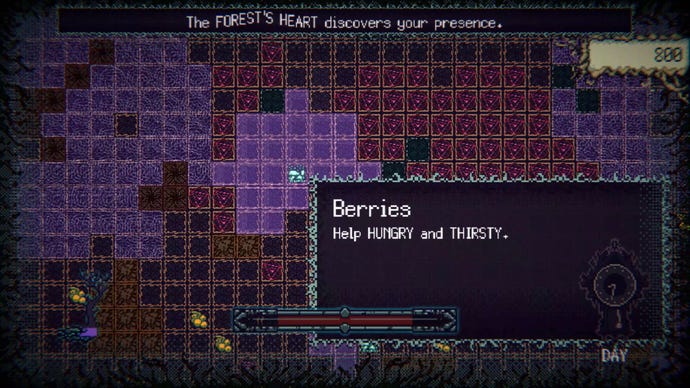
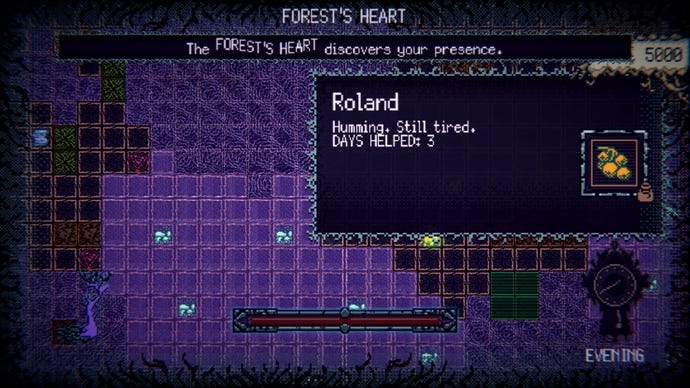
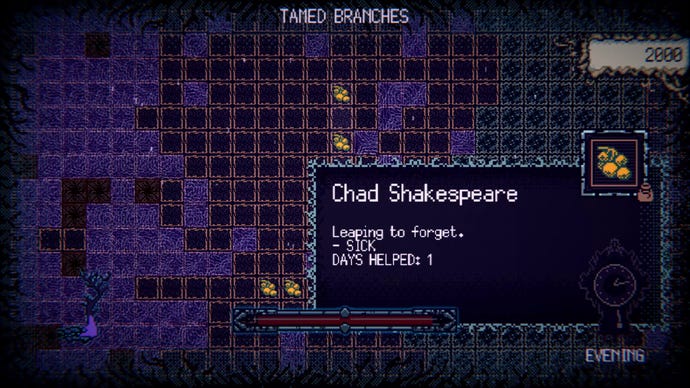
Objects you find around the world, marked in yellow, all have different effects. Giving them to the right animal will help cure their woes for a time.
As such, Witch Strandings is one of those increasingly rare things on PC: a platform exclusive. There are no plans to add in keyboard support, for example, or make it playable on a controller. To his credit, though, when I ask Nelson Jr about whether this decision makes good business sense for an indie studio in today’s climate - the going consensus being that most developers want to get their games on as many platforms as possible these days - he remains unphased.
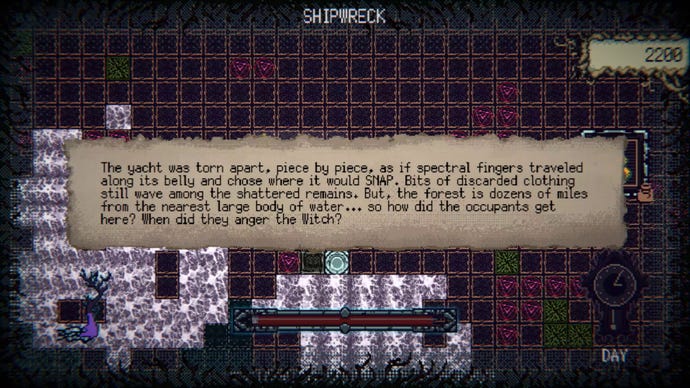
Each area of the forest is fairly abstract in nature, but notes scattered around the map give a little more insight into this strange, cursed landscape.
“Ending up being the second Strand-type game and having a form that is so distinct from the original is, I’m interested to see whether that will end up being a unique contribution to the medium that we can make, because it instantly cracks open the idea of what a Strand-type game can be. It doesn’t have to be third person, it doesn’t have to have a giant butt, it doesn’t even have to have game pad type controls. You can’t play this with a game pad. We don’t have that control setup at all, so it would be a fundamentally different game. So the question of what a Strand-type game can be now is entirely up to people’s imaginations.”
Hard same, Roland.
It’s an image that’s not too far removed from Kojima’s oil-slicked world in Death Stranding, but Nelson Jr tells me it wasn’t always like this. Indeed, as he reads out some of Witch Strandings’ earliest design ideas to me, he paints an altogether more positive picture of potential wells his Strand-type game could have drawn from: “One of them was a muse for a commune of artists, so you’re invisibly affecting this commune of artists,” he says. “There was a child in a rural setting, such as Coraline, and taking care of magical creatures only you could see; a spirit in hell comforting abandoned souls; nurturing abandoned electronics on a planet; nurturing the internal components of a computer; a direct biblical parable of where you’re like feeding sheep and flocks; an XCP control-like game taking care of anomalies in a facility…”
But then: “In very big letters I have at the top of this list, and the last thing that was added, wasDARKFOREST, magic realist Ghibli vibes, dark things live in the woods and you’re not one of them.”
Of course, it was this final idea that eventually won out with Witch Strandings, but when I asked him whether Strand-type games needed this kind of drastic, apocalyptic-type setting in order for its ideas of nurture and restoration to really sing, he does agree that “more game genres would benefit from a sense of despair”. We’ve become so used to the world ending, he says, that “we don’t bat our eyelash at an apocalypse” now, so “having a setting that also allows the player to live in a place where suffering is commonplace, and then make their business to see that status quo change is uniquely fascinating and empowering in a way that I believe a lot of games' apocalyptic fiction has not explored yet.”
“It never fully recovers. No matter how much you work to balance that ledger, people can see the scar, even in any screenshot that you post. […] I think that’s one of the ways that we can use the language of video games in a way that is unique to the medium - and sustainable for a small team to build - to do something a little bit weird and different.”
Moving your ball of light around the map with your map is a strangely frictive sensation, especially when you’re dragging and dropping items from one place to another.