HomeFeatures
How the Gulf War, Apple’s drag-select and “cheesed together” FMVs gave us Command & Conquer"If we were trying to make it cheesy, it probably wouldn’t have worked"
“If we were trying to make it cheesy, it probably wouldn’t have worked”
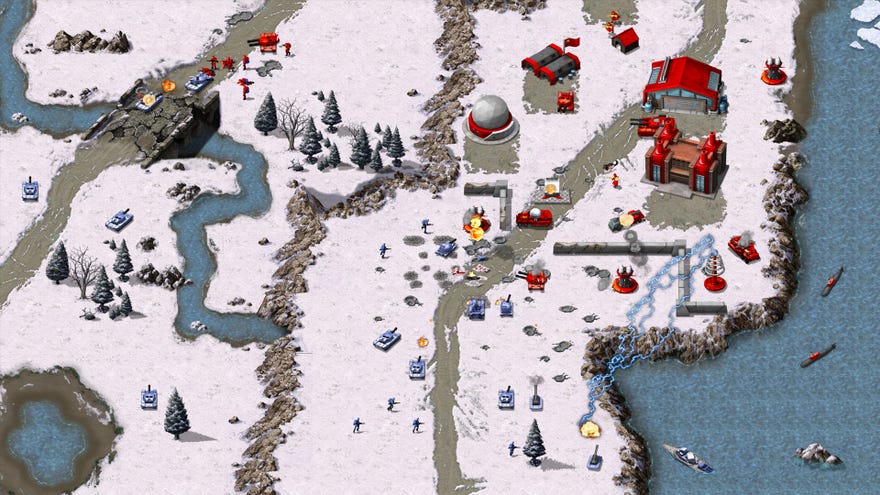
There’s always been something quaintly practical about the nameCommand & Conquer. Sure, there’s a touch of Julius Caesar’s ‘veni, vidi, vici’ in there. But less romantically, the title evokes Internet Explorer or Acrobat Reader - sitting comfortably alongside the clearly and sensibly labelled Windows software of the mid-90s. It’s a reminder of just how early Westwood happened upon the blueprint for real-time strategy, right as many PC users were buying their first trackball mice.
Command & Conquer Remastered Collection Official Reveal TrailerWatch on YouTube
Command & Conquer Remastered Collection Official Reveal Trailer

“But the more we played it, we realised the user interface needed drastic improvement,” recalls C&C co-creator Joe Bostic. “In Dune II, you’d have to single-click a unit, click on an order like ‘attack’ or ‘move’, and then click on the destination. People started using hotkeys at that point, because the UI was just so hard to navigate with the mouse. And that’s when we said, ‘Well, we have to find something else. That just won’t fly.’”
At the time, Apple was breaking new ground in desktop navigation. And occasionally, Westwood co-founder Brett Sperry would call his team away from their Windows machines to show off the magical powers of his new Mac. “Look at this,” he’d say. “Look how I just drag-select files. Look where I drop them, it knows what to do.”
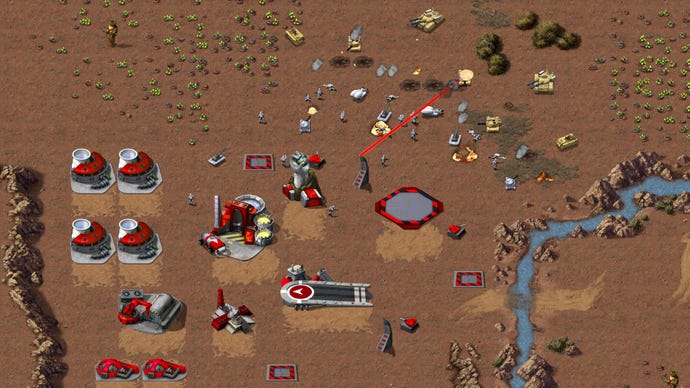
The team looked around themselves for inspiration when it came to C&C’s setting, too. While Westwood is remembered partly for its mastery over movie licenses - the all-time classicBlade Runneradventure game would arrive in 1997 - the studio wasn’t inclined to return to Frank Herbert’s universe for a Dune sequel. “Why pay a percentage to an IP holder,” they wondered, “when really Dune II didn’t have much to do with the Dune story?”
As a D&D fan, Bostic immediately set about pitching fantasy armies - one faction of wizards, another made up of knights and archers, and a third given over to fantastical beasts. In a fateful team meeting, however, Sperry pointed to the Gulf War that was playing out on TVs all over America. “Maybe people don’t know what a dragon is, and how much stronger it is than an armoured knight, or an archer on horseback,” he said. “The average person might not even care, but everyone knows what a tank is. Everyone knows what an aeroplane is. It’s in the forefront of peoples’ minds because it’s on the news.’”
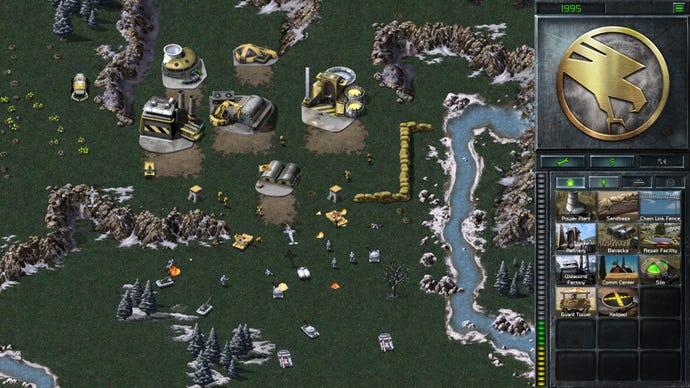
“Let’s make it reality-based, but not handcuffed to reality,” says Bostic of the team’s thinking. “Let’s stretch beyond the boundaries of physics a little bit here and there to make it more fun. If you jump into a completely science fiction world where nothing is recognisable, people tend to get lost.”
Ever since the invention of Tiberium, resource-gathering has been a fixture of real-time strategy, for the same reasons Westwood discovered during the development of C&C. “It keeps the player wanting to venture out from this little bubble of defence,” Bostic says. “It gives you something to push out and potentially fight over, and it’s dynamic, because fields get harvested, so you’re moving to different places.”
In retrospect, Bostic considers Tiberium the ‘secret sauce’ of Command & Conquer. “We needed that,” he says. “It breaks the staticness of the game. There was no way we could have C&C without resources.”
The legacy of that mantra is clear to see in today’s esports scene. But C&C’s two opposing single-player campaigns are just as well remembered - not least for their memorably broad characters, like Nod’s “larger-than-life” quasi-spiritual figurehead, Kane. “We needed someone who was over-the-top in his nefariousness and Bond villain-esque,” Bostic says. The specifics came from a writer named Eydie Laramore, who had previously worked on Westwood’s influential dungeon crawler,Eye of the Beholder.
“She was obsessed with ancient conspiracy theories and secret organisations,” Bostic says. “There’s a legend of somebody who can never die, the Wandering Jew, who lives throughout history.” The man in the myth is cursed after taunting Jesus on the way to his Crucifixion - doomed to walk the Earth until the apocalypse. Some scholars link him to Cain, who is similarly condemned to wander after killing Abel in the Book of Genesis. “Why don’t we call this guy Kane?”, Laramore suggested. “Maybe he goes back that far. Maybe he’s never died and has stayed behind the scenes, low profile but pulling strings.”
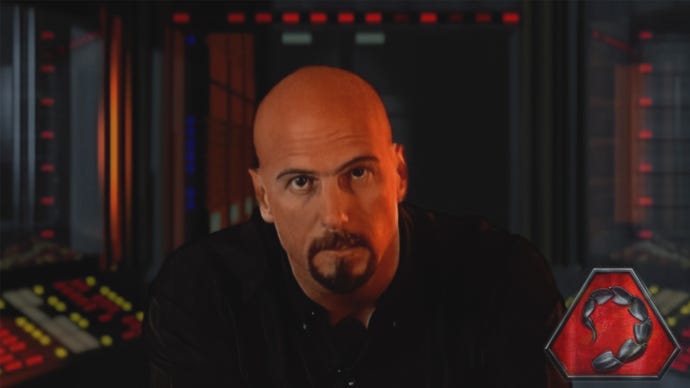
But Westwood didn’t know in the beginning that they were making cheese. “I thought it was really cool,” Bostic says. “I didn’t know any better back then. The flaw and the charm was that we didn’t know what we were doing. We cheesed it together, and I think it’s that cheese that gives C&C FMVs their charm. If we were trying to make it cheesy, it probably wouldn’t have worked. That’s just how it fell out.”
In the aftermath of that first hit, Westwood capitalised with what the studio intended to be a quick expansion pack. But the project wound up spawning an entire spin-off series rooted in tesla coils, time travel, and goofy Soviet imagery. “We really cranked it out pretty fast,” Bostic says. “I think it was nine months between the release of C&C and the release ofRed Alert. That’s crazy talk these days.”
Bostic worked on the recentC&C Remastered Collection, but today he sits adjacent to the mainstream influence of Command & Conquer. His world isn’t that of international esports championships or greenscreened Hollywood studios. Rather, he and Petroglyph are readying a new historical RTS for release, namedThe Great War: Western Front, which launches on March 30th 2023. It’s a project designed to celebrate some of the forgotten joys of ‘90s real-time strategy, like turtling, and alternate history.
“It answers the age-old question, ‘If I was there, and I was in charge, would it have turned out differently?’”, Bostic says. “That’s what a computer game’s great at being able to answer. And so that’s the motivation for The Great War, to put the player in the shoes of the commander, with the decisions he had to make.” It’s subtler than sending Einstein back in time to erase Hitler, but if you squint a bit, it’s still very much C&C.
