HomeFeaturesHearthstone
Hearthstone’s randomness is being curbed for consistency, and that’s a very good thingAlso: a fight to the death in a melee of bellowing orcs
Also: a fight to the death in a melee of bellowing orcs
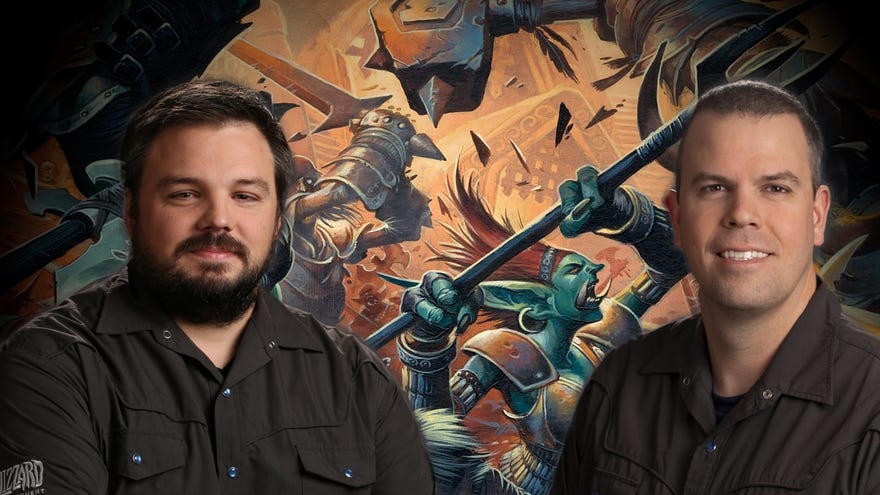
But not today. On Friday night, just after the opening ceremony of Blizzcon, I interviewed Ben Lee and Nathan Lyons-Smith, Hearthstone’s game director and production director, about the game’s future. We talked about the proliferation of ways to play, the mechanics of the upcoming Mercenaries mode, and the curbing of some of the randomness in constructed play. And for once, I was all business.
“We’re aging as a game,” says Ben Lee. “We’ve been out for seven years, and that’s a long time.” His tone is upbeat. But it’s clear, as he trudges towards me across the sun-baked wasteland of Blizzard’s interview arena, that he’s under no illusions about the challenges of maintaining a free-to-play game in the long term.
Lee, formerly game director for CD Projekt Red’sGwent, took the helm at Hearthstone in 2018, while Lyons-Smith, currently approaching me from the opposite direction and wielding a trident, moved across from Battle.net around the same time. During their tenure Hearthstone has seen a pronounced second wind, thanks in large part to the popularity of autobattler game mode, Battlegrounds. But their work is far from done.
“We’re not just competing with other games - even other card games,” Lee continues, his axe-blade scraping grimly through the dust behind him. “We’re competing with Netflix, Amazon Prime, and so much other entertainment that’s competing for people’s time.” As I test the weight of the maul in my right hand, I ask how he plans to stand out amongst all that.
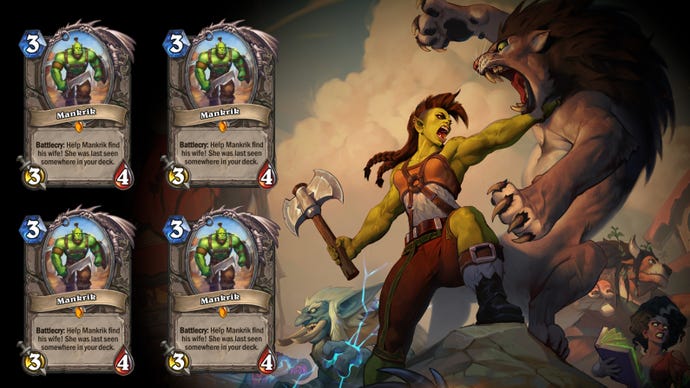
A lady strangling a lion, from the Forged In The Barrens title art. I was going to superimpose some of the new cards on top but I just decided to put Mankrik there four times instead, because c’mon it’s Mankrik.
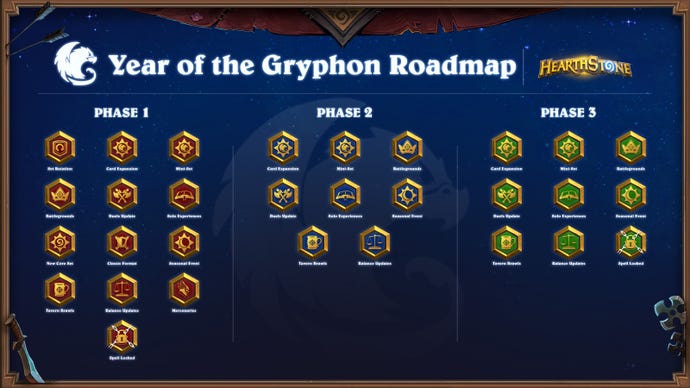
The “roadmap” for the Year Of The Gryphon, which will start at some point in the next couple of months.
Blizzard thinks of Hearthstone less as a card game, he says, but as a platform of card games with shared, central familiarity. “Different types of gameplay,” he summarises, “expressed through Hearthstone’s cards.” As an orc wearing a helmet made from a triceratops skull drags him into the fray, Lyons-Smith explains that maintaining a broad stable of game modes has plenty of advantages besides player retention.
The weekly rotation of temporary game rules in the Tavern Brawl mode, for example, act as a sort of testing ground for potential new material. Often, the Brawls challenge players to create decks from limited sets of cards, and the upcoming “Classic” Hearthstone mode - which restricts players to the use of cards present when the game was launched in 2014 - had its roots in this sort of testing.
“So I’ll finally see boulderfist ogre in play again,” I say wryly, turning back to Lee and nodding at the lumpen figure rearing up behind him. “Hey,” Lee replies grimly, turning to the two-headed colossus, “he’s got a good stat line for his cost.”
“So tell me more about Mercenaries,” I ask him, as the ogre attacks. Announced just an hour prior to our conversation, Mercenaries will be the next big game mode introduced for Hearthstone, coming along with the Forged In The Barrens expansion in the months to come.
Mercenaries!
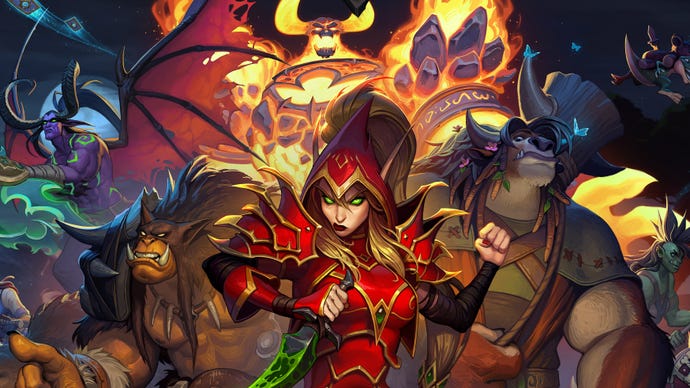
Unlike Dungeon Run, Lee says (after the ogre has fallen to the ground with a leaden thud), the new mode won’t use a co-opted version of the standard ranked play format. It’ll be “a whole different beast”, focused on small teams of characters rather than 30-card-plus decks, and running on new mechanics, comparably different from standard Hearthstone as Battlegrounds is at present.
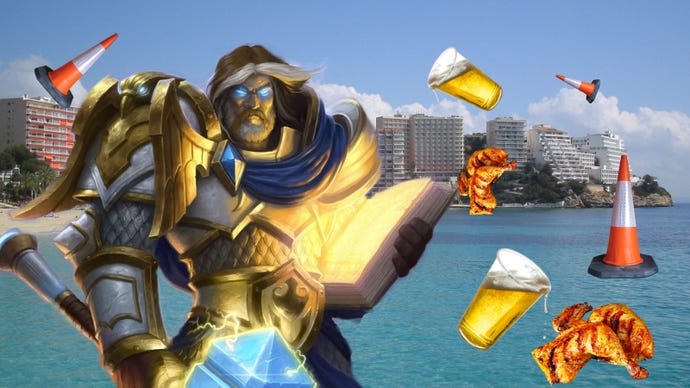
Uther “the lad” Lightbringer, from my favourite Book Of Heroes chapter.
The life of King Krush: a triptych.
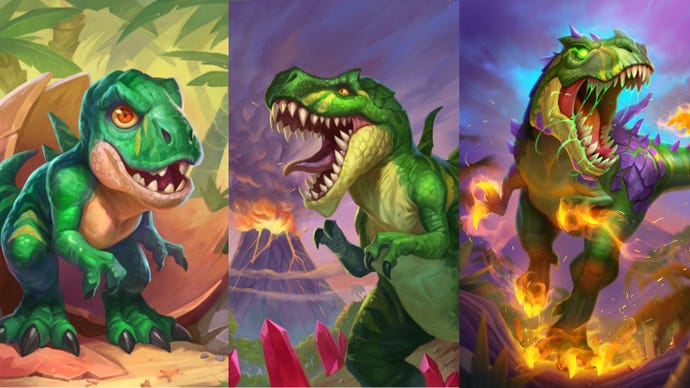
“That’s actually really interesting, Nate,” says Lyons-Smith, staggering past with a goblin a headlock. He looks animated; something about the King Krush idea has grabbed him. “I’m gonna pass that along to the team, in fact,” he says, with some enthusiasm. “One of our designers really wants to tell the story of a murloc,” Lee adds, seeing off the jaws of a hyena with the butt of his axe. “There’s a lot of people out there who really like murlocs, after all.”
Power creep is inevitable in card games with regular expansions, and it’s not entirely a bad thing. But it has become a little oppressive in Hearthstone. After the post-Dungeon-Run era turned things up to 11, 2019’s Descent of Dragons update, whose cards are about to rotate out of the standard format, turned things up to 12 or 13. I ask whether Blizzard will find new notches on the dial this year.
“We’re dialling it back to 10, honestly,” says Lee, while Lyons-Smith quietly strangles an orc. “There are moments where things are a bit too much”. Tighter combos and synergies remain a consistent focus, he says, but it sounds like they’ll be tempered with more consistent, less out-of-control outcomes.
Three of the new dragons in Hearthstone’s core set, each of which replaces one of the cards that have been there since 2014.
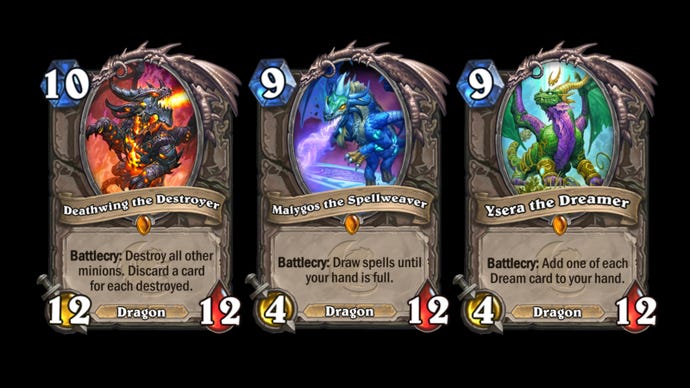
“A lot of what made things feel so powerful over the last couple of years was resource generation,” he says. As a result, both the new cards from Forged In The Barrens, and the core set that will replace the current package of cards the standard format is built on, will focus more on drawing cards than creating them at random. In theory, your power in play will now come more from getting rapid access to what’s already in your deck, than from wild swings of fortune.
“It used to be the case that card draw was off the table for a lot of classes,” he says, referring tothis blog on class identityto distract me, as he hurls a handful of grit into my face. “After a lot of thought, however, that’s something we’ve definitely decided to change. It puts the game back in a more traditional space.”
Struggling to remember why I made this image now, but it’s definitely going in this post.
This idea of greater consistency has fuelled further changes to the standard card set, Lee tells me, as I stumble blindly through the melee. “A lot of the basic and classic sets are either ‘ones’ or ‘tens’ - cards that are either universally, or never, used. We’d rather have everything be a 6 or a 7.” The balancing involved in ensuring this is incredibly hard, he concedes. “But I think we’ve shown we’re committed to changing and updating things quickly, if we do get it wrong.”
As I regain my vision, Lee is preparing for the killing blow. I offer him a nod of respect, before the end comes. But as an unseen assailant lashes out with a morning star, striking a clanging blow across the game director’s bucket helm, he is distracted and I am able to flee.
I’m always wary of buying into hype, of course. But a steadier trickle of new content, less “wooooah, random!?!” moments in constructed play, and a big new single player mode, is pretty much a checklist of the things I want from Hearthstone. Maybe it’s just the blood loss, or the euphoria of surviving mortal combat, but I’m feeling pretty good about where the game’s going.
