HomeFeatures
Game design as conspiracy theory: what Amnesia learns from Umberto Eco"One foot in cabala and the other in the laboratory."
“One foot in cabala and the other in the laboratory.”
Image credit:Frictional
Image credit:Frictional
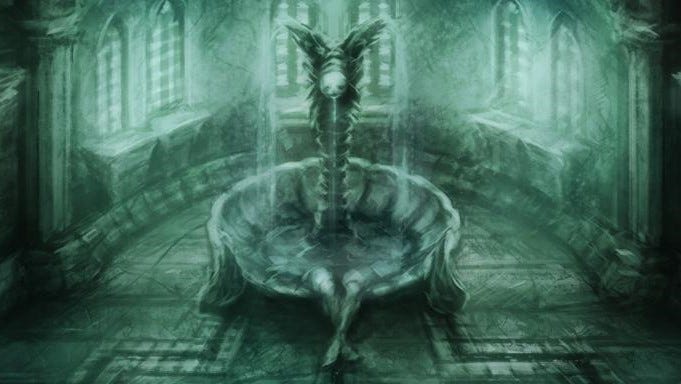
Beware: major spoilers for the entire Amnesia series below.
Amnesia Rebirth Scares In Broad Daylight | My Favourite Thing In… (Amnesia Rebirth Review)Watch on YouTube
Amnesia Rebirth Scares In Broad Daylight | My Favourite Thing In… (Amnesia Rebirth Review)

An in-game map of areas from Alexander’s castle in Amnesia: The Dark Descent. |Image credit:Frictional
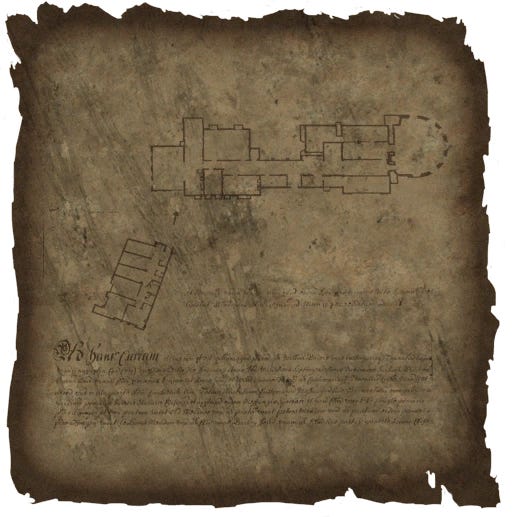
The games are often presented as Lovecraftian fables - the original Dark Descent game engine is named after the notorious cosmic horror author. But in the tentacular nature of their storytelling, they take as much or more influence from Umberto Eco’s novelFoucault’s Pendulum- a satirical “secret history” book about three jaded intellectuals, Casubon, Belpo and Diotallevi, who work at a seedy vanity press in 1970s Italy.
The trio dip into the official record like reckless surgeons, inflaming reports of obscure organisations, joining up people and places and populating spaces of ill-repute. They fill in the gaps around real-life figures, feeding on the strain of mysticism in scientific writing from the Ancient Greeks all the way to quantum physics. Casubon discovers that many canonical authors he had taken for rationalists and scientific positivists also dabbled in the occult. “Men I had studied in school as bearers of mathematical and physical enlightenment now turned up amid the murk of superstition,” he observes. “For I discovered that they had worked with one foot in cabala and the other in the laboratory.”
Concept art for the unfortunate Agrippa in Amnesia: The Dark Descent. |Image credit:Frictional
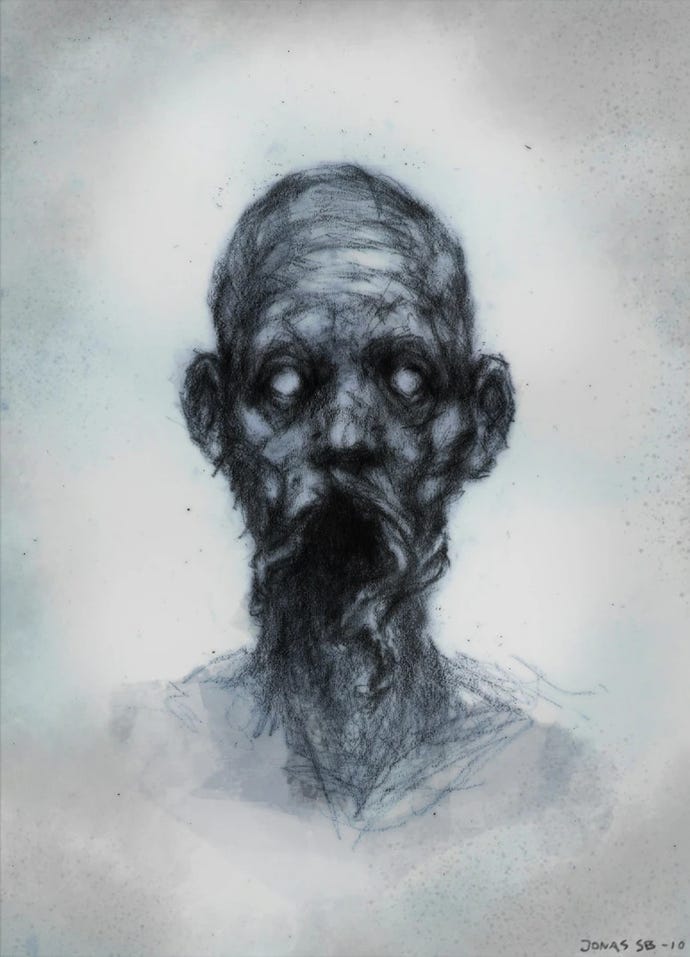
Amnesia takes direct inspiration from all this. As Grip summarises, “it’s the Foucault Pendulum thing where you find some historical figure, find some historical event, and you’re like, ‘Shit, no one really knows about this, so let’s twist it around and do something with it’.” One such historical figure is the 16th century polymath and physician Heinrich Corneilus Agrippa, who lends Foucault’s Pendulum an epigraph that could easily grace the loading screen of an Amnesia game: “Ponder the meaning we have dispersed in various places and gathered again.”
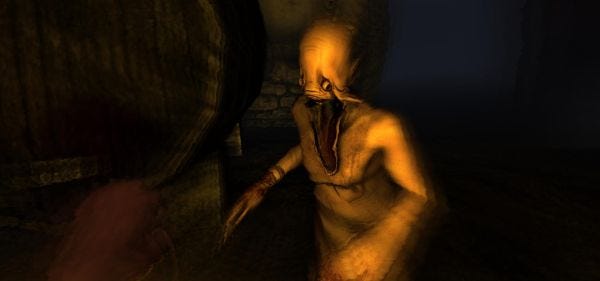
A monster from Amnesia: The Dark Descent, with sanity effects warping the view. |Image credit:Frictional
Tasi exploring an underground space in Amnesia: Rebirth. |Image credit:Frictional
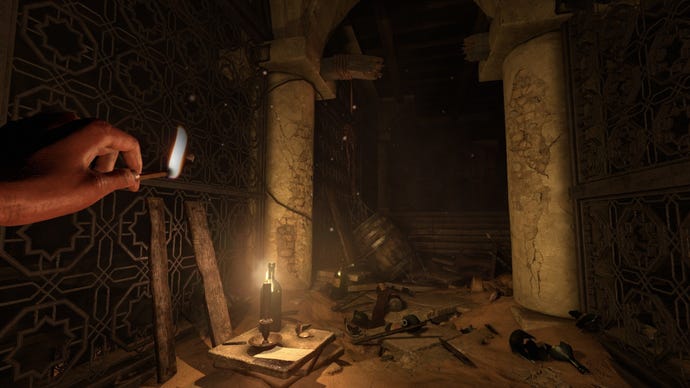
The developers spend a lot of time thinking about how and when to cross that line between period recreation and fable, with Grip conceding that the games are less convincing when they linger too long in the dreamworld. “One moment that I love in particular - I had nothing to do with it, but in A Machine for Pigs, there’s a floor that opens up in a church,” he says. “And that’s a really cool way of doing a historical building that all of a sudden has this dark secret.”
An illustration of the meat factory in Amnesia: A Machine for Pigs. |Image credit:Frictional
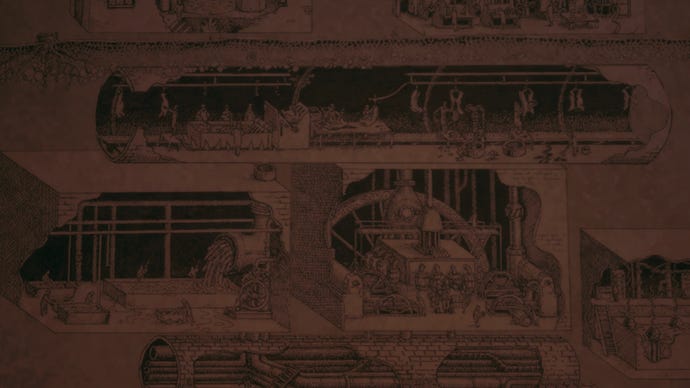
The key difference between Amnesia and Foucault’s Pendulum, of course, is that while the book’s Templar Plan is the result of “[piecing] a lot of surfaces together to create the impression of depth”, as Casubon’s partner Lia puts it, Amnesia’s scattered textsarethe pieces of an otherworldy plot. Each game is the act of rediscovering it; there’s a sense in which Amnesia is a series of remakes, not sequels.
An illustration of the dark world, from Amnesia: Rebirth. |Image credit:Frictional
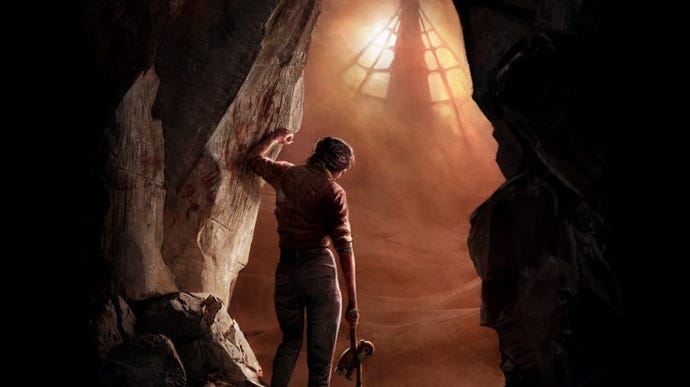
Among the traditions Amnesia draws upon is the cult of Mithras, a Roman god inherited from Zoroastrianism, whose underground temples or “mithraea” are found throughout the former territories of the Roman empire. The mithraea lend themselves nicely to weavers of occult tales in being at once widespread and in many cases, visitable, yet only partly understood and open to interpretation. They occupy a flexible hinterland between empirical reality and make-believe.
