HomeFeaturesChivalry 2
From peasants to kings: The making of Chivalry 2Another stab
Another stab
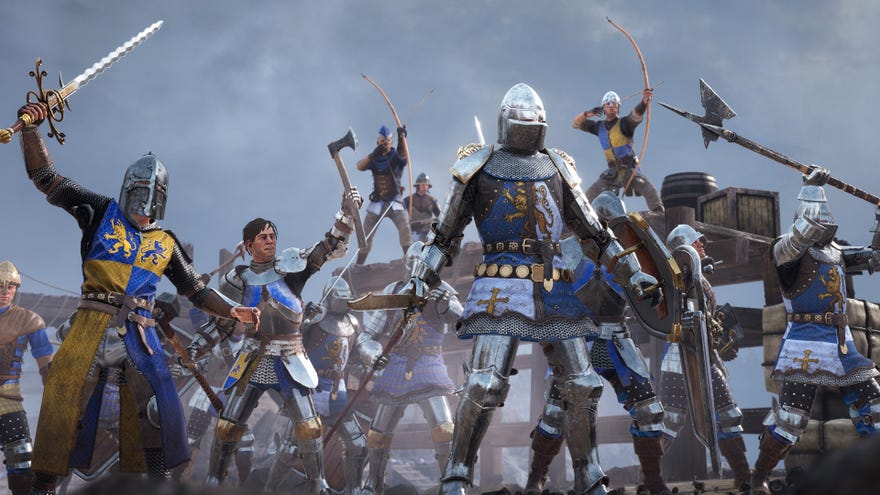
Going into my chat with Steve Piggott and Rasmus Löfström of Torn Banner Studios, I thought I had a reasonable grasp of the developer’s trajectory up to that point. After finding success in 2012 with their breakout hitChivalry: Medieval Warfare, Torn Banner had gone on to compose the difficult second albumMirage: Arcane Warfare– an Arabian Nights-inspired take on Chivalry’s multiplayer melee combat. Mirage had not been as well-received as Chivalry, yet despite this stumbling block, the studio had found its feet again withChivalry 2, a souped-up sequel to their earlier work with more nuanced combat, bigger maps, and support for 64-player battles.
It turns out that, while broadly correct, I wildly underestimated Torn Banner’s reversal of fortunes. In the five years between the launch of Mirage and Chivalry 2’s impending Steam release, Torn Banner has gone from a studio on the brink to being more successful than its leadership ever imagined.
Chivalry 2 - Coming to Steam June 12 | Tenosian Invasion TeaserWatch on YouTube
Chivalry 2 - Coming to Steam June 12 | Tenosian Invasion Teaser
“The scale of the failure with Mirage was total,” says Piggott, who founded Torn Banner in 2010 after working on theHalf-Life 2modAge of Chivalry. “We had to reckon with the fact that things went really wrong. And we had to change the studio. We had to change the way we were doing things to fix it. It was a really clear, fundamental warning sign.”
From the outside, it’s not clear why Mirage went so awry, although there are clues. The setting is less authentic and less immediately engaging than Chivalry’s straightforward medievalism, while the addition of magic into Mirage’s combat sat awkwardly alongside the swordplay. But this doesn’t account for the extensive internal struggles Torn Banner suffered during Mirage’s development.
When Medieval Warfare launched, Torn Banner were essentially still a modding team, with 13 members working remotely. With Mirage, Torn Banner tried to formalise the studio, taking on new hires and moving into an on-site office. But this organisational effort ended up taking precedence over the vision of the game itself. “It turned out that when you don’t know what the vision is, and everyone is on the same page, then it starts to pull in different directions, and then you don’t get a cohesive or product that anyone wanted to make at the beginning,” says Löfström, Torn Banner’s COO.
In addition, Torn Banner took on some ambitious tech challenges for Mirage, switching to the then brand-new Unreal Engine 4, and targeting support for 64-player matches. “How you empower designers versus programmers really changed between Unreal 3 and Unreal 4,” Piggott explains. “And it just became obvious that in certain ways we had gone too far, and in other ways we hadn’t gone far enough, in getting that balance right.” Indeed, Torn Banner’s initial experience with UE4 was so bad that, according to Löfström, “we actually weren’t able to take that much from it” and that development of Chivalry 2 “was almost like starting from scratch.”
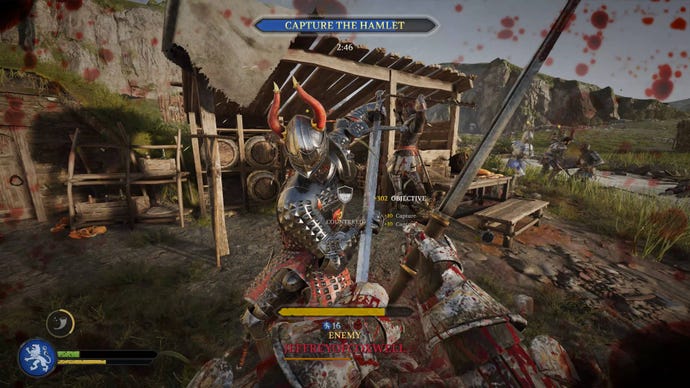
The maps, meanwhile, were very limited in scope. “We actually didn’t have a proper castle in Chiv 1”, Lofstrom says. “It was very much like Source multiplayer levels in scope, and that made the castles not feel like castles.” Hence, one of the key pillars of Chivalry 2 was to get rid of the “corridor shooter” DNA lingering in the first game, to create levels that looked more like battlefields and felt more open and natural, and didn’t make players feel “like a rat in a maze” as Piggott puts it.
The idea of big maps in multiplayer games is nothing new. But Torn Banner faced several unique problems when implementing them into Chivalry 2. First, Torn Banner was a 20 person team building a game for 64 players, meaning it was 44 people short to effectively test the maps they were making. “We started placing, like, just static characters and seeing how [it felt] when you play 64,” Löfström says.
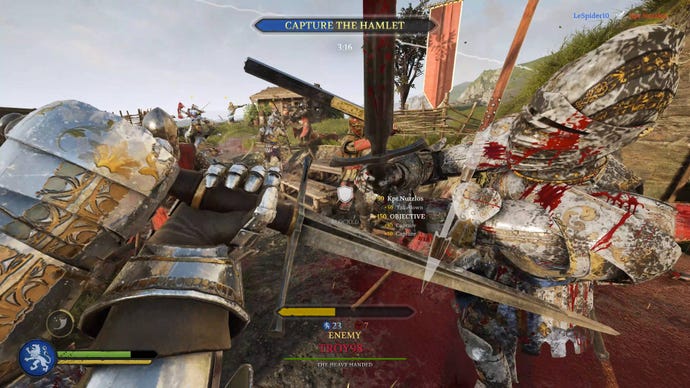
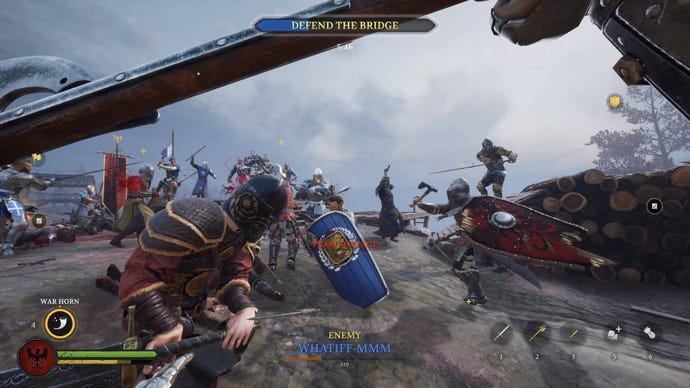
Moreover, most competitive multiplayer games with large maps these days are shooters. Creating a large-scale melee combat game causes its own problems. Players need to be close to one another to actually fight, but if you force players together too much, then fights turn into a shapeless brawl. “In Lionspire Bridge, where we put 64 people in an elevator and then have them smash it out, that’s amazing,” Piggott says. “But you can’t do that for too long, you’ve got to open it up again. So level design is always playing with the squeeze on the players.”
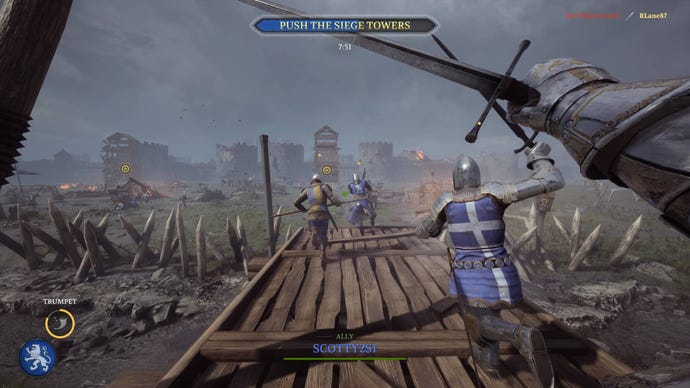
Crucial tomaking Chivalry 2 fun, therefore, was minimising the frustration of death. Torn Banner’s solution was twofold. First, Chivalry 2 makes a small and yet vital adjustment in how players return to the fight. Instead of respawning standing still, players reappear on the battlefield already at full sprint, ready to unleash their powerful charge attack when they enter the fray. This change emerged from the first map the team built, where both armies start the match lined up in formation and then charge toward one another for a huge clash. “We realised [those moments] just won’t happen naturally, and we have to kind of help them happen,” Löfström says. “It became obvious that we can’t always spawn standing still. We’re coming in with our unit, with our squad. We’re running into battle to save our friends… and then that just felt great. And we did it for basically every spawn.”
Unlike Mirage, Torn Banner was confident in its vision for Chivalry 2. Nonetheless, there were still some concerns. The studio was punching far above its weight, and the expectations placed uponmultiplayer gameshave increased enormously since the days of Medieval Warfare. “As a small team, we can’t build that forever game,” Lofstrom says. “So there’s a focus on pure fun and moment to moment gameplay.”
At least, that’s how Torn Banner felt before Chivalry 2 launched last year, whereupon it sold a million copies in its first two months, and that’s as anEpic Games Store exclusive, no less. Fast-forward a year, and Torn Banner’s team of twenty has grown to around seventy, and they’re gearing up for aSteam launchwith an update that will complete their original vision for the game. “We don’t have to be the game called Chivalry that doesn’t have horses,” Piggott says.
Yes, the upcoming Tenossian Invasion update will finally see players able togallop into battle on horseback, crashing through enemy ranks and jousting with other mounted players using lances and other polearms. Horses have always been part of the plan for Chivalry 2, but Torn Banner wanted them to be more than a simple novelty for players.
“We wanted to make the best horses ever,” he says. “Our implementation of the movement system is basically designed to give the player as much control and creativity over the way that you could move a horse, so that you can have engaging fights with other players on horses or on foot.” This includes being able move sideways and change direction without first “accelerating” like a motorcycle, alongside wielding any weapon on horseback as you would fighting on the ground. You can even use Chivalry’s kick ability while on horseback, only it’ll be the horse that does the kicking, able to use both its front and back legs to shunt and damage enemy players.
Image credit:Torn Banner

That phrase “evolving story” is telling about Torn Banner’s intent. While the studio may not have started out building a ‘forever game’, Chivalry 2 might well be turning into one. Certainly, the Tenossian update is far from the final chapter in the game’s story. “It’s probably important to say how much more is coming,” Piggott says. “The Steam launch is the biggest update. But we also have several more updates planned for later this year that we’re not going to get into right now.” Löfström, meanwhile, specifies that there is “more than the amount of content we’ve already released for the game” planned for the future.
And Torn Banner’s ambitions don’t end there. While the focus is on Chivalry 2 for now, Piggott states that the success of the game has “expanded” the studio’s horizons. “We’ve got some of the best people from AAA studios joining us,” he says. “The new update is feeling fresh enough that you can feel it in the way the team interacts, how much fun they’re having. There are lots of good signs right now. It’s looking good.”
