HomeReviewsEvertried
Evertried review: a rough-hewn roguelike that fails to stand outTile and error
Tile and error
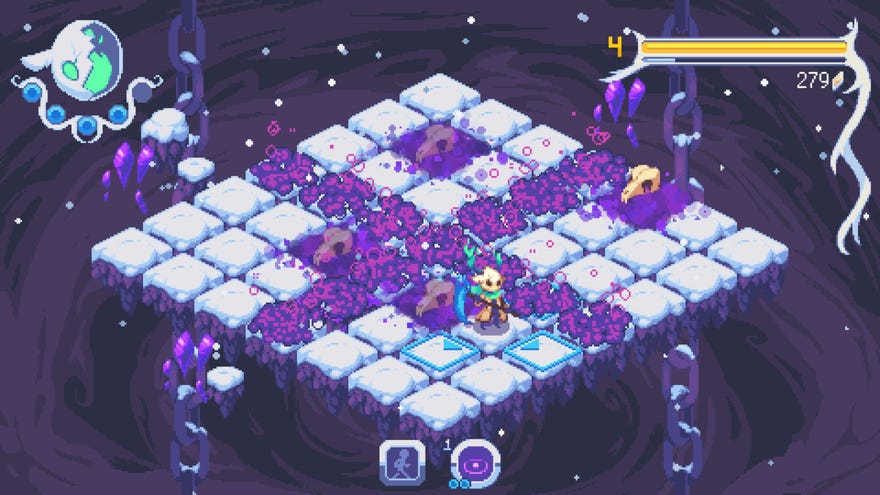
There is no mouse cursor inEvertried. You control everything with the keyboard, from the hops and scythe attacks of your cute otherworldly hero, to the settings in the pause menu. It’s a strange omission but one that is representative of the feeling this roguelike evokes throughout your time climbing its purgatorial tower of baddies. That is to say, a feeling that there’s something important missing. In fact, there seems to be a lot missing from this tile-based timewaster, small touches that could have given its solid foundation the polish it needed to excel.
It’s a pared-back roguelike with a pixel artist’s heart. You are a warrior’s spirit, brought to this tower to climb ever upwards and fight monsters on a big tile board. There’s a bunch of different enemy types, from exploding ghost wolves to gas-spewing slimers, each with particular movement and attack rules. You hop around or dash (moving two spaces instead of one) and kill all to proceed to the next floor. Die, and it’s all the way back to the bottom.
Evertried - Announcement Trailer | Nintendo Switch, PS4, Xbox One, PCWatch on YouTube
Evertried - Announcement Trailer | Nintendo Switch, PS4, Xbox One, PC

You can suffer three hits before you succumb. Which is not a lot once you get into double-digit floors with crowds of enemies, bonkers lasers, and less space to move around. To help, you can buy skills at a mid-climb shop. You can unlock a heavenly sword that drops on creatures two tiles away, a four-way harpoon grenade that drags enemies towards it, a trap that stuns units for a couple of beats. There’s a roulette skill that simply kills an enemy at random. And there are passive skills, like the one that makes your dash leave behind a blot of fire, or another that gives you back a pip of life for every four little brutes you slay.
None of these alone are game-killers. But the way it handles death might be. Croak it and you go back to the start, straightforward enough. Yet while other roguelikes give you some leeway, a little chunk of progress to hang onto, Evertried gives you almost nothing. The only thing saved is whether you have mastered a skill or not. Essentially, the only thing you keep is a minor bonus damage or some inconsequential buff to a skill you might rarely use.
There’s definitely space in this world for the “hard reset roguelike”, but I find staunch dedication to strict restarts should come with a variety that Evertried lacks. If the player must traverse the same starter floors over and over, they should feel noticeably different every time, whether that is encountering different monsters, overcoming fresh obstacles, or gaining unforeseen skills. Here, the floors feel too similar, each journey unidentifiable from the last. The skill pool is shallow, and none feel particularly powerful. The first five floors get especially repetitive, the first boss is a complete non-event once you understand you can dash through his clouds of toxin harmlessly. You will be sick of his skeleton face within ten deaths.
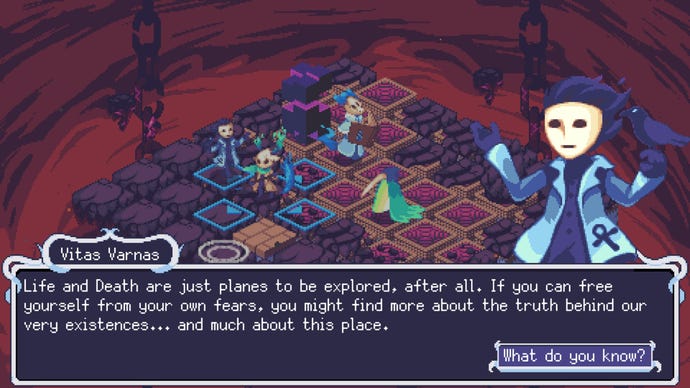
There’s also a problem when it comes to learning what new enemies or skills do. Other similar games might opt for a pop-up that reveals itself any time you hover your mouse over an enemy. Simple diagrams or GIFs showing the movement or attack patterns of the game’s rhino lads or sentient fireballs. Or there might be clear, learnable icons to show attack direction or status. There’s no such quality-of-life touches here. There is a little “Towerpedia” in the pause menu that lists enemies, and an accompanying “help” section. But the written descriptions of enemies aren’t always specific enough to understand their tile-based movements, plus when you have to navigate all this entirely with key presses, it quickly becomes tiresome.
I don’t want to rag on it too much. It’s clear a lot of work went into this. There is vivid pixel art, with lots of melty transitions, heavy on the necromancer purple and done with a lot of love. There are glistening scythes and mysterious characters and everyone wears bone masks reminiscent ofHollow Knight. The chirping music evokes SNES-era bangers, even if it never truly finds a groove of its own. And there remains a compelling spirit to its rhythmic obstacle course of hops, skips and jumps. It is also difficult in a way that many will find inviting, with 99 floors to overcome, interspersed with bosses that demand even more spatial awareness and careful skittering across the tiles.
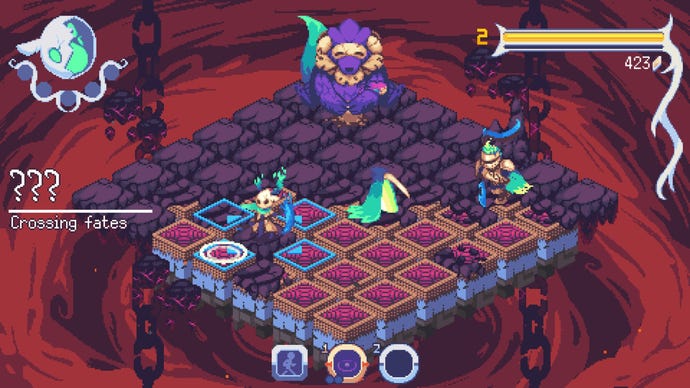
It’s too underdone and roughly composed for me, though. That’s a shame, because it’s easy to see how it could be improved. Highlights around enemies or obstacles could make the board more readable. If the player received a single random skill at the very beginning of a new run, right from the start of the game, it could lessen the tedium of repeating those first few floors. More quirks or improvements carried across runs could speed up each opening. A mouse cursor might also be, you know, handy. It feels like a game that has a good essence, a strong foundation, but hasn’t been tested on many people. Or perhaps the developers simply didn’t have time to iron it all out. At some point you’ve got to accept your roguelike project is done and move on, no matter the omissions.
