HomeReviewsDune: Spice Wars
Dune: Spice Wars review: a compulsive 4X that both nails and wastes its source materialNo long similes about toast this time, promise
No long similes about toast this time, promise
Image credit:Funcom/Shiro Games
Image credit:Funcom/Shiro Games

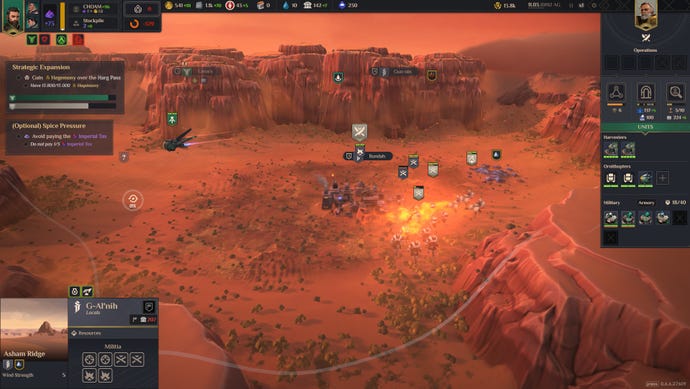
There’s something that feels oddly momentous about sending one ofDune: Spice Wars’ harvesters to get to work worm-dodging while hoovering up MSG (magical space glitter). It was, after all, Dune II’s implementation of these trucks that are largely responsible for the shape of the entire RTS genre. I’ve mused before that if you count Alien as something that wouldn’t exist without Dune, along with the effects the RTS had on esports, it’s wild to consider how different gaming could have been if Frank Herbert hadn’tvisited Florence in 1957to chronicle a natural phenomenon. It’s one heck of a butterfly effect, which is fitting, because Spice Wars itself can often feel like a creative exploration of how integral butterfly effects are to grand strategy rulesets. Forget those harvesters for a moment, because this dry but undeniably captivating 4X is all about the steamroll.
Image credit:Rock Paper Shotgun/Funcom/Shiro Games
There are five short tutorials, but you’ll really learn to play in the early missions of the campaign mode, named Conquest. Here, interconnected scenarios offer fun riffs on the domination/political/hegemony victories in standard matches. You might be sent to assassinate an enemy counciller, which effectively walks you the intel path to a domination victory, but it’ll throw in a couple of Bene Gesserit spies and economy tweaks, so it’s far more alive than a standard tutorial. This also extends to more nuanced tactics, like a bonus objective to stiff the Emporer on three Spice tax payments, offering a great primer on how ignoring this seeming fundamental was actually a valid approach, albeit one with its own risks.
To see this content please enable targeting cookies.Manage cookie settings
To see this content please enable targeting cookies.Manage cookie settings
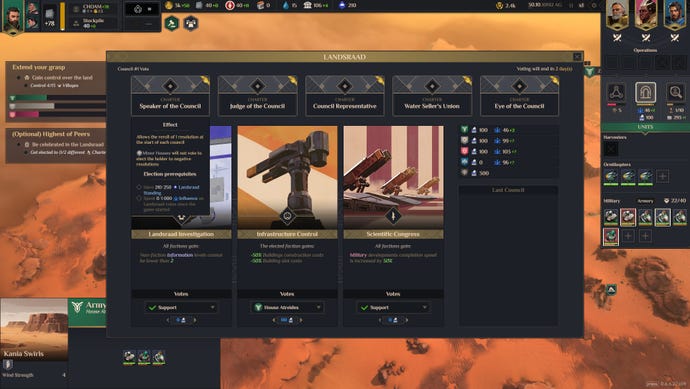
I mentioned all those resources up top, and this isn’t a mindblowing revelation so much as one of those things that’s so obvious I sometimes fail to notice it, but: Spice Wars makes such good use of its real-time action economy that it’s got me thinking about how the secret resource that everystrategy gameuses is actually time. It might be more accurate to say efficiency, but it’s something you generally factor into every other decision involving one of the more tangible resources. Spice Wars, through early access tuning, has evolved into something where - even on the standard speed and difficulty setting - barely a second passes without a new decision to make, action to take, or scheme to set in motion.
Image credit:Rock Paper Shotgun/Funcom/Shiro Games
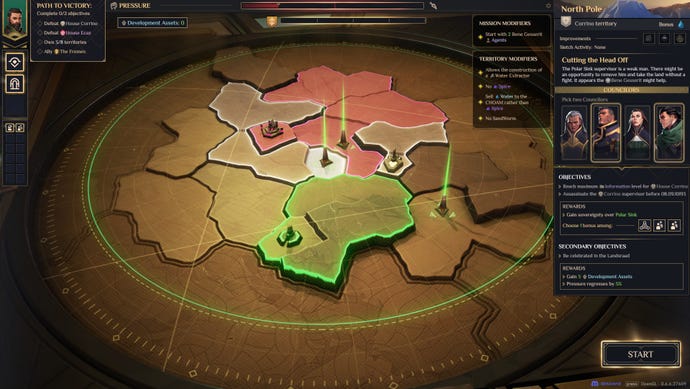
Image credit:Rock Paper Shotgun/Funcom/Shiro Games
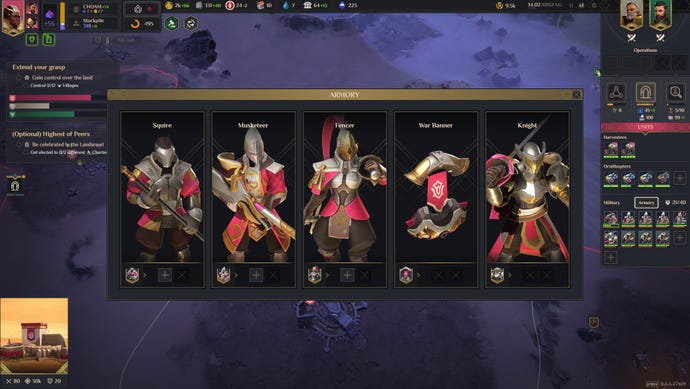
I still don’t love the game as much as I want to, though. I’m happy enough to potter away on it, but I can’t get too excited about it. I’m having a hard time expressing exactly why, except to say that it all feels a bit lizard-brained. Someone smarter than me once described strategy design as either classical or romantic in intent. Chess is both classical and romantic, since the pieces represent regiments or characters; checkers is purely classical, as its pucks exist only as game pieces. As a Dune game, Spice Wars feels like it should have romance in spades. But as involved as I am, I may as well be moving around checkers for how invested I feel on any level other than how engaging it is to tinker with its systems. I’m not sure I have some unifying theory on why this is, but here’s a few elements I reckon might be responsible.
The first is that while a 4X is clearly a great fit for the furniture of Dune’s fiction (like I said in early access, it’s very good at abstracting the details of the fiction into game ideas), I’m less convinced it’s a good fit for that fiction’s soul. Without completely reinventing the wheel, a 4X generally has little choice but to reduce people to numbers, history to a power curve, and culture to a clutch of percentage bonuses. You could stretch this to a Veerhoven-esque critique if you want, but the effect is pretty much the same from moment to moment. You could make the argument that this results in a Dune-flavoured game that ultimately undermines the entire point of the setting, or you could just enjoy it and make “Harvester go brrrr” noises. I’m not your Duke. I tend to oscilate between the two anyway.
Image credit:Rock Paper Shotgun/Funcom/Shiro Games
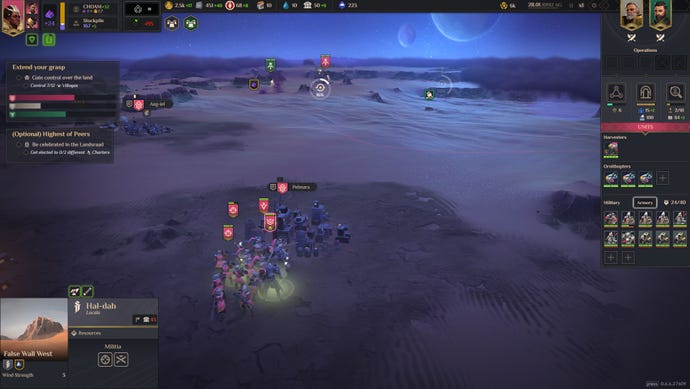
Another issue is the discoveries you make while scouting about with your Ornithopters. You find things like ruins, crashed spaceships, mercenary enclaves and the like. They generally offer you a choice between two options, such as sending agents or the military for different bonuses. There’s some very light storytelling here, notably in the ruins you can either exploit or preserve, but they feel like such a ripe opportunity to go deeper. I know the ‘pop-up with flavour text and a moral choice’ is somewhat ubiquitous, but I genuinely felt the absence of some more colourful storytelling here.
There’s also some slightly odd AI behaviour. You can be in open war with a faction and still happily trade resources, which led to situations like the emperor happily swapping me for the intel resource I needed to fund the upkeep for my assassination operation against his faction. “And you’re sure this isn’t going towards the ‘shank my family’ fund? “Yes mate, promise.” I understand there’s not too many options with the setup necessarily being focused on a single planet, though. And I’m now imagining Todd Howard just discovering Dune this year, rolling about in a bed of shredded paperbacks like a mad hamster screaming “‘One planet!One shitting planet!” over and over until security has to lock him in the stationary cupboard.
