HomeHardwareFeaturesThe Lord of the Rings: Gollum
DLSS 3 is The Lord of the Rings: Gollum’s biggest and perhaps only successMy preciouSS
My preciouSS
Image credit:Daedalic Entertainment / Nacon / Rock Paper Shotgun
Image credit:Daedalic Entertainment / Nacon / Rock Paper Shotgun
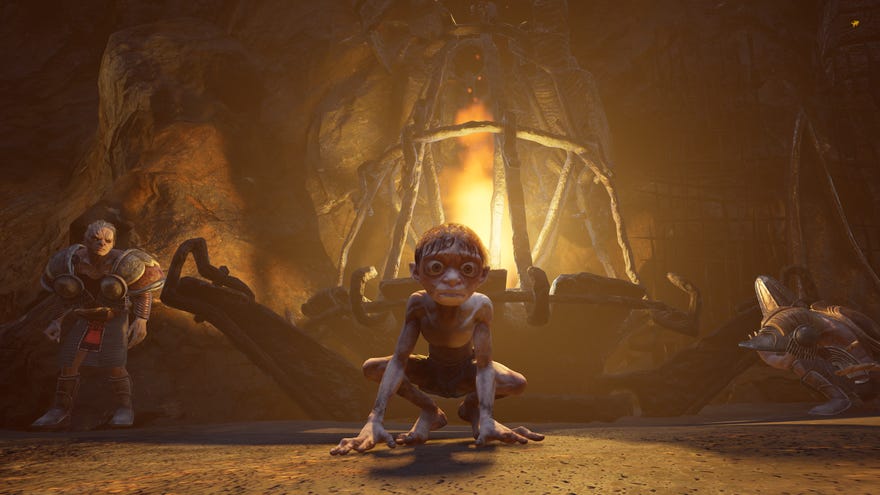
I didn’t get as deep intoThe Lord of the Rings: Gollumas ourreviewistRachel, but I do share her view that it is not A Good Game. In fact, I’ve had about as much fun with it as I would on a spa day in the Barad-dûr sulfur pits. Between the soulless platforming, undercooked stealth, tedious storytelling, and framerate stuttering so bad it’s got me killed twice, Gollum is perilously short on likeable qualities. Especially if you’re not into LOTR lore, orfine hattery.
In my unclad head, then, Gollum’s highlight so far has beenDLSS 3. It’s one of justa few dozen games to supportthe newest, most artificially intelligent version of Nvidia’s deep learning-powered upscaler, and frankly makes a very compelling argument for switching it on.Graphics cardallowing, obviously.
The Lord of the Rings: Gollum™ | 4K RTX On Gameplay RevealWatch on YouTube
The Lord of the Rings: Gollum™ | 4K RTX On Gameplay Reveal
The second is that it only currently works on Nvidia RTX 40 series cards, like the just-released RTX 4060 Ti. I hope it can eventually spread out to at least older GeForce GPUs, because as Gollum shows, frame generation can let you crank up a game’s other quality settings while dealing with the choppiness that this would otherwise impose.
Below are some benchmark results I recorded on anRTX 4070 Ti(with the RPS test rig’s usual Intel Core i5-11600K and 16GB of DDR4 RAM). At 1440p, this card can coax a decent average framerate out of Gollum’s Epic quality settings, complete with maxed-out hair simulation (??!?), and it would appear that adding ray traced reflections wasn’t enough to render it totally unplayable. Still, 69fps to 41fps is a big, easily visible drop, and enabling ray tracing does exacerbate Gollum’s moments of stuttering and slowdown.
Image credit:Rock Paper Shotgun

DLSS 3 is even more effective at 4K. This time, the RTX 4070 Ti simply couldn’t handle ray tracing without upscaling help, but with DLSS in Performance mode it was able to outspeed native non-RT performance. Frame generation then took Gollum up past the 60fps barrier, with Performance-level upscaling averaging the best at 82fps. That’ssix timesthe average FPS of native, ray traced 4K.
Image credit:Rock Paper Shotgun

A more frowny-faced reading of this could be that I’m praising a mechanism for glossing over performance problems that should never have been there in the first place. Which I suppose I am, but then if the workaround is right there in the menu, and it still looks roughly as good as native resolution, and doesn’t even really suffer from the added system latency that frame interpolation causes, then surely there’s nowt wrong with using it.
Image credit:Daedalic Entertainment / Nacon / Rock Paper Shotgun
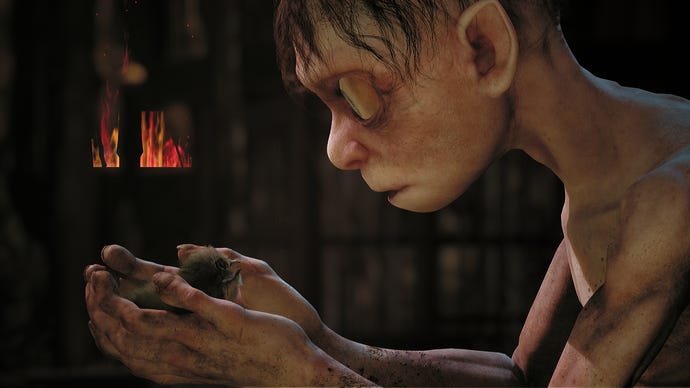
The real problem here is that so few Gollum players will actually be able to; as productive as DLSS 3 is, it’s still limited to a tiny fingerful of graphics cards, and mostly rather expensive ones at that. Cheaper models like theRTX 4060 Tiand the upcomingRTX 4060could therefore be even more significant launches, in the grand old GPU scheme, than previous Nvidia mid-rangers, as they’ll be making this tech a lot more attainable. AMD’s FSR 3 could also make for a useful combination of upscaling and frame interpolation, though we haven’t seen this in action or heard when it’s launching.
