HomeReviewsDistant Worlds 2
Distant Worlds 2 review in progress: two steps forward and one backGalaxy brain
Galaxy brain
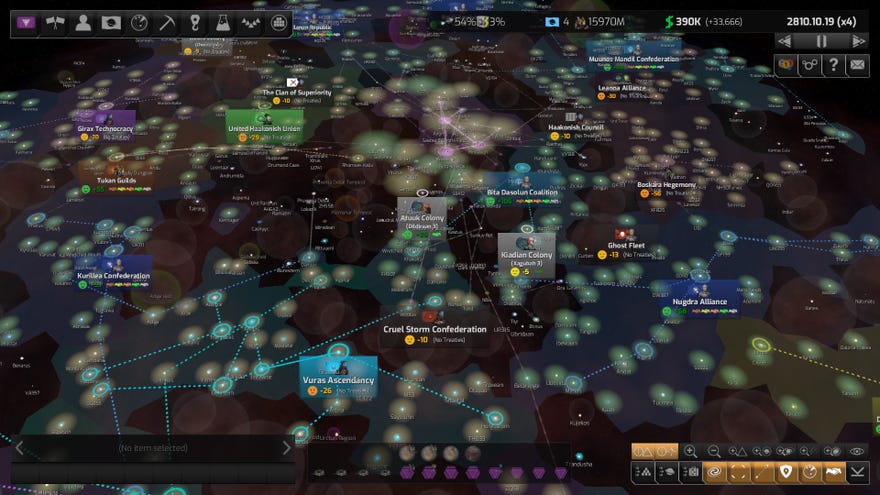
I still don’t know where to start.
Distant Worlds 2is enormous. Even when familiar withthe original, even after ourpreviewlast month, there’s way too much going on to review it comprehensively within a mere few days. But in thespiritof the ancient ones, I can share a review-in-progress of what I’ve seen so far.
Alright, alright. Partly it’s because it’s a long game. But it’s also because Ireallywant to keep playing.
Distant Worlds 2 | Start Up [Gameplay Commentary]Watch on YouTube
Distant Worlds 2 | Start Up [Gameplay Commentary]

That latter point ties into a better and more nuanced degree of control over automation. You could always seize and return control of anything in Distant Worlds at any time, but in its sequel it’s much less likely to cause havoc, and there’s less friction thanks to different tiers of delegation. Construction ships, for example, can now be set to automatically build mining stations only, or to automatically salvage. There’s now a panel to explicitly choose whether a fleet’s AI will take precedence over an individual ship’s, or vice versa, on a per-fleet basis. That lets you, for example, build a defensive fleet that will never retreat, but still create an exception for the very valuable battleship you patched up after finding it abandoned so it will retreat at soon as things look dicey.
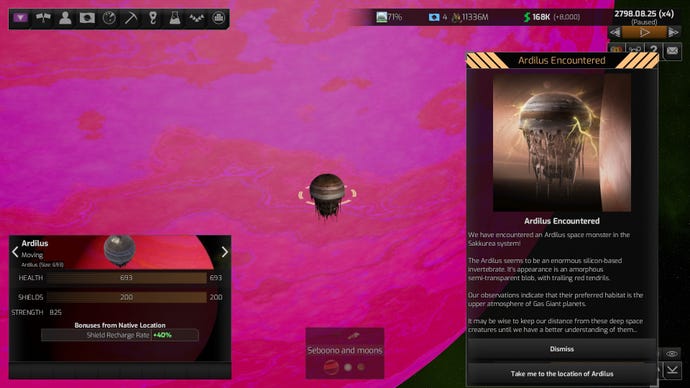
Or perhaps you want your tougher ships to charge at a planet and drop their invading troops in the midst of a battle, while some supplementary ones will hang back and only drop reinforcements when the coast is clear. Set this up right and you don’t even need to manually send them - just have some fleets defined as invasion fleets, then click on the “queue an attack here” button while examining the target, then zoom away across the universe to do something else, confident that your people will take care of it. The ship design interface now distinguishes between automatically updating your blueprints following research milestones, and having the ships automatically refit to those designs on aper designbasis, allowing you to switch any setting back and forth at will in a manner that would take a paragraph to demonstrate.

It’s all very esoteric. Changes not just to the AI but to your influence over it mean that there’s a general, somewhat intangible sense of things just running more smoothly, without the need for the first two hours of the game to involve wrestling with lots of clashing systems hidden away across multiple screens. Planetary management is less prone to haemorrhaging your money. Pirates are no longer absolutely crippling whether you fight or pay them off. Shipyards no longer start building until all resources are present so you don’t get stuck with a logjam during a shortage. Small sounding things that prevent a lot of the obstructive frustrations of DWU, allowing the core ideas to shine.
There’s still abitof that AI friction, though, I have to mention. Fleets can still chafe under their limited ability to understand the contexts you put them in, dashing off to another system to refuel even when you’ve put a fuel tanker right next to them. Attacking ships will sometimes charge into a fight without waiting for the rest of their fleetmates. Newbuilt ships added to a distant fleet don’t seem to physically join that fleet unless prompted.
But some of this is symptomatic of my failure to lean on the automation enough. The clue is in the total lack of control you have over the private economy - you’resupposedto delegate at least a little. Even if you’re like me and want to know exactly what’s going on at all times, you’ll eventually reach a point where you’re making things hard for yourself for no reason. You’re the queen of space making decisions that ripple outwards, not the author choosing every word. Distant Worlds 2 has, so far, made that process go much more smoothly as I’ve learned to trust my invisible lackeys to do their thing.
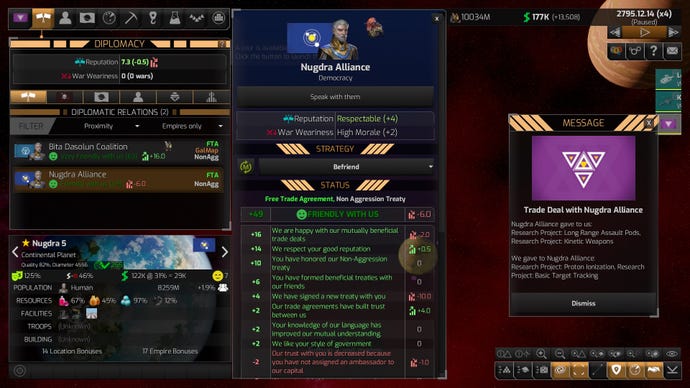
And watching them do their thing is more of a joy than before, thanks to a much more robust engine and modest, but still prettier 3D graphics. While the zoomed out map is still a little on the ugly side, seeing all that activity as your traders move around turns what’s usually a case of pushing numbers up into a simulation of… motion. It’s motion that keeps an empire going, keeps the blood flowing involuntarily through the organism without the brain consciously arranging it. In DW2, you’re the brain, not the whole. When I see that I’ve somehow exported a heap of space wine to an empire literally on the other side of the galaxy, or that my planet full of weird space desert rats has become the top migration destination of two human civilisations, or even just watch the buzz of activity as a hundred freighters warp in to upgrade their engines, I find myself thinking thatof coursesuch a complicated thing has its issues. A little leak here, a troubling lump there. It becomes about nurturing and managing a thing that has life of its own.
There’s still that period of learning how it interprets things, how various systems interact, which is surely inevitable. A great deal of the UI stuff in particular is the kind of patch fodder that makes “day one purchase!!” an innately foolish idea. When DW2 is annoying it’s often in the small details like a specific ship acting weird or a cumbersome process for resolving a situation it would take me a paragraph to describe. But I can’t let it off the hook entirely.

For a sequel to take such huge strides in useability but then flub so many details is aggravating, but at present, the biggest caveat I have when recommending Distant Worlds 2 is simply that I need more time to know what else I can do with it. But I alreadywantto spend that time. When playing a 4X I am usually one of those people who leaves during the second act because I already know how this one ends. Not only do I want to see this one through, but I’m keen to do it all over from the beginning again. I will have more to say when I do, and I have a feeling it’ll be mostly good.
