HomeReviewsCult of the Lamb
Cult Of The Lamb review: an adorably twisted cult management gameBleat-em-up
Bleat-em-up

This, friends, isCult Of The Lamb. And it is excellent.
Cult Of The Lamb Is Properly Grim, But Very Good | My Fav Thing In…. (Cult Of The Lamb Review)Watch on YouTube
Cult Of The Lamb Is Properly Grim, But Very Good | My Fav Thing In…. (Cult Of The Lamb Review)

With Cult Of The Lamb, developers Massive Monster have quickly cemented themselves as absolute masters of presentation and style. From the opening moments I was already marvelling at just how much panache was on display at all times. Trees and tufts of grass sway in the wind. Cultists explode delightfully into chunks of bone as my swordshwingswickedly through the air. The Lamb itself doesn’t just walk forward, it charges single-mindedly towards its target with a sinister glint in its giant ovine eyes. Already, I felt like I was in good hands.
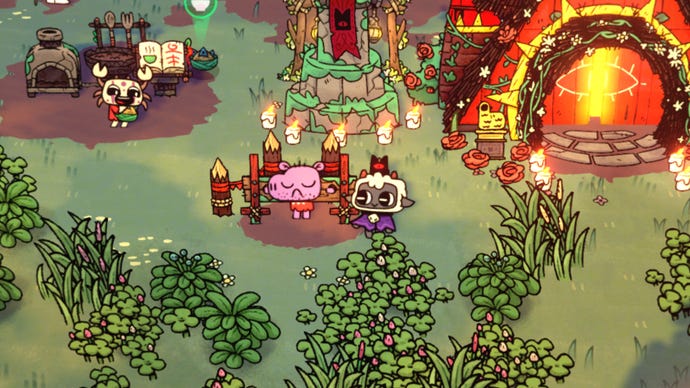
Your home really starts to feel like an idyllic retreat, a safe haven away from all the chaotic fighting and slathering abominations. Of course, you still have to watch your step for all the shit lying around.
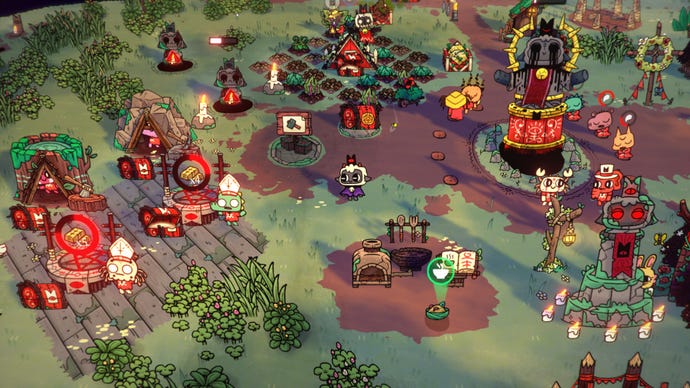
The overarching goal of Cult Of The Lamb is to free The One Who Waits from their prison. To do this, you have to track down and kill the four Bishops, each of which guards one of the chains binding the Big Ol' Patient Boi in his mystical jail. Each Bishop resides in their own domain, and you can unlock the door to each domain once you have enough followers. This means you can start working on the second domain before you’ve completed the first, which gives you a nice bit of freedom to mix up your runs.
The combat in Cult Of The Lamb doesn’t just look great, it feels pretty good too. Don’t let the camera angle mislead you: this is lessBinding of Isaac, moreHadesorDead Cells. Expect lots of dodging through attacks, lots of stunlocking and backstabbing enemies. It lacks a little of the precision and polish of those two titles, but the fact that it is even comparable to two of the best combat systems in the history of roguelites is pretty good going.
You start each run with a primary weapon and a curse, which is essentially some sort of eldritch spell, like calling forth a row of damaging tentacles from the ground in front of you. The weapons aren’t terribly interesting, which is a bit of a shame. As time went on I unlocked more weapon types, but they mostly boiled down to reskins of the basic four - sword, dagger, axe, and hammer - just with extra effects like poison or critical hits. The curses added some more variety though, and kept things interesting.
I found a lot of the game to be easy, but there were certain boss fights that definitely gave me some trouble.
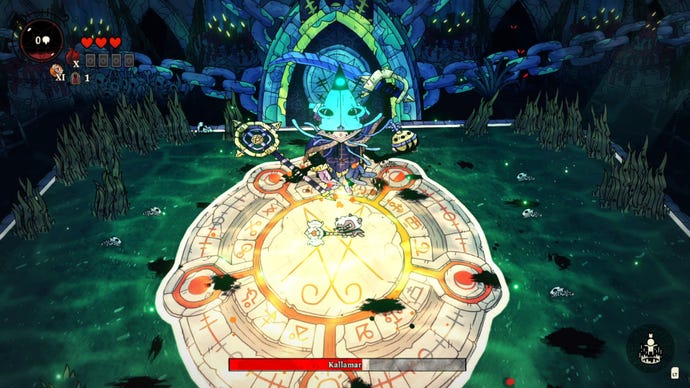
Crusader KingI also found the crusades to be, on the whole, too easy. I quickly set the difficulty up to Hard, and I still only fully died once. Looking back, I wish I’d set the difficulty to Very Hard from the start, and this is what I’d recommend to any player who’s well-versed in the frenetic dodge-attack-dodge-attack combat loop of games like Hades.
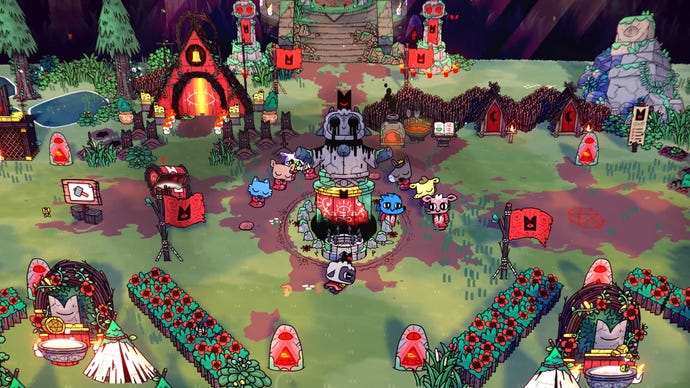
I’m a big fan of the way the game unfolds and expands over time. Each procedurally generated dungeon is broken into different nodes and paths, a laSlay the Spire. Some nodes offer the more traditional rooms upon rooms of fighting, while others offer resources, followers to rescue, or interesting and mysterious characters to talk to and trade with. Complete the same realm’s dungeon run four times, and you can challenge the Bishop in one final boss fight. Once you win, the realm then opens up further, allowing you to embark on endless dungeon runs that only stop when you die or decide to teleport home to your cult.
As time went on, the game also found ways to cleverly tie together the dungeon-crawling parts with the cult management parts. At one point I unlocked a summoning circle building which allowed me to convert one of my followers temporarily into a spiky little demon that could aid me in my next crusade. Another time, I entered one Bishop’s realm, they visited me in all their ghastly towering glory and cast a famine upon my cult back home. Time doesn’t stand still while I’m off adventuring; the cultists have to be able to survive in real time while I fight, or I might come home to find half my followers dead. So that was a proper “oh shit,okay” moment for me. I was on the clock. My followers were counting on me to end the run quick, or they’d starve.
At another point, a lucky shot from an Old Faith cultist managed to strike a would-be killing blow on me. But thanks to a perk I’d selected earlier in the game, I could choose to sacrifice one of my followers back home in order to come back to life. Sorry, Rachel. You died for a noble cause.
Watching two of my followers engage in a ritualistic slap-fight-to-the-death was honestly my favourite moment in the entire game.
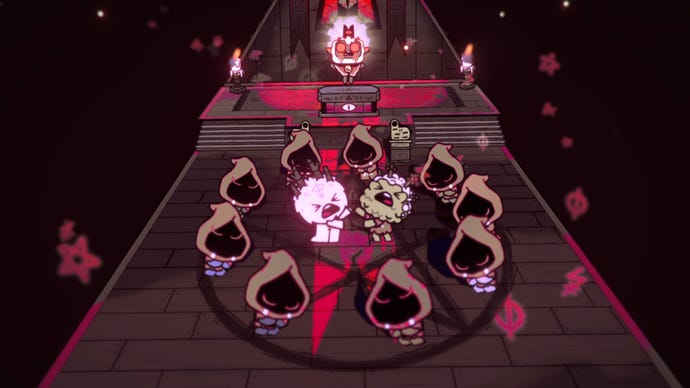
You may recall that earlier on I mentioned ritual combat of the elderly. Yep, that’s a thing in my cult, and I’m quite proud of it actually. Followers age and die in Cult Of The Lamb, and that presents problems such as bodies that need burying before they rot and make everyone sick, and also the sadness of other followers lowering the amount of Faith in the cult as a whole. Faith is very important - just as important as food and health - because if your cult’s Faith runs too low, your followers will start to dissent, spouting falsehoods to other followers. And then eventually they’ll leave you.
There are plenty of ways to keep Faith in your cult high, such as delivering daily sermons, completing quests, embarking on successful crusades, and so on. But you can also unlock and enact rituals as long as you have the resources. Some of these resources lower faith in order to give you benefits; for instance, I can sacrifice a follower in order to become more powerful, but the other followers may frown on that. But then I passed a couple of doctrines that dovetailed perfectly with one another. The first doctrine allowed me to declare combat rituals between two followers, who would promptly fight to the death (unless I choose to let the loser live, which I never did). The second doctrine touted the glory of the afterlife, and actually gave all cultists a boost to their Faith whenever one of their members was sacrificed as part of a ritual.
Thus began the tradition where the old people in my cult would be paired off and forced to fight to the death. Not only would it mean one less body to deal with, but it actually became a source for celebration amongst the village as one of their most venerable members got to “ascend” to the afterlife. Cult Of The Lamb encourages pragmatism at every turn. It probably isn’t the best fit for people who don’t have an evil streak somewhere deep inside them.
Hopefully I’m getting across that those of you expecting a pure roguelite should be prepared for a surprise. I actually think I spent more time outside of dungeon crawls than inside them during my playthrough - and I’m perfectly happy with that. It turns out there’s an awful lot to be getting on with besides fighting. Making sure your followers are clean and well-fed is a full-time job as it is, and besides that there are also various other areas that you can travel to and meet new characters. One area, known as Pilgrim’s Passage, is home to a fisherman who also happens to be a fish themselves. You can come back to this area whenever you like to do a spot of fishing, and bring home your catches to create more pleasing meals for your followers than the usual grass soups and spider-meat stews they’re used to having.
In Knucklebones you have to place dice down in different columns to increase your score. Place multiple of the same die in one column to multiply their value, or place down a die opposite an opponent die of the same type to remove it from the game.
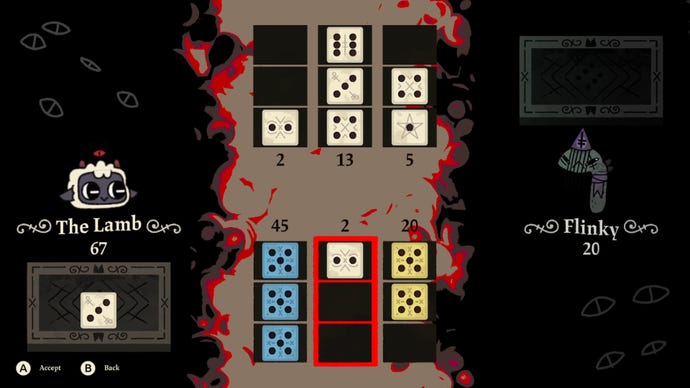
Another minigame can be played in the Lonely Shack, an area to the northwest of your cult. There you can challenge various NPC characters to a game of Knucklebones - a surprisingly engaging little dice game that favours both luck and skill. It’s extremely simple, and it wouldn’t keep me occupied for very long as a standalone game, but as a minigame it’s actually quite layered and interesting, particularly when the opponents get cleverer over the course of your playthrough.
The production quality of this game is just off the charts. Even something as menial as blessing a follower or pressing a button to declare a new doctrine feels like a MOMENT thanks to all the effects and pomp and character. As you hold down the button, the screen starts to shake, a crescendo builds, and a bell tolls at the moment of completion. It might be enough to annoy some people who just want the button to be pressed and the MOMENT to be over with already, but it’s done with so much style that I lapped it up. Little details like this really elevated the whole experience. It made me feel excited whenever anything happened, no matter how small. There aren’t many games out there that make me look forward to delivering a sermon.
Hayden missed the last sermon. He’s locked in the stocks as punishment for dissenting and spouting falsehoods about my rule. Later, he will be murdered in the night and his flesh used to feed and strengthen his former fellows - not that they’ll know anything about that. That, my friends, is the kind of evil streak you’ll need to get the most out of Cult Of The Lamb.