HomeFeaturesDistant Worlds 2
Code Force played Distant Worlds 2 for us, and the signal is strongThis is “Distant Worlds rebuilt from the ground up,” says co-designer Erik Rutins
This is “Distant Worlds rebuilt from the ground up,” says co-designer Erik Rutins
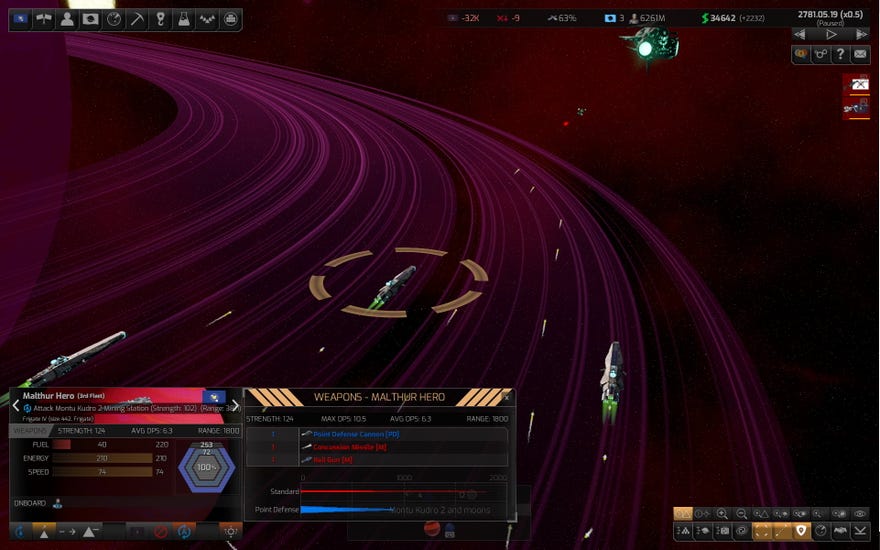
Strategy games set in space are almost innately ambitious. The very concept of doing anything meaningful in an infinite void, let alone making it playable and entertaining, is a challenging one, and for every game that reaches for the stars there are countless kinds of… spiraling chaos orbitals.
Between its design flaws and unique ideas with semi-brilliant execution, the 2010 4X/wargame/economic/management simulationDistant Worlds: Universehas straddled those two experiences for a decade. It’s needed a sequel for a long time.Distant Worlds 2is that sequel, and it’s almost upon us. Last week I attended a live demo and Q&A session with its producer and co-designer Erik Rutins. With only a hands-off demo to go on I obviously can’t say for sure how it plays yet, but it’s already looking very promising.
Distant Worlds 2 | Start Up [Gameplay Commentary]Watch on YouTube
Distant Worlds 2 | Start Up [Gameplay Commentary]

This isn’t just window dressing either. Rutins tells us immediately that “this is a 64-bit, multi-threaded 3D engine. It’s a whole new code base… basically Distant Worlds rebuilt from the ground up.” Players of the original will be relieved to hear that Distant Worlds 2 is based on “a newer engine that allows us to do bigger galaxies and 3D graphics, and not be constrained as much performance-wise. The old engine was beyond creaking at the seams.”
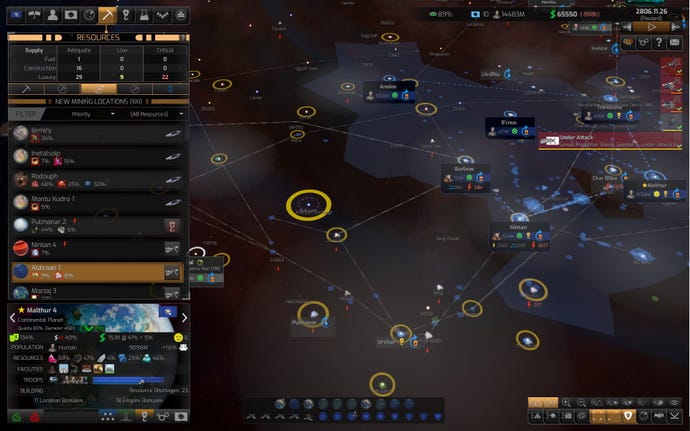
Given that Distant Worlds already boasted tens of thousands of planets per game, that’s a lot to manage, bringing us to the second area that badly needed improvements: the automation. Delegating tasks to the AI remains fundamental to the design, and Rutins stresses the importance of supporting a wide range of playstyles. Players uninterested in any aspect of running an empire can hand it to the AI, even so far as controlling only a single ship for themselves.
In between full automation and maximum micromanagement mode, many departments of your empire can be entrusted to advisors whose authority level is up to you - you might have them form the plans for your approval, or let them do what they want but occasionally send notice of decisions should you want to veto them. Each department can be further finetuned through ‘policy settings’ from within the same menu, essentially leaving specific standing orders for AI behaviour. Personally, getting the right degree of control without either constant messages or no idea what my ships were doing was always the first big hurdle with starting a DWU game. I’m hoping this approach will remedy those early stumbling blocks.
This attitude extends to diplomacy, too. Code Force’s new policy layer only lets you make the big diplomatic decisions, and then gives your advisors broad instructions and “control at a somewhat higher level what your strategy will be”. Here, he shows us that his diplomats are instructed to ‘undermine’ a neighbouring faction without him having to think up passive aggressive remarks himself. The list of playable factions has been cut from 20 to seven “because each faction frankly is a huge amount more work than it was in Distant Worlds”. It’s a small disappointment, but should still allow wide range of playstyles, and the remaining species will be available as independents who provide bonuses if conquered or peacefully assimilated.
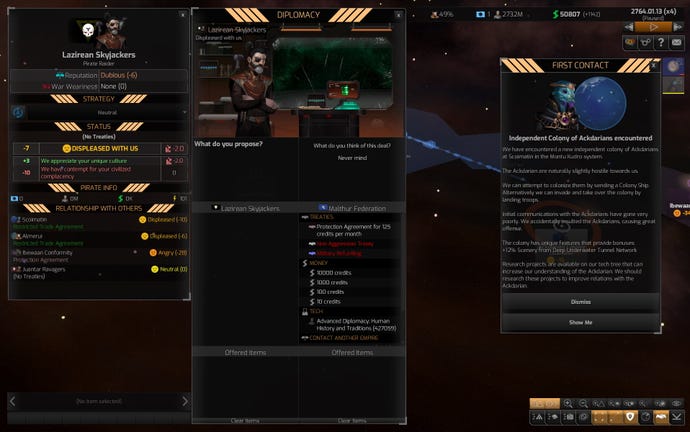
From the sound of it, those factions are closer toAlpha Centaurithan Stellaris, setting a loose archetype that you can bend, but not fundamentally change beyond a different government type. There are more factors affecting foreign relations, and new treaty types, the most interesting being multiple trade agreements. Initially, empires won’t trade with you at all, but may sign a series of treaties to share increasingly favourable economic terms. When I ask, Rutins indicates that although it would depend on circumstance and good relations and treaties, it should be possible to trade extensively rather than mine everything yourself.
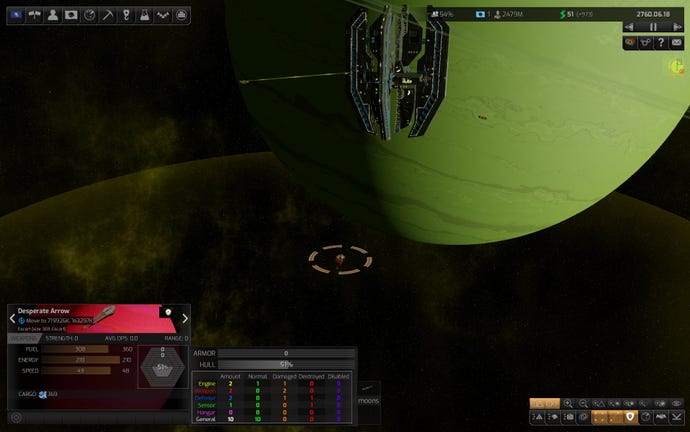
He continues: “We have the main story, which is equivalent to the first, and a story for each faction. You really only get all the pieces of the entire narrative if you play through each faction.” Less completionist players might still piece together what they miss with one faction though, as “we try to put everything in the galaxy at the beginning, and make you have to find it. But the order that you find it, and what happens, is up to you.” This is true of the main and faction stories; any faction can find parts of any other’s story, but may be less able to understand their significance.
Much of the new design is about refinement and better integration, like the new ability to set immigration policy on a per-planet basis rather than just empire-wide, and the same is true for resource storage policies. Civilian transports will manage deliveries and stock levels as before, but you can alter their priorities to stockpile or clear out any given resource from any planet or station. Also like DWU, everything in your economy is physically present on the map, with every ship made from materials mined and shipped from place to place.
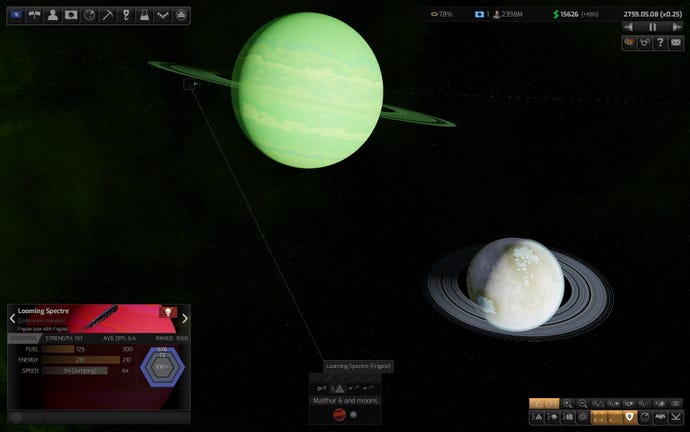
Building, colonisation, and fleet building and formation all have one-click purchase orders added in easily-accessed places, and your full build order can be viewed at a glance and rejigged with minimal fuss. Exploration ships have new, more nuanced AI settings to differentiate between basic exploration, prospecting, and spying. Even civilian transports show up on one menu tab, complete with their cargo or passenger manifest and a wee line on the map showing their flight plan.
One of many details that experienced players will recognise as a potentially huge problem solver is the replacement of fiddly and unreliable supply ships with fuel tankers. These too can be supervised and manipulated from an accessible list, but more crucially will now seek out and deliver fuel directly to fleets, keeping them from abandoning their posts to fly back to a fuel source. At one point, Rutins even says my holy word: “salvage”. In addition to the old system of recovering derelicts, destroyed ships can now leave behind debris, from which you can salvage resources, money, or scraps of knowledge.
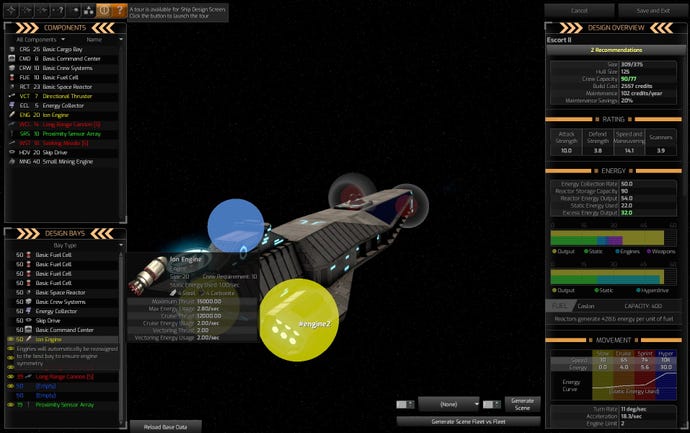
Sensor stations will help with this, as should the new “dangerous locations” menu, which records threats like space monsters and pirates, plus when you last scouted the area. This should hopefully keep scouts and builders out of trouble, and give you a better picture of how the galaxy is shaping up at a glance. There’s plenty of war to be mongered too, of course. As of last week, Code Force have another layer of detail to add to fleet automation, but in keeping with the other departments, the gist appears to be that there are more AI routines for different types of attack, and they intend to add levels of delegated management between full control and full auto as they have elsewhere.
DWU’s three research trees are now merged into one (you can still spread research over three items at a time if you prefer), but you’re now blind to undiscovered technologies. There’s a lot more than what the player sees, Rutins says, so how the research tree connects each time can be different. It’s not the classic 4X one school research system either; I sneakily counted ten sub-fields on screen like shields, engine, and industrial research. Each research facility apparently specialises somewhat, as do recruited scientists. We didn’t get time to get into the character system, but I caught a glimpse of a scientist adding to a research rate, and an ambassador directly improving a diplomatic relationship.
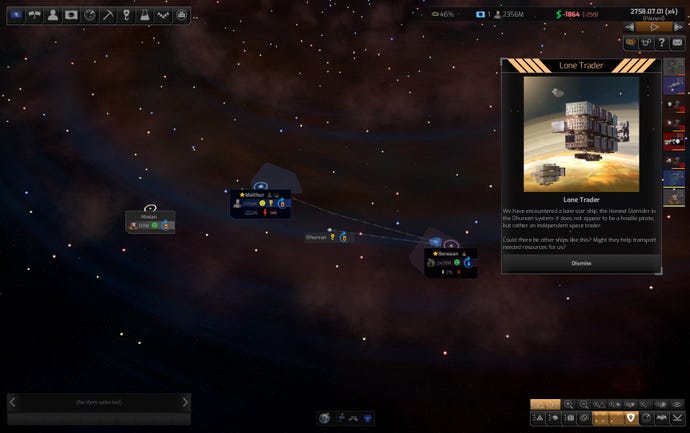
More information rapidly becomes an ever-increasing list of small details. I get a strong impression that Rutins (and co-designer and developer Elliot Gibbs, who wasn’t present but their work certainly was) has attacked a great many of the little problems Distant Worlds had, and tied the solutions all together with the kind of thankless interface and data management structures that can dramatically multiply their effect. Of course, I can’t tell for sure how successful they’ve been without playing, but when I compare how smooth it’s looking with how clumsy and laborious an equivalent demo of the original would have been, I’m finding it hard to be cynical.
Distant Worlds 2 is currently due out on March 10th. We’ll havemore impressions and thoughtsas soon as we can get anything more substantial.
