HomeReviewsCobalt Core
Cobalt Core review: rootin' tootin' timeloop space shootin’Once more Into The Breach
Once more Into The Breach
Image credit:Rock Paper Shotgun/Brace Yourself Games
Image credit:Rock Paper Shotgun/Brace Yourself Games
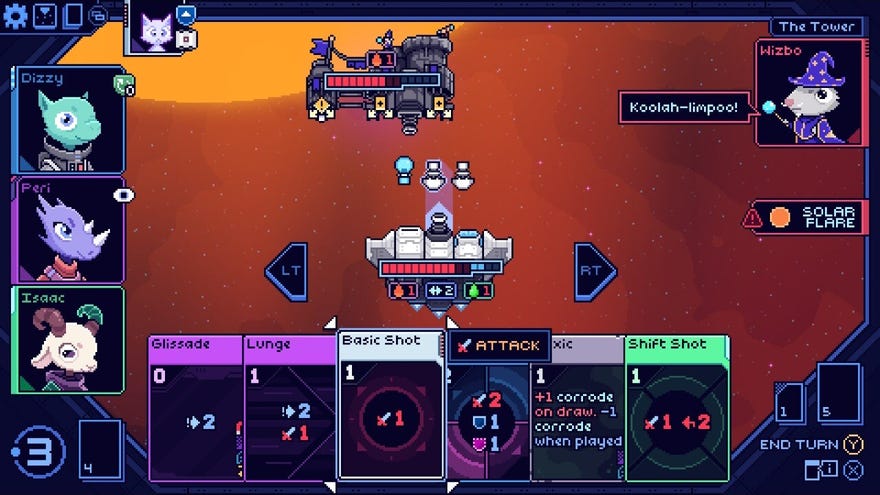
If there’s one genre I’ve never quite had the reflexes or spatial awareness for, it’s the bullet hell shooter. I’ve long admired their intricate dances of orbs and criss-crossing laser fire, but I have long resigned myself to merely being a spectator of such games, rather than an active ship pilot.Cobalt Core, however, is exactly my kind of speed. It’s not a bullet hell shooter, but it is about two spaceships facing off against each other in an eyes-locked duel of incoming cannon fire, and sliding side to side to avoid getting exploded as you attempt to unravel the mysterious timeloop your crew of weird space animals appear to be stuck in. Just, you know, in a neat, turn-based fashion, where your opponent’s attacks are flagged up in advance, and you must use your randomised deck of cards to weave and dodge your way to victory. It’s very moreish, and veryInto The Breach. I love it.
I wasn’t kidding about these excellent opponents. |Image credit:Rock Paper Shotgun/Brace Yourself Games
It’s all very charming, and it’s these kinds of details that make Cobalt Core feel fresh and exciting every time you start a new run, and more so, I’d argue, than the usual kind of randomisation you’d get from it simply being a roguelike. Like Slay The Spire, there are many paths you can take across its web of interlocking enemy encounters, and each solar system will give you a good half dozen fights to enjoy between its small serving of repair stations, special artifact drops and unknowable ‘mystery’ events. The latter can sometimes land you a new card or artifact to bring yet more effects and buffs into play, but you can also run into black holes, say, where you must jettison one of three cards in order to move on. They’re a gamble, but as the game itself tells you when you run into one, at least it will be “interesting” either way.
A complete run often took me in the region of an hour and 40 minutes, making it feel sizable without turning into a marathon. Before you head out to solve the mystery of your timelooping predicament - which is seemingly related to theCobaltentity that gives the game its name - you must pick a crew of three, all of which have their own types of deck and accompanying strategies. The dragon-like Dizzy, for example, is your wide-eyed science officer, specialising in shielding and shield manipulation. Goat engineer Isaac, meanwhile, is all about using the middle row of the battlefield to launch drones and missiles. And if dino weapons officer Perry isn’t spicy enough for you, then the hot-headed merc Drake can juice your arsenal further at the cost of overheating, for example. If you like darting about the battlefield, however, then the mousy Riggs will be a must-have pick instead, and it’s finding the synergies between these different playstyles that pumps up the drama and tension in every encounter - especially when your hand of cards each round is mostly random.
There are plenty of options to pick as you travel through each solar system. |Image credit:Rock Paper Shotgun/Brace Yourself Games
All hands on DeckCobalt Core doesn’t have an official Steam Deck rating (yet), but as you might expect, it does play wonderfully on it. The interface is just as legible as it on a larger desktop screen, and it’s just as easy to thumb over all the icons on its interface to remind yourself of what they mean. The explainer text from some of the cards can occasionally obscure what’s happening on the battlefield, but this is sometimes also true on desktop, too.Image credit:Rock Paper Shotgun/Brace Yourself Games
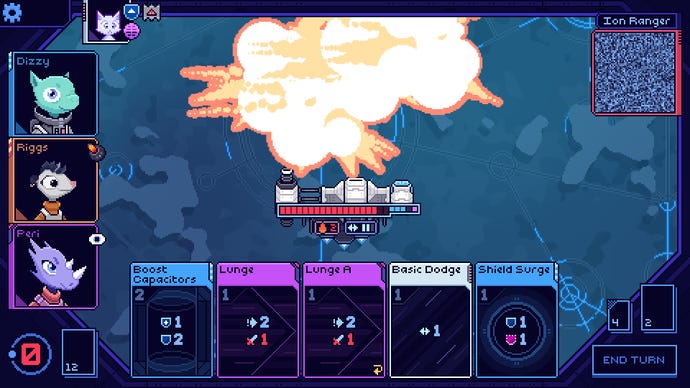
Sure, you can peek at your draw pile at any time to see what’s left before your discard pile gets shuffled back in once it’s exhausted, but you never know what you’re going to get at the start of every turn, which is exactly what I loved about Marvel’s Midnight Suns last year. The trick here, though, isn’t eking out your turn for as long as possible, as the energy you can expend on activating your cards is firmly fixed to three (though additional artifacts you might find can extend this to four if you’re lucky). Rather, Cobalt Core trades in the thrill of simply making it through to fight another day.
Image credit:Rock Paper Shotgun/Brace Yourself Games
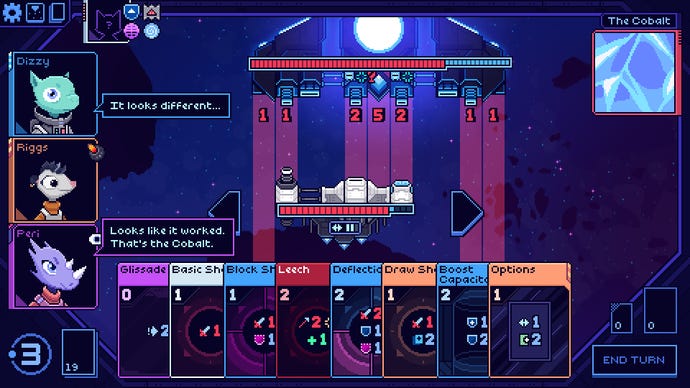
Like Into The Breach, you always know in advance what the enemy is going to do next, and how much damage they’ll pump out from each of its cannons (and even if you’ve forgotten what a particular icon means, you can mouse over it for a reminder so you’re never in the dark). |Image credit:Rock Paper Shotgun/Brace Yourself Games
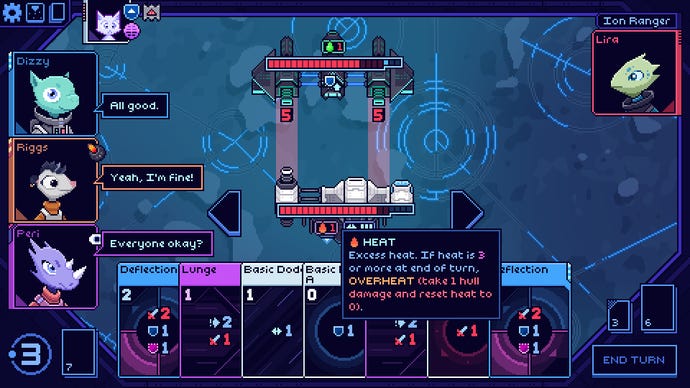
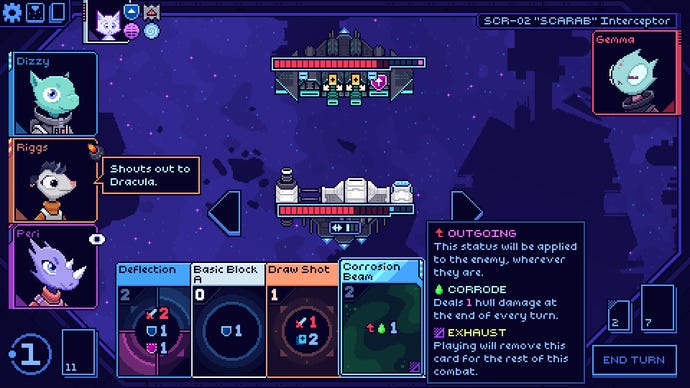
The only point where Cobalt Core lets itself down slightly is its end of solar system bosses. So far, these have been the same every time, meaning the same ships, the same kind of tactics, and the same multi-cannon onslaught to dance around as you fight for survival. It makes the final crescendo of each system fall just a bit flat for me, especially after such varied fights leading up to it. Facing off against The Cobalt right at the end obviously makes a lot of sense, and the game does a good job of making it feel like you’re constantly chipping away at what’s causing this strange timeloop with every successful run. Ultimately, you’re working toward unlocking the amnesia-clouded memories for your individual crew mates, and the gradual peeling back of its story does provide a compelling hook to reel you back in for more. At the same time, though, the repetition of its three core bosses falls into that dreaded trap of ‘Man, not this guy again’, which is a bit of a shame. I want to fight a boss that’s an even deadlier giant crab/nautilus/armoured rat, goddamnit, is that too much to ask? (I jest, of course, a little, maybe, not very much).
More seriously, though, if the bosses did switch it up a bit more, Cobalt Core would easily be right up there with Into The Breach and Midnight Suns for me. As it stands, though, it’s just one rung down, still exceedingly moreish and brilliant in its own right, but not quite reaching my personal god tier ranking of roguelikestrategy games. Perhaps that’s being overly finickity, but let’s put it this way: in such a crowded and accomplished genre, getting within spitting distance of these all-time heavyweights is still mighty impressive in my books, and I will absolutely be playing more of it in the months to come.
