HomeReviewsBlack Book
Black Book review: plays its Russian folklore cards rightBetter than a game of Durak
Better than a game of Durak

Each seal is accompanied with a kind of riddle, which sets up the “monster of the week” sort of structure that holds the game together. One seal is to do with water, so Vasilisa needs a powerful water demon to break it, and so on. It’s part adventure, part card-battler, and despite its clear cut framing device, Black Book plays around within each chunk. It even puts away its card battles entirely at one point to play detective: who’s the leshy disguised among the villagers? It’s a fun interlude, and stops the main loop from feeling too repetitive.
Black Book - Release Day TrailerWatch on YouTube
Black Book - Release Day Trailer
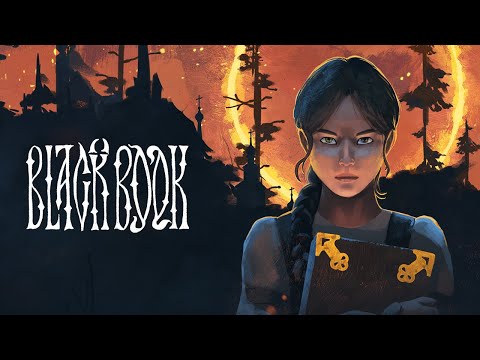
Each of the sections has a self-contained story, but as both Vasilisa and her book become more powerful, it becomes clear that others are interested in the artifact she wields, or the wish gated behind its final seal. Many people aren’t who they seem to be — including your cat — and it’s apparent that Vasilisa isn’t the only person willing to make terrible bargains to get what they want. It isn’t all grim, though. Even if it, too, isn’t quite what it seems, youdoget to arrange a wedding.
As Vasilisa, you start off each day in the izba you share with your grandfather, Old Egor, where you talk to him (and any companions you may have picked up), maybe play some card games, and organise your chorts. These are the little devils that accompany every koldun. You can choose to send them out on sinful errands, or leave them idle - but then they’ll end up torturing you instead, inflicting debuffs in combat.
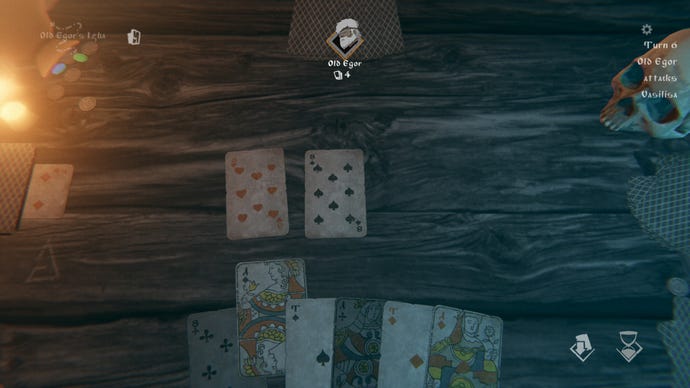
Playing cards with Old Egor.
The visible sin counter was enough to dissuade me from ever truly using my chorts on others, instead choosing upgrades that allowed me to distract some of them. Sins are significant, affecting dialogue choices and potential endings, but having a Bad Deeds counter is an overly-effective deterrent. Without it, I still probably wouldn’t have stolen or murdered… but I might have been a little more spiteful, and I’m curious what those consequences would have looked like.
Black Book is primarily a deckbuilder, with a few neat flourishes. Your cards are split into “orders” and “keys”, with a key being needed to seal the zagavor (spell) you’re casting on each turn. Each card represents one part of a ritual text, replete with swooshy sigils. You assemble your whole zagavor before playing it, so you can re-arrange your cards for maximum impact — making sure any buffs go at the start, for instance. Your offensive cards are all black, and your defensive cards are all white, which is a nice touch to separate them at a glance.
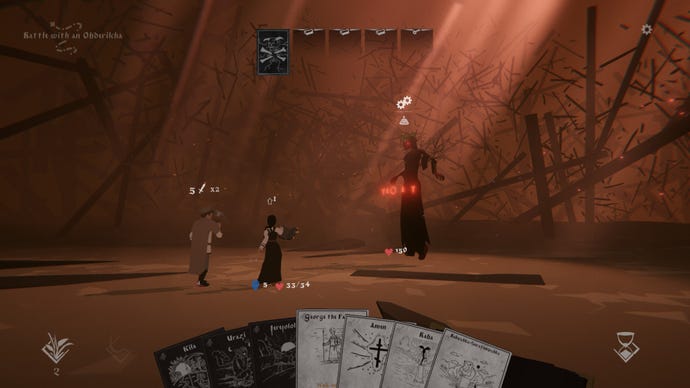
Because of the way you assemble each turn, you can build up interesting individual synergies. There are card verbs in the mix like “well-versed”, which will scale the power of any individual card depending on how many other cards are the same colour. Then you have “firm” cards, which stay in your zagavor for an additional number of turns without taking up a space. You can rack up silly amounts of damage scaling even with your starting set of cards. Unlocking seals reveals more complex verbs and card types.
After you’ve found your bearings, the game introduces battle puzzles. These have a fixed deck, and are set to end in a limited number of turns. The idea is that you need to find the optimal way of winning the battle, so that it ends in less than e.g. three turns. The deck it assembles also typically involves cards you haven’t unlocked yet, giving you a sneak peek of what’s to come. Despite the intrigue these set up, having only one correct answer while introducing new verbs on both sides of the battlefield felt like being asked to brute force a combination lock. Thankfully, there are only two or three battle puzzles per chapter, so once I’d given them an honest effort I was quite happy to hit the skip battle option and get back to the good parts.
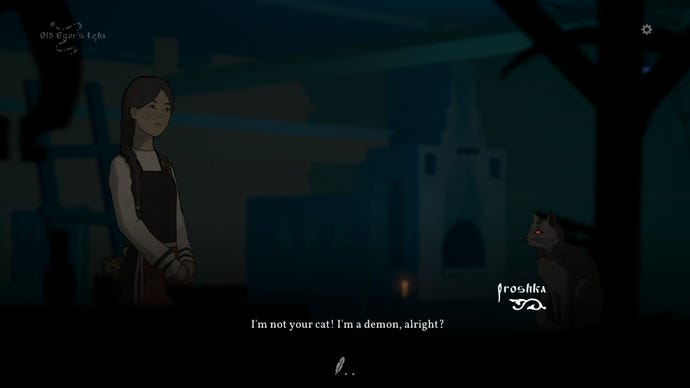
We’ve all suspected the same thing at one time or another…
When not doing battles as a koldun, you’re more likely than not putting to use your skills as a knower. Some encounters aren’t something you need to fight, but are a problem you need to solve, and the main way you get XP outside of fights is correctly knowing things. What kind of a demon is this? What’s the answer to this riddle? With all your wisdom, what choice do you make at this moment? And sometimes the world simply exists, and the only choice you need to make is “do you join in singing a song”? This is where Black Book shows its heart: it doesn’t localise the Slavic folklore that informs the story; it wants you to meet it there.
For a while, the front of my brain resisted a little, and I mentally changed terminology to things I was more familiar with, but eventually I stopped this. Things get lost in translation, and change in the retelling, and Black Book is clear that a precise choice of words is very important. Vasilisa is a koldun, she casts complex zagavor on a journey to resurrect her dead fiancé, and I’m absolutely there for the ride. Somewhere else, a long time ago.
