HomeHardwareReviews
AMD Radeon RX 7600 review: a GPU with nothing newThere are worse 1080p graphics cards. Better ones, too
There are worse 1080p graphics cards. Better ones, too
Image credit:Rock Paper Shotgun
Image credit:Rock Paper Shotgun
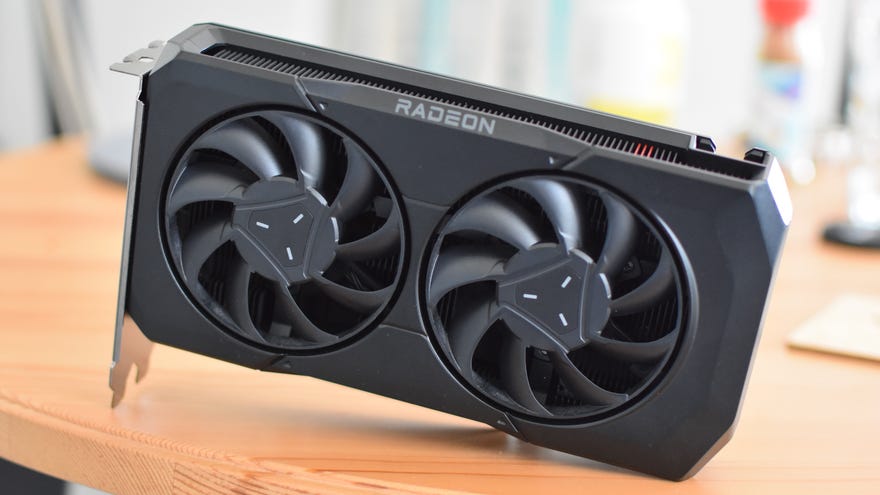
This AMD Radeon RX 7600 review will explain, I’d hope, a fair bit about the red team’s newest 1080pgraphics card. It will tell you how fast it runs games, how hot it gets, how it compares toNvidia’s RTX 4060and suchlike. What I can’t explain with it, admittedly, is why the RX 7600 exists.
To see this content please enable targeting cookies.Manage cookie settingsNow that Baldur’s Gate 3 has left early access, vid bud Liam reckons it was worth the wait.Watch on YouTube
To see this content please enable targeting cookies.Manage cookie settings
To see this content please enable targeting cookies.Manage cookie settings
There is a competent 1080pGPUhere, it must be said, and you can kind of see where the intent was with its RDNA 3 architecture. While the RX 7600 is another 8GB card that packs the same total of 32 Compute Units (CUs) as the RX 6650 XT, RDNA 3 allows for each of these CUs to squeeze in twice as many arithmetic logic units, increasing compute performance. Despite this, the RX 7600 is more efficient too – AMD rates its maximum, full-board power draw at 165W, down from 180W on the RX 6650 XT. I recorded my test unit, an AMD reference card, pulling between 161W and 163W, so it’s an accurate spec.
It’s also a few coins cheaper than its main, green-eyed rival, the RTX 4060. The latter starts from about £285, whereas it’s easy to find partner versions of the RX 7600 from around £270. AMD actually lists this very reference design on their own store for £253 / $269, chucking in a free copy ofStarfield, though it’s currently out of stock in the UK.
AMD Radeon RX 7600 review: 1440p performance
Still, depending on which games you’ll be playing (and, I suppose, how urgently you want a new Bethesda RPG), it could be worth paying a little extra. At 1440p, the RX 7600 frequently equals but never convincingly surpasses the RTX 4060 – its biggest individual lead in these Ultra-quality tests being a mere 4fps inWatch Dogs Legion. It’s the GeForce card that more often finds a double-digit advantage, especially inShadow of the Tomb RaiderandHitman 3.
Image credit:Rock Paper Shotgun
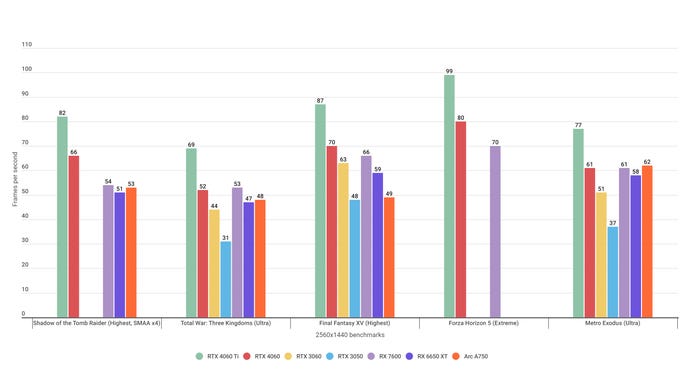
Image credit:Rock Paper Shotgun
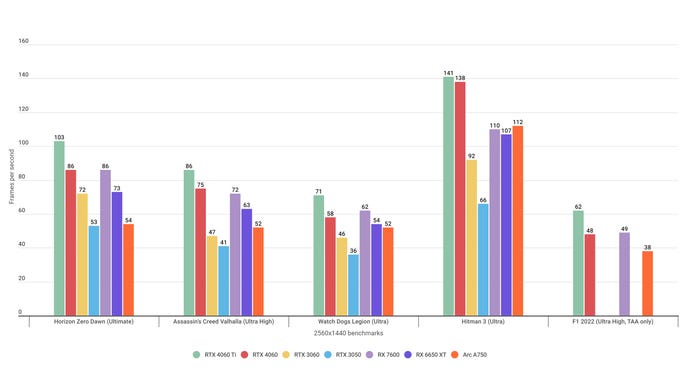
Clearly, neither are a match for theRTX 4060 Tiat this resolution, and the RX 7600 would need upscaling help fromFSRor Intel XeSS to more consistently hit 60fps. Help which is often available, and can yield impressive results:F1 22with FSR 2 on Quality mode averaged 85fps, speeding ahead of the RTX 4060’s 75fps result with Quality-levelDLSS.
The absence of a DLSS 3 equivalent also makes it harder for the RX 7600 to hide another disappointment: weak ray tracing performance.Hitman 3with fully rasterised lighting effects may sail along at 110fps, but the addition of full ray tracing sees it collapse to just 34fps. I could get that up to 54fps with FSR on Quality, but meanwhile, running the same effects at native res on an RTX 4060 produces a perfectly playable 43fps. Add Quality DLSS, and it pastes the RX 7600 with 70fps.
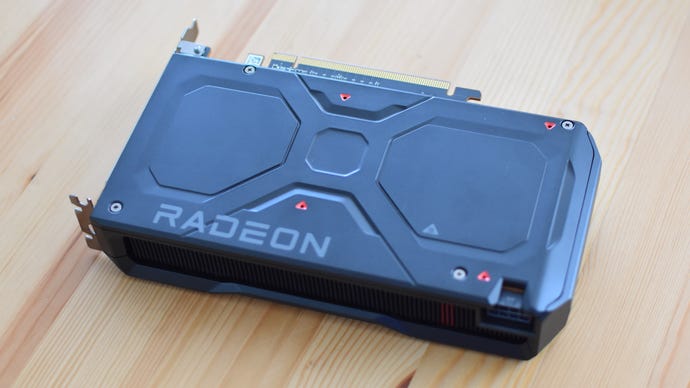
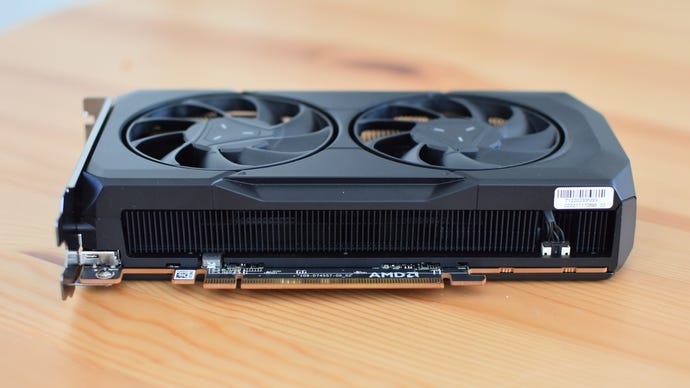
The reference design does have a nice aesthetic: compact, yet chunky. |Image credit:Rock Paper Shotgun
AMD Radeon RX 7600 review: 1080p performance
No, is that answer to that. At Full HD the RX 7600 does manage to turn around its deficit in Hitman 3, but is still mainly drawing with the RTX 4060 and losing when it isn’t.
In fairness, both this and the RTX 4060 look like much better propositions at their intended resolution, even coming close to the pricier RTX 4060 Ti in several games. They never fail to reach well beyond 60fps, including for tough’uns like F1 22 and Watch Dogs Legion. Even so, Nvidia edges it in a head-to-head race, and the RX 7600 still has the RX 6650 XT breathing down its neck. A 5fps difference inMetro Exodus, 8fps difference in Hitman 3 and a dead even(!) Shadow of the Tomb Raider result make it hard to see the RX 7600 as a worthwhile update.
Image credit:Rock Paper Shotgun
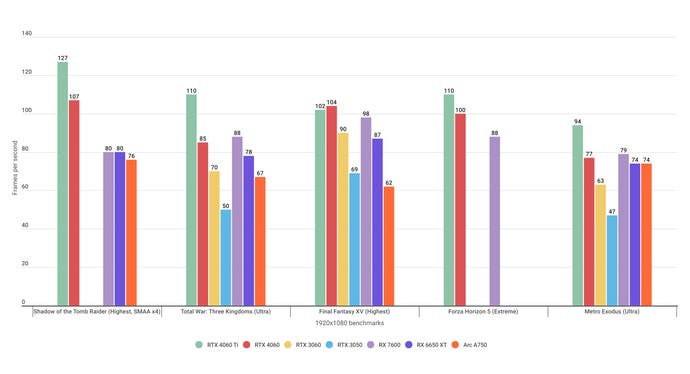
Image credit:Rock Paper Shotgun
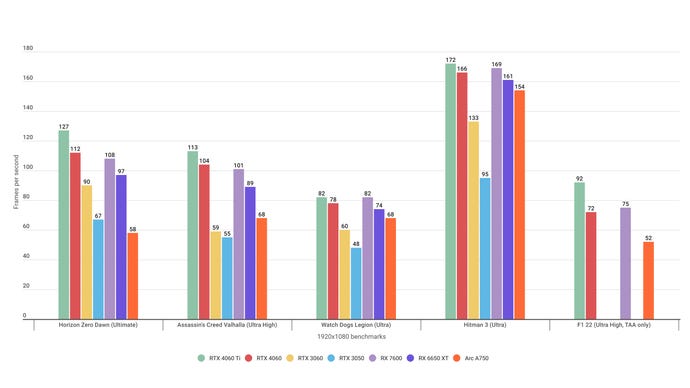
At least the RTX 4060’s DLSS advantage is lessened at 1080p. Using any upscaler at this resolution, even the best in its class, will make your games look noticeably blurrier. Hence why –with some exceptions– the like of DLSS and FSR are mainly only recommended for 1440p and above. This is also why upscaler compatibility is less important when you’re shopping for a 1080p card.
Nevertheless, DLSS 3 can still be useful. Because you don’t need to activate the upscaling component to use the frame generation feature, the RTX 4060 can give itself a boost that the RX 7600 simply can’t recreate, all without skimping on resolution sharpness. AMD’s card is effectively stuck at 75fps on Ultra quality, but on the RTX 4060, I could enable frame generation alone to turn that 72fps average into an even slicker 110fps.
The RX 7600’s fuel requirements are modest, but even the RTX 4060 Ti is rated lower for maximum power usage. |Image credit:Rock Paper Shotgun
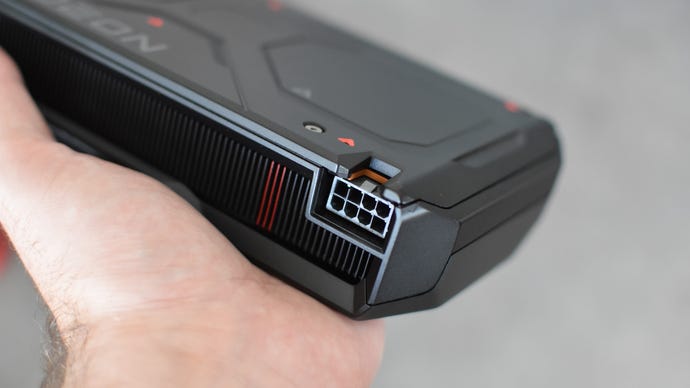
Image credit:Rock Paper Shotgun
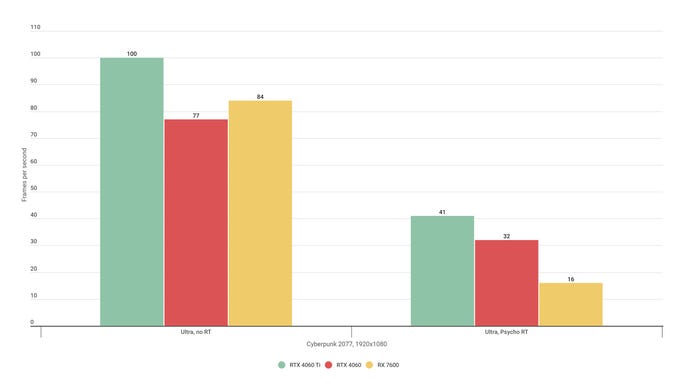
You could stress that ray tracing remains a fully optional part of modern game visuals, one that may not be foremost on the minds of anyone looking at affordable GPUs. But at this point, it is quite deeply entrenched in PC gaming tech, with over 100 games either currently supporting ray tracing or being confirmed to include it at launch. It does seem untoward that a new, specifically gaming-focused graphics card in 2023 is still so prone to crumbling before these upgraded shadows and reflections. It’s not like the RX 7600 is some £180 entry-level model, either – it’s cheaper than average, but still a mid-ranger that could feasibly be the costliest part of anew PC build.
Also, you know what else struggled with ray tracing? The RX 6650 XT. Making the conscious decision to ignore cutting-edge effects in favour of value is, of course, a valid strategy, but then if that’s what you’re doing than this previous-gen card is at least worth considering alongside the RX 7600. It’s much cheaper yet is only narrowly slower, and again, offers an identical 8GB of VRAM.
The fans are pretty quiet, at least. |Image credit:Rock Paper Shotgun
As long as temperatures aren’tdangerouslyhigh, a few degree’s difference is small taters next to visually significant gaps in performance. On these grounds, the RTX 4060’s DLSS 3 feature set makes it the better buy, extra £15 be damned. That could still leave the RX 7600 as a worthwhile 1080p GPU, given DLSS support in games is always growing but not yet ubiquitous. Alas, it also faces competition from within, and the RX 6650 XT promises similar specs and performance at a more appealing price.
The RX 7600 is therefore a graphics card that isn’t ambitious enough with its upgrades to go after Nvidia’s performance crown, a shortcoming which simultaneously allows older, cheaper GPUs to keep pace and relevancy. Simultaneously, it’s not interested in targeting budget builders specifically. One or the other would have been fine, but this? I honestly can’t say who the RX 7600 is for, or indeed, why it needed to exist in the first place.
