HomeHardwareFeatures
AMD Radeon RX 6800 vs 6800 XT: benchmarks comparedWe put AMD’s two Big Navi cards head to head
We put AMD’s two Big Navi cards head to head
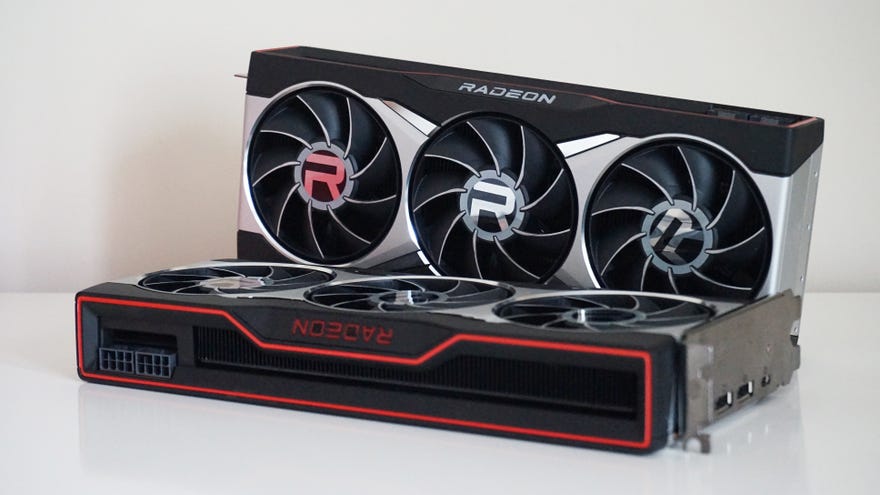
AMD’s long-awaitedBig NaviGPUs, theRadeon RX 6800andRX 6800 XT, are finally here. But how do they compare performance-wise and which one should you consider buying when they finally come back in stock? To help answer that question, I’ve put together some lovely bar graphs of my 1080p, 1440p and 4K benchmark results, showing you exactly how they stack up across all the major resolutions.
7 Reasons Metro Exodus Is The Best Metro Game Yet | PC ReviewWatch on YouTube
7 Reasons Metro Exodus Is The Best Metro Game Yet | PC Review

Admittedly, both the RX 6800 and RX 6800 XT are sold out almost everywhere at the moment, making them as difficult to buy as Nvidia’s equally new RTX 30 series. I’ll be comparing AMD’s new RX 6000 cards to Nvidia’s RTX 30 series in a separate article, but for now I wanted to focus on how AMD’s new cards compare, and whether the £620 / $650 RX 6800 XT is really worth all that extra money over the £530 / $580 RX 6800.
To test the RX 6800 and RX 6800 XT, I paired them with my usual Intel Core i5-10600K processor and 16GB of Corsair Vengeance LED RAM, and put them head to head in my suite of graphics benchmarks, taking an average frame rate from their own built-in benchmark tools or from my own repeatable manual gameplay tests. The games include a mix of blockbusters from the last couple of years: Shadow Of The Tomb Raider, Total War: Three Kingdoms,Final Fantasy XV,Monster Hunter: World, Assassin’s Creed Valhalla, The Witcher 3,Metro Exodusand Control.
AMD Radeon RX 6800 vs 6800 XT: 1080p benchmarks
Clearly, neither the RX 6800 or RX 6800 are going to struggle playing games at1920x1080for the foreseeable future, as even the RX 6800 is capable of hitting at least 100fps on max settings here, while the RX 6800 XT is often pushing 120fps. Of course, that’s hardly surprising given how expensive they are, and in most cases the RX 6800 XT has a decent lead on its non-XT sibling.
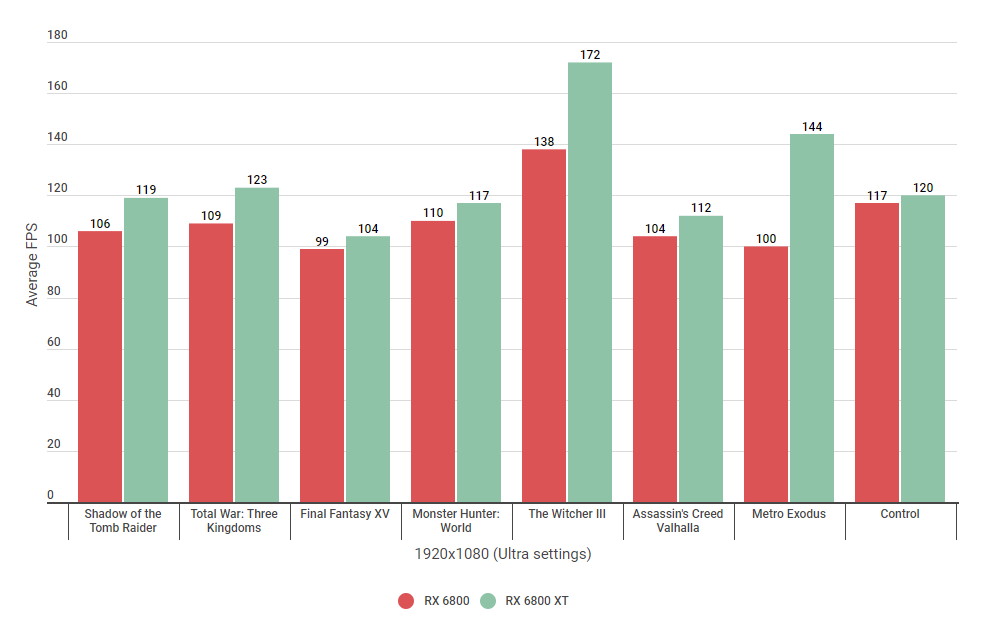
When you’re dealing with powerful graphics cards like this at 1920x1080, any potential bottlenecks are almost certainly going to be related to your CPU rather than your GPU at this resolution, and it can make a surprising amount of difference to your PC’s overall performance. As such, you’ll likely see better performance from the RX 6800 XT at 1080p if you pair it with a more powerful processor, such as one of Intel’s Core i7s or AMD’s Ryzen 7 chips.
AMD Radeon RX 6800 vs 6800 XT: 1440p benchmarks
Still, as powerful as today’s graphics cards are, bumping up the resolution to2560x1440still puts the burden squarely back onto your GPU, making CPU bottlenecks much more unlikely. AMD’s two RX 6000 cards are still highly capable in this department, though, with the RX 6800 hitting at last 75-80fps in today’s big blockbusters, while the RX 6800 XT is hitting at least 90fps.
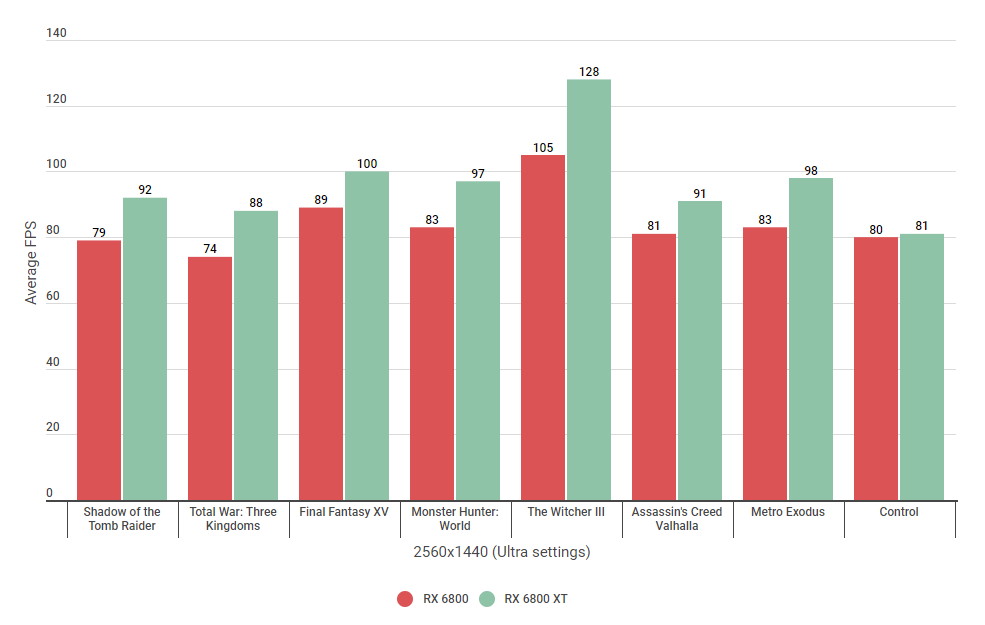
Of course, unless you own a high refresh rate monitor, opting for the RX 6800 XT won’t get you any benefit at all, as monitors with a standard 60Hz refresh rate will display the same 60fps regardless of which card’s inside your PC. Indeed, even if you do own a high refresh rate monitor that goes above 60Hz, I’m not sure I’d be able to tell the difference between 80 and 90fps without the aid of a frame rate counter. I might just about be able to distinguish between 105fps and close to 130fps in something like The Witcher III, for example, but 80-90fps is all much of a muchness to my eyes. As a result, it may be worth sticking with the regular RX 6800 if you’re planning to play games at 1440p, as I’m not sure you’re really getting one hundred quid’s worth of extra performance here.
AMD Radeon RX 6800 vs 6800 XT: 4K benchmarks
If you’re aiming to play games at4K, however, then you’re definitely going to get a lot more out of the RX 6800 XT. Admittedly, neither card is really fit for 60fps on max settings at this resolution, as you can see from the bar chart below. The RX 6800 XT gives it a pretty good shot, hitting 60fps in pretty much everything but two games on max settings, but there are still cases where it falls down closer to the 40-50fps mark, such as in Total War: Three Kingdoms and Monster Hunter: World.

The RX 6800 XT also struggles with Control on max settings (although given its max settings are technically called ‘High’, I’ve included them in the chart below to avoid confusion). Here, the RX 6800 XT managed an average of just 45fps, which is still just about playable, but it’s very much on the borderline of what I’d call an acceptable frame rate.
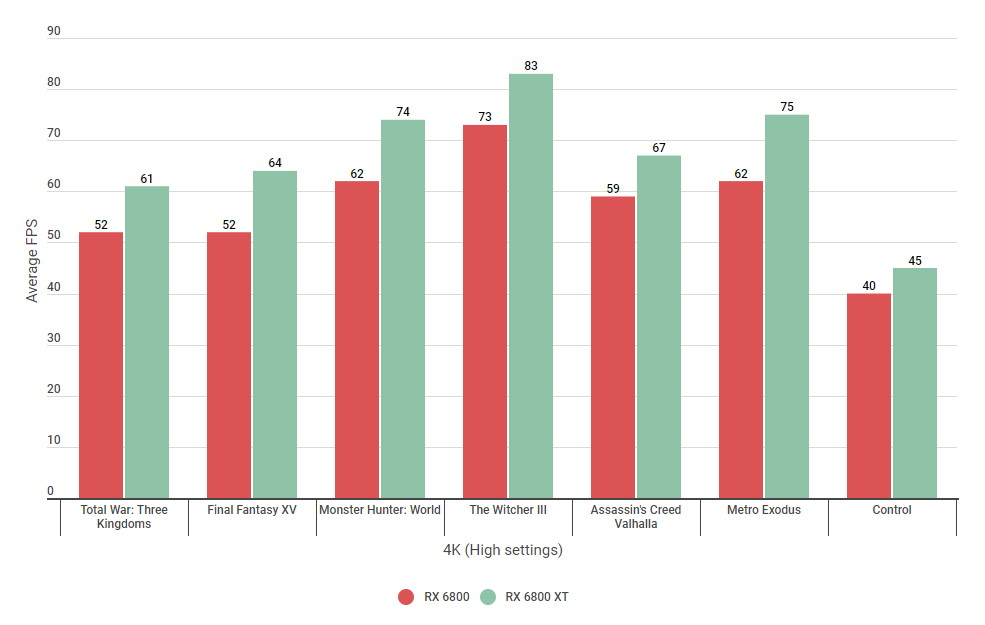
In Assassin’s Creed Valhalla, for example, the RX 6800 hit a low of 42fps in its built-in benchmark versus the 6800 XT’s low of 49fps, while Final Fantasy XV saw the RX 6800 hit lows of 48fps, which is almost 10fps below the RX 6800 XT’s low of 56fps. It’s a similar picture across other games, too, with the RX 6800 dipping much lower than the XT. As a result, the extra horsepower you get with the RX 6800 XT will help push those minimum frame rates up much closer to a more consistent 60fps, making it much more likely that you’ll be able to carry on playing games at this kind of quality setting in the years to come.

Of course, you could say the same about the RX 6800 XT’s speeds on High quality settings, and there is some truth in that. However, as I said above, if playing games as close to 60fps is important to you, then the RX 6800 XT is much more likely to achieve those kinds of frame rates on High than the non-XT version. On Medium, though, the RX 6800 has more than enough power to hit a consistent 60fps at 4K - although as Control once again proves, there will still be the odd game out there that taxes both cards equally, regardless of quality setting.
AMD Radeon RX 6800 vs 6800 XT: conclusion
Overall, then, it’s clear that both the RX 6800 and RX 6800 XT are both incredibly powerful graphics cards, capable of filling out high refresh rate monitors at both 1080p and 1440p, and hitting consistent 60fps frame rates on Medium to High settings at 4K. However, while the RX 6800 XT is clearly the faster card of the two, I’d probably err on the side of the regular RX 6800 as being the better value card overall.
The RX 6800 (top) is exactly the same size as the RX 6800 XT (below), just a bit thinner.

However, this situation will likely change once AMD launch their upcoming DLSS competitor tech, FidelityFX Super Resolution - although whether it will be as good at boosting each card’s performance as Nvidia’s DLSS tech remains to be seen. As I mentioned right at the top of this article, I’ll be doing a separate ray tracing comparison piece with all of today’s next-gen graphics cards very soon, so watch out for that to get a better idea of how things stack up.
Needless to say, ray tracing at 4K is pretty much out of the question on these cards right now, but even if you’re just looking to buy a 4K card in general, I’d probably still side with the RX 6800 here, if only because once you start hitting the £600 / $650 mark, you might as well opt for Nvidia’sRTX 3080rather than AMD’s RX 6800 XT at this resolution. As I said in myRX 6800 XT review, the RTX 3080 is clearly the superior card at 4K, and you can read more about its 4K performance in myRTX 3080 vs 2080 and 2080 Supercomparison article.
In truth, you’re probably also better off going with Nvidia’sRTX 3070instead of the regular RX 6800 for 4K gaming as well, as their respective speeds are both much of a muchness. Indeed, until AMD’s FidelityFX Super Resolution tech comes out, you shouldn’t really be buying either RX 6000 card for 4K gaming at the moment, as their raw performance just can’t compete with what you get with Nvidia’s RTX cards with DLSS turned on (although again I’ll be doing more in-depth benchmark comparisons between AMD and Nvidia’s new cards very soon).
Ultimately, though, I reckon the RX 6800 is the one to try and get out of AMD’s new crop of Big Navi cards when it eventually comes back in stock, especially if you’re after a top notch 1440p GPU. There’s no denying the RX 6800 XT has buckets of power at its disposal, but when it comes to overall value, the regular RX 6800 is tough to beat.
