HomeHardwareFeatures
Adata XPG Gammix S70 reviewIt’s expensive, but it still gives rival 1TB PCIe 4.0 SSDs a run for their money
It’s expensive, but it still gives rival 1TB PCIe 4.0 SSDs a run for their money
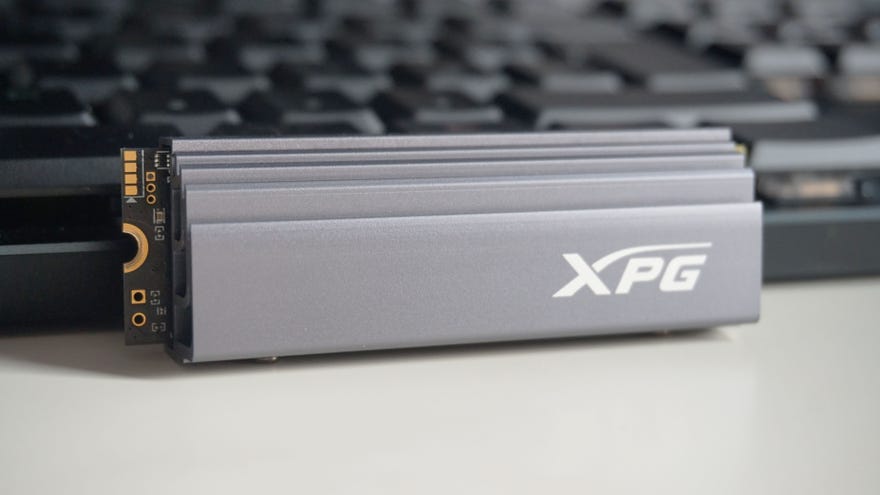
I think everyone breathed a big sigh of relief when Microsoft announced their upcomingDirectStoragetech would work withboth PCIe 3.0 and 4.0 SSDslast week, as it means we don’t have to necessarily shell out the seriously big bucks to benefit from shorter loading times once it gets released. Indeed, prices for PCIe 4.0 NVMe SSDs are still eye-wateringly high compared to their PCIe 3.0 counterparts, and you only need to look at the Adata XPG Gammix S70 on test here today to see that difference in action.
The Gammix S70 is at a slight disadvantage here as it’s currently only available in large 1TB and 2TB size capacities, giving it a naturally higher starting price than some of its competitors. However, whereas the 1TB model of my currenttop NVMe recommendation, theWD Blue SN550, can be had for around£88/$105these days, the 1TB Gammix S70 will set you back£166/$200. That’s almost twice the price of the SN550, and Gammix S70’s 2TB model is even more expensive, going for a whopping £361 / $330 at time of publication.
We probably won’t get the full answer to that question until later in the year. While we now know that DirectStorage won’t be exclusive to PCIe 4.0 SSDs, Microsoft haven’t yet said how their faster loading time tech will vary between the two PCIe standards, and we probably won’t get that information until some time after they release their upcoming Developer Preview of it, either. I’d imagine that PCIe 4.0 SSDs will still offer a couple of advantages over PCIe 3.0 drives, but the incentive to get one for gaming has definitely become a lot less urgent.
In the here and now, PCIe 4.0 SSDs still offer marginally faster loading times than PCIe 3.0 drives, and they’re also much quicker at transferring large files and reading and writing bits of data. Personally, I’m not sure that difference is worth paying double the amount of money for at the moment, as PCIe 3.0 SSDs like the WD Blue SN550 are still pretty darn nippy for gaming and everyday desktop tasks alike.
Nevertheless, the Gammix S70 must be benchmarked and benchmarked it has - and what I found was an NVMe drive with great random write speeds, but only middling random read speeds compared to its PCIe 4.0 rivals. When I put it through AS SSD’s 1GB 4K random test, for example, the Gammix S70 managed a random read speed of 65.7MB/s and a random write speed of 212.5MB/s.
Not bad, considering their respective prices, but sadly the Gammix S70’s random read speeds aren’t nearly as impressive. Indeed, both the Samsung and WD are quite a bit faster in this department, managing scores of 79MB/s apiece. That’s 21% faster than the Gammix S70, making both of them much better gaming candidates. After all, your PC doesn’t do any writing when playing games - it just needs to read your game files as quickly as possible.
In fairness, that doesn’t mean the Samsung and WD SSDs will load games 21% faster right now. In fact, when I timed how long it took the Gammix S70 to load certain scenes in Shadow Of The Tomb Raider,Monster Hunter: WorldandFinal Fantasy XV, it was often only a couple of seconds slower than its rivals. The only game that showed even the slightest ‘tangible’ difference in load time was Final Fantasy XV, where the WD Black SN850 managed to load into my trusty Duscae benchmarking spot four seconds faster than the Gammix S70. Four seconds! That’s practically nothing in the grand scheme of things, and I don’t think you’d be disappointed with either drive were you to get one or the other. It’s possible we may see bigger differences start to emerge with DirectStorage-enabled games further down the line, but as I said earlier, we won’t know that for a long old time.
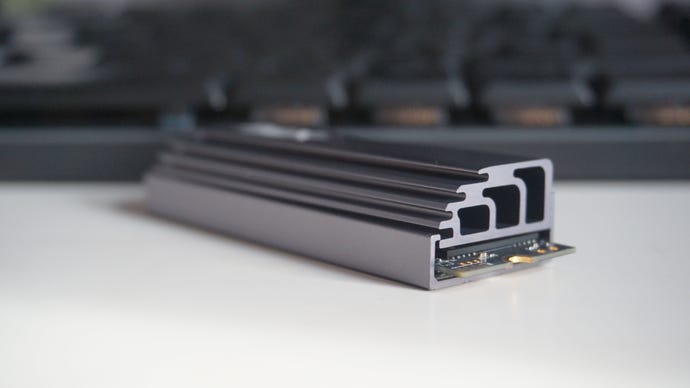
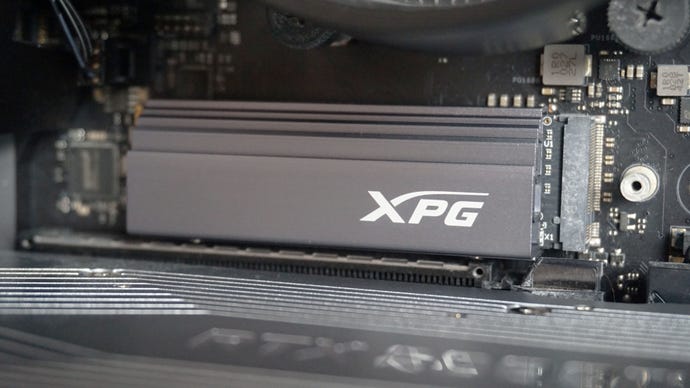
The Adata XPG Gammix S70 has quite a chunky heatsink attached to it, so you’ll need to check it won’t clash with your motherboard beforehand.
It was a similar picture in my file transfer tests, too. While the SN850 and 980 Pro were both ahead of the Gammix S70 in AS SSD’s copy benchmark test, in practice they performed more or less the same when I timed how long it took them to copy over my giant 100GBAssassin’s Creed Odysseyfolder from my old WD Black 3D NVMe drive. The Gammix S70 copied the entire thing in just 59 seconds, hitting a top speed of 1.9GB/s and rarely falling below 1.3GB/s. The SN850 managed it in 58 seconds and matched the Gammix S70’s top and bottom speeds pretty much beat for beat.
Yes, the Gammix S70’s sub-minute speeds are pretty attractive in this respect, but is waiting an extra couple of minutes really worth paying double the money for? For me, the answer is no. Until we have a better idea of how Microsoft’s DirectStorage tech is going to affect things on the gaming front, anyone looking to buy a new SSD right now is almost certainly going to be better off saving their money and getting a cheaper PCIe 3.0 SSD like theWD Blue SN550instead. For more of our top SSD recommendations, read ourbest SSDs for gamingrankings.
